The Palace of the Visigoth Kings was an ancient palace in Toulouse active during the Visigothic Kingdom of Toulouse, from 418 to 507. It was destroyed in the 6th century after the defeat of the Visigoths at the Battle of Vouillé in 507 and after the capture of Toulouse by Frankish forces in 508. The remains were first discovered in 1988 and again in 1990 during preventive archaeological excavations on the site of the former Larrey military hospital near Place de Bologne. The excavated remains were not preserved and were later obliterated to allow construction of a large real estate development.
Research described the palace as a Visigoth royal residence with a monumental façade and an axial, symmetrical layout centered on a vestibule with long galleries. Scientific dating based on stratigraphic study and carbon-14 analysis of a charred beam supported this identification. The site was located near the Bazacle ford along the river and incorporated part of the city wall and Garonne rampart. A few fragments, including lapidary elements and limited furniture, were also found.
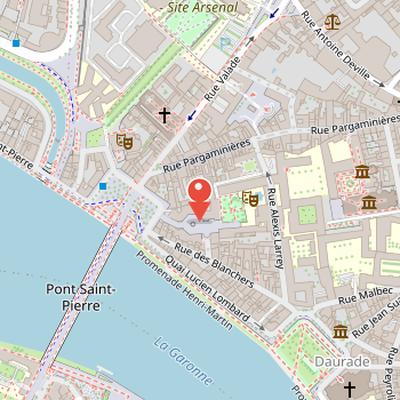
Nearby Objects
-
 Toulouse Regional Conservatory 110 m away
 -
 Place Saint-Pierre 150 m away
 -
 Saint-Pierre des Cuisines 150 m away
 -
 Saint-Pierre des Chartreux Church 200 m away
 -
 Monastery of the Jacobins 250 m away
History and Loss of the Palace
The Palace of the Visigoth Kings was an ancient palace in Toulouse, dating from the Visigothic Kingdom era between 418 and 507. It was active during the period of the Visigothic Kingdom of Toulouse. The palace was destroyed in the 6th century after the defeat of the Visigoths at the Battle of Vouille in 507 and after the capture of Toulouse by the Frankish forces of Clovis in 508.
Remains of the palace were discovered in two stages, first in 1988 and again in 1990. These finds came from preventive archaeological excavations carried out on the site of the former Larrey military hospital. The remains were not preserved and were later obliterated to make way for the construction of a large real estate development on Place de Bologne.
Site, Excavation, and Palace Layout
The Palace of the Visigoth Kings was identified through archaeological and scientific study as a Visigoth royal residence. Stratigraphic analysis and carbon-14 dating of a charred beam were used to support this dating. The palace was located near the Bazacle ford along the river and occupied a significant part of the city wall and the Garonne rampart, an appropriation that could only have been decided by the highest political authority.
The remains were first uncovered in 1988 during excavations of the former Larrey hospital near Place de Bologne, and further remains were discovered in 1990 by D. Schaad on another part of the Larrey site. In 1989, however, the excavation site was obliterated to make way for residences between Place Saint-Pierre and Place de Bologne.
Architecturally, the building is described as typical of Late Antiquity in Brittany, Germania, and Gaul. It had a monumental facade and an axial symmetrical layout centered on a vestibule surrounded by long galleries. The palace was built on the site of a potter's workshop active at the end of the century, which produced common ceramics such as bowls, jugs, and mortars, as well as decorated ceramics with stamps, including plates, dishes, and bowls. The workshop also specialized in stamped decorated tableware and oil lamps with handles shaped like horse or mule heads.
Recovered Decorative Fragments
The recovered material from the Palace of the Visigoth Kings includes only a limited group of lapidary elements and personal items. Among the stone fragments, there were pieces of a transenne and a bas-relief with vegetal decor. The finds also included limited furniture, such as a clasp decorated with cloisonne garnets and a bronze belt pendant with ocellated decor. These remains provide evidence of decorative workmanship associated with the site, even though the surviving material is fragmentary and scarce.