Palais Rameau is a building in Lille designed by local architects Auguste Mourcou and Henri Contamine. Its architecture includes a facade topped by two bell towers and an extension in the form of a circular horticultural greenhouse made of cast iron. The building combines traditional alternating brick and white stone elements with Moorish-style orientalism, giving it a distinctive urban presence. It was designated as a historical monument in 2002.
The Palais has served multiple public functions over time. It hosted school exams from 1930 to 1960 and later housed prisoners returning from Germany in 1945. It also received historical attention for the trial of five Gestapo agents from La Madeleine. In 1898, Berthe Dassonville, the Muse Lilloise, was elected there in connection with a procession honoring poet Alexandre Desrousseaux, author of P'tit Quinquin. The building was partially renovated for Lille 2004 and has since hosted periodic events, including the annual Solid'Art salon since 2015. Renovations began again in 2021 as part of a project led by the student group Junia, aiming to transform the Palais into an incubator for future agriculture and food.
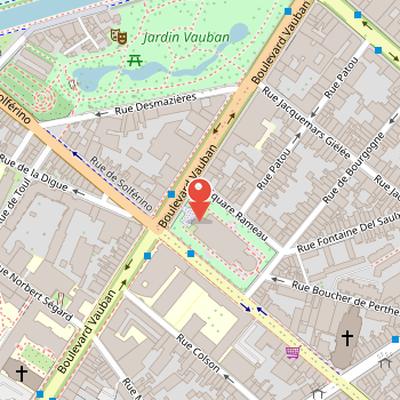
Nearby Objects
-
 Chapelle Saint-Joseph 90 m away
 -
 Les Fusillés lillois 400 m away
 -
 Saint-Étienne Church 750 m away
 -
 Église Sainte-Catherine de Lille 750 m away
 -
 Temple maçonnique de Lille 800 m away
Architecture and heritage status
The Palais Rameau is a building in Lille designed by the Lille architects Auguste Mourcou and Henri Contamine. It was designated as a historical monument in 2002, highlighting its recognized heritage value. The building is served by the Republic - Beaux-Arts and Rihour metro stations, which place it within the city's public transport network and make it accessible as part of the urban center.
Architecture and Design
Palais Rameau is defined by a facade topped with two bell towers and an extended circular horticultural greenhouse made of cast iron. Its architecture combines traditional elements, including alternating bricks and white stones, with Moorish style orientalism. This mix of materials and styles gives the building a distinctive appearance and reflects the varied character of its design.
Historical Uses and Later Events
Palais Rameau has had a varied history marked by cultural, administrative, and commemorative uses. In 1898, it was the site of the election of Berthe Dassonville, known as the Muse Lilloise. She was intended to appear in a procession honoring the poet Alexandre Desrousseaux, the author of P'tit Quinquin, and the event was inspired by the Muse of Montmartre elected in Paris for the Promenade de la Vache enragee procession. French composer Gustave Charpentier attended the election.
In the 20th century, the building was used for school exams from 1930 to 1960. It also served a postwar role in 1945, when it housed prisoners returning from Germany. The Palais later became the setting for a trial of five Gestapo agents from La Madeleine. After four days of hearings, the tribunal sentenced four of them to death and acquitted one, and the Lyon military tribunal later commuted two death sentences to life labor with mitigating circumstances.
The building continued to host public events in later decades. It was partially renovated for Lille 2004 and has since hosted periodic events, including the annual Solid'Art salon organized since 2015 under Secours Populaire francais. Renovations began in 2021 by the student group Junia, made up of several engineering schools. The project aims to transform Palais Rameau into an incubator for future agriculture and food, with spaces for research, experimentation, production, and awareness.