The Charvet Clock, or L’horloge Charvet, is an automaton clock installed at 8 rue de la Poulaillerie in Lyon, France, on the façade of l’Hôtel de Gadagne, which houses the musée d’histoire de Lyon. Also known as the horloge aux Guignols, it is a monumental clock mounted on a facade wall on a public street.
Its dial bears the mark Charvet, the location Lyon, and the date 1852. The dial controls the mechanism and the automata visible through a glass pane. The mechanism contains five gilded bronze bells. Four bells are topped by wooden and red copper puppets: Guignol and Gnafron strike the largest bell, while Arlequin and Polichinelle, figures from commedia dell’arte, ring the other bells every quarter-hour. Every hour, the clock produces a large chime animated by the bugle of the soldier Trompette. The mechanism operates with hidden counterweights inside the casing and originally required winding every two days before electrification in 1987-1988.
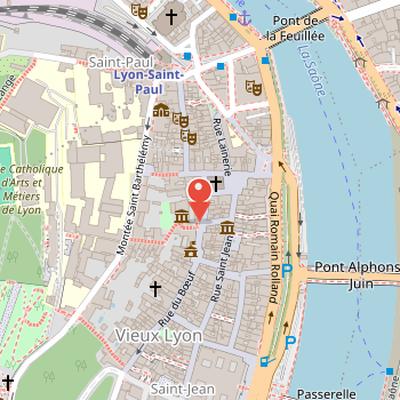
Nearby Objects
-
 Gadagne 30 m away
 -
 Temple du Change 70 m away
 -
 Place du Change 80 m away
 -
 Rue du Bœuf 120 m away
 -
 Rue Juiverie 140 m away
Location of the Charvet Clock
The Charvet Clock, also known as the horloge aux Guignols, is installed at 8 rue de la Poulaillerie in Lyon, France. It is placed on the facade of the Hotel de Gadagne, the building that houses the musee d histoire de Lyon. Its location links the clock to one of the citys historical sites and to a museum dedicated to Lyons history.
Clock Face and Automata
The Charvet Clock is a monumental automaton clock, or jacquemart, mounted on a facade wall on a public street. Its dial bears the name Charvet, the location Lyon, and the date 1852. The dial controls the mechanism and the automata visible through a glass pane, making the clock both a timepiece and a public display of moving figures.
The mechanism contains five gilded bronze bells. Four of the bells are topped by wooden and red copper puppets. Guignol and Gnafron strike the largest bell, while Arlequin and Polichinelle, figures from commedia dell'arte, ring the other bells every quarter hour. The clock also produces a larger chime every hour, animated by the bugle of the soldier Trompette. Trompette was added after the war of and his costume changed according to political events.
The clock is operated by a mechanical system with hidden counterweights inside the casing. Before electrification in , the mechanism had to be wound every two days.
Installation and Later Preservation
According to Histoire, sieur Charvet, a clockmaker on rue de l'Imperatrice, obtained authorization from prefect Vaisse to install a clock near his shop at 8 rue de la Poulaillerie in Lyon's 2nd arrondissement. The clockmaker was exempt from street fees because the clock provided free timekeeping to Lyon residents. The Charvet house, founded in 1852, also produced mechanical systems for large Lyon clocks, and its company manufactured automata. The mechanism's core was a building clock made by Bailly-Comte in Morez, in the Haut-Jura. Later, the Augis house, which took over Charvet clockmaking, restored and electrified the mechanism in 1987-1988. The business was then sold to the Fortune company, which decided to auction the clock publicly. Because of its heritage value, Lyon city issued a conservation order suspending the auction. After a legal debate, the city acquired the Charvet clock for 100,000 euros and, after six months of restoration, moved it to the facade of Hotel de Gadagne at 1 place du petit-Collège in Lyon's 5th arrondissement.