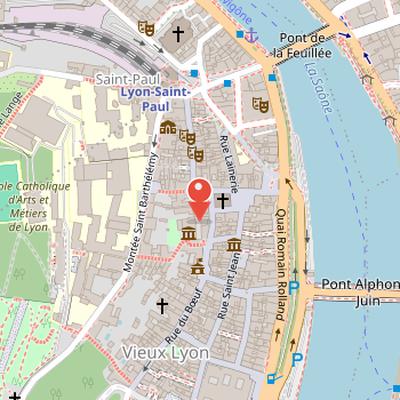
Gadagne is a museum complex in Lyon, France, situated in the 5th arrondissement in the Saint-Jean neighborhood. It is installed in the Hôtel des Pierrevive, renamed Hôtel de Gadagne, and brings together two museums: the MHL - Musée d'Histoire de Lyon and the MAM - Musée des arts de la Marionnette. The complex also includes a small theater that offers puppet theater shows and conferences, as well as a boutique, a café-restaurant, and a suspended garden overlooking the city.
The site has a long history of occupation and rebuilding. The Hôtel de Gadagne stands on a long plot once owned by Guido d'Albant, and the property later changed hands several times. The building was arranged at the beginning of the 16th century by the Pierrevive brothers, then rented by merchant-banker Thomas II de Gadagne starting in 1538 and bought in 1545 by his sons Guillaume and Thomas III. It underwent immediate remodeling after this purchase. The complex therefore combines museum use with a historic urban setting that reflects successive phases of ownership and adaptation.
Nearby Objects
-
 Charvet Clock 30 m away
 -
 Temple du Change 50 m away
 -
 Place du Change 70 m away
 -
 Rue Juiverie 120 m away
 -
 Rue du Bœuf 140 m away
Gadagne Museum Complex in Lyon
Gadagne is a museum complex in Lyon, France, located in the 5th arrondissement in the Saint-Jean neighborhood. It is installed in the Hotel des Pierrevive, which was renamed Hotel de Gadagne. The complex houses two museums: the MHL, or Musee d'Histoire de Lyon, and the MAM, or Musee des arts de la Marionnette. It also includes a small theater that offers puppet theater shows and conferences, as well as a boutique and a cafe-restaurant. A suspended garden overlooking the city is part of the site.
From Medieval Plot to Gadagne Residence
The hotel de Gadagne site was occupied only sporadically before it emerged as an important building on the site in the early 16th century. Its earlier form was laid out on a long plot owned by Guido d'Albant, extending from Montee Saint Barthelemy to rue du Palais. The house was equipped with an icehouse and decorated with stained glass, colonnetted windows, and glazed tiles. It may have been modified when d'Albant sold the property to Pierre and Claude de Pompierre between 1371 and 1388. At that time, the plot contained two houses: one on Palais, now 2 rue Saint Jean, and the Boyssette house at the rear. The Boyssette house partially occupied the site of the current buildings on rue Gadagne and had dependencies including a barn, which was later converted into a residence with raised walls and new windows. Additional houses were also constructed on terraces, likely as dependencies of the Boyssette house.
Ownership changed again in the late 15th century, when Jean de Vareys transferred the property to Amedee, Jean Michel Michelet, and Andre de Pierrevive between 1489 and 1492. Reconstruction began with the demolition of the Boyssette house and the sale of the eastern part of the plot to Guillaume. The site was then arranged at the beginning of the 16th century by the Pierrevive brothers. In 1538, the southern plot belonged to Marie Catherine de Pierrevive, wife of Antoine de Gondi, while the northern half was rented by Thomassin Gadagne from Antoine de Pierrevive, baron de Vaulx. Thomas II de Gadagne began renting the property in 1538, and it was bought in 1545 by his sons Guillaume and Thomas III. They immediately remodeled the building, occupied the two main parts separately, and lived there lavishly, holding numerous sumptuous parties. The family kept the property until 1581.
The Gadagne family was a wealthy Florentine family present in Lyon since the beginning of the 16th century. Thomas I de Gadagne was the richest man in Lyon, lending money to different French kings and funding an expedition to the New World. He also gave part of the ransom to Louise de Savoie, enabling King Francois I's release after the Battle of Pavia in 1525. Later, in the 19th century, the hotel de Gadagne was divided into small lodgings and partially bought by the city of Lyon in 1902. The present architectural features include a ramp leading to a door surmounted by a first body of buildings, a large courtyard with a well, and a gallery of superimposed passages between two building bodies on each floor.
Creation and redevelopment of the museums
The idea of creating a museum of Old Lyon was first proposed by Leopold Niepce in 1874, in a report to the prefect of the Rhone. The project aimed to focus on the history of Lyon and to bring together collections from different buildings. It was later supported by press campaigns and by the Old Lyon archaeological commission, created in 1898. In 1923, the museums were defined as a project by Emile Leroudier, with the approval of Henri Focillon, director of Lyon museums.
Several buildings were considered before the Hotel de Gadagne was chosen for its architecture and historical interest. The city of Lyon bought the building in 1902, after acquiring it step by step between 1902 and 1941. The building had already been classified as a historical monument in 1920. The mayor of Lyon, Edouard Herriot, inaugurated the first rooms on March 24, 1921.
In 1998, the Lyon city council decided to undertake major expansion and renovation works. Renovation began that same year, and the museums remained open to the public until 2004. After ten years of construction and archaeological excavations, they reopened partially in 2014 for temporary exhibitions, then fully in 2015.
Collections and Renewal
The collections of Les musées were formed from several earlier collections assembled at the City Hall before being dispersed. Their initial core was later expanded through purchases, donations, and bequests, especially from the 1930s onward. Important holdings include the Sebastien-Louis Rosaz collection of nearly 10,000 objects acquired in 1846, the Francois Morel fund bequeathed in 1916, and objects from 19th century demolitions and excavations. The museums also preserve funds from the political figures Justin Godard and Edouard Herriot, as well as items linked to Freemasonry, companionship, and archaeological furniture devolutions for post-antiquity periods. Another notable set is four queen's chairs attributed to Pierre Nogaret, received by MHL in 1980; these chairs are made of gilded wood with removable frame upholstery, a rare feature in 18th century Lyon production.
The first curator of Les musées was Felix Desvernay, a former librarian. The collections are oriented toward graphic and decorative arts, including prints, pewter, earthenware, and cabinetry. In 2003, the museums closed the Gadagne building for restoration and renovation work, then reopened it after renovation and expansion. A new permanent route was begun in 2019 and was scheduled for completion in 2024. This route includes Portraits of Lyon, which presents the city's historical evolution, Les Pieds dans l'eau, on living with the Rhone and Saone rivers, Qu'est-ce que tu fabriques, on workers' and industrial history, and Lyonnaises, Lyonnais ! Pouvoirs et engagements, focused on political and local celebrity objects and portraits.
The Museum of the Arts of Puppetry at Gadagne
The Museum of the Arts of Puppetry is housed in the Gadagne hotel. Its puppetry collections have been part of the Lyon History Museum visit since 1950, and after renovation work in 2000 they were grouped into a separate museum space. The museum was previously named the International Puppet Museum and the Museum of Puppets of the World. In 2019, the first three rooms of the route were renovated and the museum was renamed musee des arts de la marionnette, while the next six rooms were kept in the classic route with a planned rearrangement for the same year.
The museum has developed an immersive route for discovering puppetry arts, centered on four major questions. Contemporary artists, puppet companies, and visitors are given a large place in several parts of the route. Tutorials made with puppeteers and professional puppets allow visitors to learn basic technical gestures, and several sections explain puppet manipulation secrets. Contemporary companies present shows that address social and societal current subjects in their creations. Salle Carte Blanche is dedicated to a renewed exhibition every two years highlighting a company or contemporary puppeteer. In the last room, visitors of all ages can handle puppets of various techniques with tutorials.
The museum has also hosted exhibitions and installations linked to contemporary puppetry. From June 2024 to April 2025, it presented an exhibition dedicated to Michael Meschke, a Swedish-French puppeteer, and displayed puppets from Le Petit Prince, Antigone, and Don Quichotte in Salle Carte Blanche. From April 18, 2025, it hosted Compagnie a, formed by Nicolas Alline and Dorothee Saysombat, with an immersive installation showing twenty years of object theater creations.
Restoration and Museum Adaptation
Between 1998 and 2009, Restauration, working with Atelier Bizouard-Pin, carried out a major restoration project at the Hotel de Gadagne. The aim was to restore coherence to a fragmented building while adapting it to contemporary museum uses. The intervention combined preservation of the building with efforts to clarify its architectural reading and increase its museographic value.
The project began with thorough diagnostic work, including surveys, archaeological studies, stratigraphies, and documentary research. On the basis of these findings, the team identified elements to conserve, reinforce, adapt, or remove. The restoration used traditional materials and compatible skills in keeping with the logic of the original construction, and it avoided speculative reconstruction where historical data was lacking.
The treatment of the site distinguished between old and new fabric. Original facade materiality was preserved, while a contemporary tint reinterpretation was introduced. Isolated or newly added elements such as stairs, doors, and extensions were designed in a contemporary architectural language, using materials such as concrete, steel, and glass. These new interventions were clearly identified as belonging to modern times, without altering the identity of the site.
The project also included numerous structural and functional transformations. The useful surface area of the museum was doubled from 3,500 square meters, and new spaces were added, including an auditorium, documentation center, cafe, and educational workshops. Each intervention was designed with high precision as a response to specific diagnostics.
Visitor Attendance in 2013
Museum attendance decreased in 2013 compared with 2012. This decline was linked to lower visitor interest in the exhibition Lyon, centre du monde !. Attendance for this exhibition was also lower than for previous exhibitions, including Gourmandise.
Critique and the Museum Redesign
Critique is a new permanent exhibition installed between 2019 and 2023 at the Museum of History of Lyon, in the Hôtel de Gadagne. According to Le Figaro, it provoked division and was described as caricatural and ultra-politicized. The magazine Lyon Capitale relayed the analysis from Arrêt sur images and the museum management, which emphasized that the exhibition also exposed historical errors in Le Figaro's article about the museum. Arr?t sur images presented Critique as placing the Museum of History of Lyon among the most innovative museums in Europe.
The exhibition was developed under the direction of Xavier de la Selle, who is both the museum director and exhibition commissioner. Paul Chopelin, a historian and researcher, took part in the development of the scenography. The design had to work within the intertwined rooms of the Hôtel de Gadagne, which strongly limited the available exhibition space. The presence of other history museums and the Museum of Fine Arts in Lyon also made the project more difficult. A specific choice was made for Critique, and its approach may shock visitors who were expecting a traditional redesign of the museum paths. Unpublished excerpts of the right of reply stated that Le Figaro's journalist did not fully examine Critique and did not understand it.