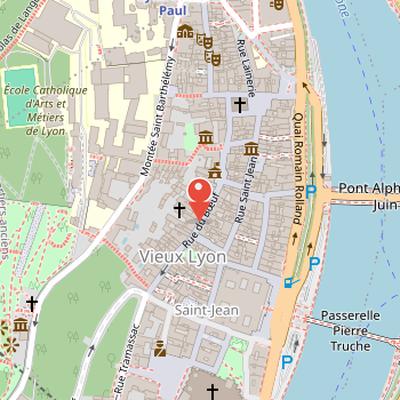
Rue du Bœuf is a paved pedestrian street in the Vieux Lyon quarter of Lyon, France. It runs north to south, connecting rue de Gadagne with the intersection of montée du Chemin-Neuf and rue de la Bombarde. The street is lined with buildings from the French Renaissance period of the 16th century and shows a mix of Gothic architecture, including emblematic crossed mullion windows, and Italian Renaissance architecture, such as the entrance of the maison du Crible.
The street’s history dates back to the end of the 15th century, when rue du Bœuf and rue Saint-Jean were traced near Fourvière in Lugdunum. It was originally named rue Tramassac or Tresmarsal, while the present rue Tramassac was then called rue de la Bombarde. In the 16th century, the first Lyon monetary workshop was established here, and the street was sometimes called rue de la Monnaie. The name rue du Bœuf came from the house called le Bœuf, built by Louis Thorel at numbers 2 and 3 of place Neuve-Saint-Jean. Since 2017, rue du Bœuf has had three starred restaurants and has been described as the street with the most starred restaurants in France.
Nearby Objects
-
 Maison du Crible 40 m away
 -
 Villa Florentine 120 m away
 -
 Musée Miniature et Cinéma 120 m away
 -
 Charvet Clock 120 m away
 -
 Palais de justice historique de Lyon 130 m away
Architecture and Culinary Reputation of Rue du Boeuf
Rue du Boeuf is a pedestrian paved street in the Vieux Lyon quarter of Lyon, France. It runs north to south, connecting rue de Gadagne to the intersection of montee du Chemin-Neuf and rue de la Bombarde. The street is lined with buildings from the French Renaissance period of the 16th century. Its built heritage combines Gothic architecture, including emblematic crossed mullion windows, with Italian Renaissance architecture, such as the entrance of the maison du Crible. Since 2017, rue du Boeuf has also been known for hosting numerous starred restaurants, making it the most starred street in France.
Historical Development of Rue du Boeuf
Rue du Boeuf and rue Saint-Jean were traced at the end of the 15th century near Fourviere in Lugdunum. Rue du Boeuf was originally named rue Tramassac or Tresmarsal, while the present rue Tramassac was then called rue de la Bombarde. In the 16th century, the first Lyon monetary workshop was established on rue du Boeuf, and the street was sometimes referred to as rue de la Monnaie after this installation.
Between 1551 and 1571, Louis Thorel inherited a property at the southwest corner of place Neuve-Saint-Jean and rue du Boeuf. He built the current complex at numbers 2 and 3 of place Neuve-Saint-Jean, and a statue of a bull decorates the corner of the building. Thorel was ennobled in 1597 for services during the plague, and he used a bull emblem on his coat of arms. The building later became known as the house called le Boeuf, which gave the street its name.
Rue du Boeuf was extended north to rue de Gadagne in 1650. This extension improved circulation and created a parallel to rue Saint-Jean. Starting in 2017, the street has had three starred restaurants, and it was described as the street with the most starred restaurants in France from that year.
Louis Dugas de Bois-Saint-Just and Rue du Boeuf
According to Les maisons et sites remarquables, Louis Dugas de Bois-Saint-Just was seigneur de Bois-Saint-Just, conseiller en l'election, subdelegue de l'intendance, and an echevin in 1658. The same source also states that he acquired the charge of premier president aux Cours de Lyon from Claude III de Villars. His connection to rue du Boeuf is recorded through the acquisition of a house there, with the right to have a burial in eglise Sainte-Croix de Lyon. The source also notes that he married Jeanne du Pin in 1632.
Historic Buildings and Traboules
Rue du Boeuf is noted for a dense concentration of historic architecture and passageways. Les maisons et sites remarquables states that Pierre de Monconys, father of Gaspar and Balthasar de Monconys, lived in an hotel on the street. The street also contains many traboules, although not all are open to the public. Among them is the longest traboule in Vieux Lyon, called la longue traboule, which begins on rue du Boeuf and ends on rue Saint-Jean after crossing four houses.
Several buildings on rue du Boeuf form a notable architectural ensemble. Four Renaissance buildings are identified as part of this group; they were restored and now house the hotel Cour des Loges and the restaurant Les Loges. The street is also home to a four-star hotel and restaurant named La tour rose, founded in 1975 and originally located at number 16 rue du Boeuf.
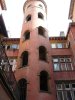
Individual structures on the street also carry architectural interest. The maison du Crible includes a courtyard with a round tower, the tour ronde, which has a spiral staircase facing a terrace and garden. In the same courtyard, near the door of the institut des sciences clavologiques, there is a shell-shaped well. The upper floor of the maison du Crible preserves 16th-century frescoes.