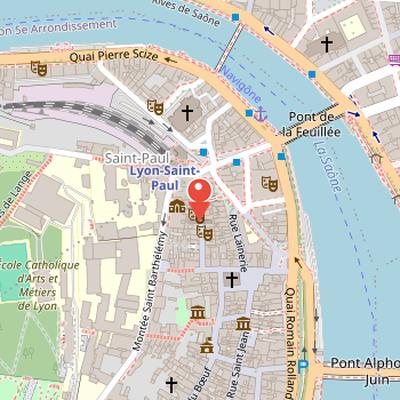
Rue Juiverie is a pedestrian, cobbled street in the Vieux Lyon district of the 5th arrondissement of Lyon. Oriented north to south, it connects Place Saint-Paul to the junction of rue de la Loge and montée du Change. Its name recalls the Jewish population, the Juiverie, who lived there in the Middle Ages. The street was previously called Rue de la Porcherie in 1371, was attested as Rue Juiverie in 1550, and was also called Rue Jurie in 1680. According to the historical record provided, the Jewish population was expelled in 1379, and it may also have been chased by Philippe le Bel in 1311.
The site was occupied since the Roman era, and after the fall of the Roman Empire the population gathered in the central district during the Burgundian era. The street later became associated with several notable historical references, including the presence of the Medici branch in 1466 and the reported residence of Nostradamus. Architecturally, the street is entirely paved and slightly winding. Its current façades date from the Renaissance on older bases, and many display mullioned windows, doors with caryatid sculptures supporting the impost, and lions. A traboule also links number 5 to 3 Place Saint-Paul.
Nearby Objects
-
 Sainte-Marie Lyon 60 m away
 -
 Temple du Change 90 m away
 -
 Lyon-Saint-Paul station 100 m away
 -
 Place du Change 110 m away
 -
 Gadagne 120 m away
Location and Layout
Rue Juiverie is a pedestrian cobbled street in the Vieux Lyon district of the 5th arrondissement of Lyon. It runs on a north-south axis and connects the place Saint-Paul to the junction of rue de la Loge and montee du Change.
Origin of the Street Name
The name rue Juiverie honors the Juiverie, referring to the Jewish population that lived on the street during the Middle Ages. The facts record that this population was expelled in 1379, and note that it would have been chased by Philippe le Bel in 1311. The street is attested in 1550 in the Plan scenographique de Lyon. It was also called Rue Jurie in 1680, and it had previously been named Rue de la Porcherie in 1371.
Historical Layers of Rue Juiverie
Histoire states that the site of rue Juiverie had been occupied since the Roman era, and that after the fall of the Roman Empire and during the Burgundian era, the population of Lyon gathered in the central district. According to Histoire, King Louis le Debonnaire officially permitted Jews to settle in Lyon and to build a synagogue there, and a medal confirming this authorization was found in the house called de la Breda before later being lost. In 1387, a royal decree clarified the legal status of Jews in Lyon, stating that they should not serve in the guard but should pay taxes.
The street also appears in later historical accounts. Histoire reports that in 1466 a branch of the Medici family moved from Geneva to Lyon and rented a house on the street. It also states that Charles VIII entered Lyon after returning from Italy and took part in three tournaments at Place de la Grenette, Place des Cordeliers, and Place de la Juiverie. In the 1490s, the street was transformed after the livestock market was moved to Rue de la Croix de Colle, and Histoire describes it as becoming one of the most beautiful streets in Lyon. Histoire further notes that Nostradamus lived there, and that Catherine de Medicis consulted him.
Architectural Features of Rue Juiverie
Rue Juiverie is entirely paved and slightly winding. Its current facades all date from the Renaissance, although they stand on much older bases. The street includes a traboule connecting number 5 to 3 Place Saint-Paul, and many of its facades preserve characteristic details such as mullioned windows, doors with caryatid sculptures supporting the impost, and lions. A lion's head is also noted at number 28.
Along the street, coats of arms of several city echevins have been added, including those of Guy de la Mure, recorded in 1294, and Jacques Imbert Colomes, who remained an echevin until his expulsion by the Revolution. After the Revolution, the role of echevin was replaced by that of mayor. The reproductions of the echevins' coats of arms at the start of the street are credited to the patrons and artisans responsible for them.
The architecture also invites attention to interior features visible inside the buildings, including staircases, galleries, towers, wells, and alleys supported by ogive ribs with small sculptures. Some inhabitants have also hung modern gargoyles on their windows.