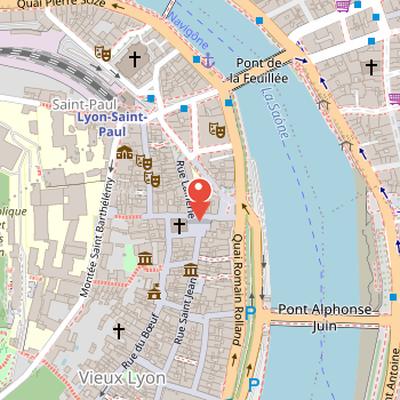
Place du Change is a square in Lyon attested since 1487 and created in 1584. It should not be confused with the former Place du Petit Change, now place Ennemond-Fousseret. Historical research indicates that the site corresponded earlier to a street called rue de la Revenderie, later renamed rue de la Poulaillerie, and that a large part of the area was occupied until 1584 by the Maison Ronde, visible on the 1550 scenographic plan. The square was associated with exchange activity from the Middle Ages, when city exchange operations were held at the descent of pont de la Saône. During the Renaissance, bankers and merchants settled progressively in the area, while many Italians also lived there. The first official building dedicated to exchange operations dates from 1653 and is the current Temple du Change, remodeled by Soufflot in 1748-1750. A text from Cicero’s letter to Munatius Plancus was inscribed on its facade.
Nearby Objects
-
 Temple du Change 20 m away
 -
 Gadagne 70 m away
 -
 Charvet Clock 80 m away
 -
 Rue Juiverie 110 m away
 -
 Palais Bondy 130 m away
History of Place du Change
Place du Change is attested since 1487, but it seems to have taken its current extent only from 1584. It should not be confused with the former Place du Petit Change, now place Ennemond-Fousseret. Before the present square was created, a large part of the area was occupied by a tenement called Maison Ronde, which can be seen on the 1550 scenographic plan and remained in place until 1584. Research by Benoit Vermorel and Joseph Pointet also identified an earlier street, rue de la Revenderie, at the location of the current Loge du Change doorsteps between 1303 and 1493; it was renamed rue de la Poulaillerie in 1476.
The square was created in 1584, in a district where exchange activity had already long been present. City exchange operations were held at the descent of pont de la Saone since the Middle Ages, and Les Changes were located on the east side of Maison Ronde as an overflow of tables from place des Changes, later renamed place du Petit Change. In the Middle Ages, the population of Place du Change and its district was popular, and during the Renaissance bankers and merchants progressively settled there, pushing modest people further south. Many Italians also settled on Place du Change.
The first official building dedicated to exchange operations dates from 1653. It was created by Simon Gourdet, also known as Griard, a Parisian architect. This building is the present Temple du Change, remodeled by Soufflot in 1748-1750, and its facade bears a text from Cicero's letter to Munatius Plancus.