The Monument aux morts pour la France en opérations extérieures is a memorial inaugurated in Paris in the garden Eugénie-Djendi of the parc André-Citroën. It honours the memory of soldiers who died for France in external operations (OPEX) and is considered one of the important places of national memory. The monument was entrusted to General Bernard Thorette, who first planned to place it near the Invalides before the project was moved to its current location after refusals from the Paris city hall and the architect of French buildings.
The memorial was inaugurated by the President of the French Republic, Emmanuel Macron, on the commemorative day of the Armistice of 1918, in the presence of families and relatives of the deceased. The sculpture, created by the agency Pièces montées and artist Stéphane Vigny, represents six anonymous soldiers, including five men and one woman, carrying an invisible coffin. The life-size figures are fixed directly to the ground and include one Polynesian soldier, with different military headdresses shown. The names engraved on a brass wall are listed by operation and year, classified by dates of death, and leave space for future victims updated by the historical service of Defense.
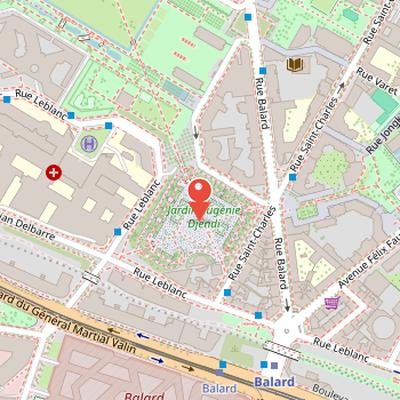
Nearby Objects
-
 Georges Pompidou European Hospital 250 m away
 -
 Parc André Citroën 300 m away
 -
 Ballon Generali 400 m away
 -
 Paris Expo Porte de Versailles 1100 m away
 -
 Statue of Liberty 1300 m away
Memorial in Parc Andre-Citroen
The Monument aux morts pour la France en operations exterieures is a memorial inaugurated in Paris in the Eugenie-Djendi garden of Parc Andre-Citroen. It was created to honor the memory of soldiers who died for France in external operations, also referred to as OPEX. Its setting within a named garden in a public park gives the memorial a specific place of remembrance in the city.
History and Commemorative Role
The project for the monument honoring soldiers who died in external operations was entrusted by General Bernard Thorette. A location near the Invalides was initially planned, but this was abandoned after refusals by the Paris city hall and the architect of French buildings. The monument was then placed at its current location. It was inaugurated by the President of the French Republic, Emmanuel Macron, in the presence of families and relatives of the deceased, on the commemorative day of the Armistice of 1918. The monument is considered part of the important places of national memory.
Sculptural Design and Construction
The sculpture was created by the agency Pieces montees and artist Stephane Vigny. It represents six anonymous soldiers, five men and one woman, carrying an invisible coffin. The figures are life-size and fixed directly to the ground, and one of the soldiers is Polynesian. The group is distinguished by different military headdresses, including a cap, side cap, kepi, beret, bachi, and tricorn. Its construction was documented in a five-episode web series produced by the Ministry of the Armed Forces.
Names Inscribed and Memorial Organization
The monument lists soldiers who died in overseas operations, with the names arranged by operation and year. At the time of its inauguration, it included 549 names: 2 women and 547 men, grouped by 17 theaters of operation and classified by date of death. Their names are engraved on a brass wall. The memorial also leaves space for future victims, with updates maintained by the historical service of Defense. It is referenced on the Ministry of Armies website in the In Memoriam section, where some of the commemorated individuals also have available biographies.
Named Casualties Recorded on the Monument
The monument records several specific casualties from French operations abroad. Among those inscribed are two French soldiers killed in the Haiti earthquake on January 12, 2010, as well as soldiers who died in the Uzbin ambush in 2008. The list also includes four soldiers who died on August 19, 2010, during a night operation storm, and two soldiers of the 21st Marine Infantry Regiment who were killed near Tagab on the same date. Other inscriptions commemorate five soldiers killed in a suicide attack at Joybar on October 19, 2010, and two legionnaires of the 4th Foreign Regiment killed by insurgents in the Tagab valley on November 29, 2010. The monument also includes soldiers from BG Raptor during its mandate, which counted casualties. Later losses recorded on the monument include four soldiers killed on February 20, 2011, in an attack inside the Gwan base, and four soldiers killed in the Kapisa valley on April 18, 2011.
Commemorated Promotions
The names inscribed on the monument honor two specific military promotions. One commemorates the 2010-2011 promotion of the inter-arm military school named after CBA Dupin, who died near Jalokhel in Afghanistan. The other honors the 2012 promotion of EOR/OSC of Saint-Cyr named after CBA Barek Deligny. Through these inscriptions, the monument records the memory of these training cohorts and connects them to individual service and loss.
Names Inscribed on the Monument
The monument includes the names of several service members who died in operations outside France. Among them are nine peacekeepers who were killed in a road accident near Sarajevo, at Mont Igman, on August 15, 2014. The inscription also includes two soldiers killed at Dobrinja and in a Sarajevo suburb on August 13 and 19, 2014, as well as two marsouins who died during the assault on the Vrbanja bridge on November 4, 2014. Other names recorded are Captain Panazol, who died in a plane accident at the Trieste base during the Balbuzard deployment on January 10, 2015, two peacekeepers killed in a road accident on April 24, 2015, and Adjutant Andreoli, who died in a mine explosion in the Prozor region on September 3, 2015.
Commemoration of Operations and Losses
The monument records a wide range of deaths connected with French operations outside metropolitan France, as well as some later commemorative additions and related memorial references. Among the names inscribed is Captain Friconneau, who was recognized as died for France and added to the monument on December 15, 2016. His death is recorded as the result of a rare cancer linked to uranium exposure during investigations in Kosovo.
Several inscriptions refer to deaths in combat or during specific missions. These include soldiers killed in the Battle of Kolwezi, in the combat of Eranga, and in the battles of Ati. The monument also mentions deaths during Operation Baumier, associated with the evacuation of French nationals, and Operation Ephemere in 1986, linked with the recapture of Ounianga Kebir. Other entries recall Major Birault, who died defending the Case de Gaulle in Brazzaville, and deaths in Marine commando action during the Combat de Gorom-Gorom in a hostage liberation operation.
The monument also records multiple accidents and incidents. These include nine soldiers killed during Operation Licorne in the Bouake bombing, two soldiers killed in an accidental explosion of a munitions depot of Force Licorne, eight people killed in a helicopter accident during a Franco-Gabonese exercise, three train soldiers who died near Tessalit when their vehicle hit a mine, and two spahis who died when their vehicle exploded. Other memorial entries include two Blue Helmets killed in a road accident between Mogadishu and Baidoa, one soldier who died during a humanitarian escort mission to Baidoa, three soldiers who died in a plane accident near An-Dagashi during Operation Languedoc, and three non-commissioned officers killed when their DC-3 was shot down by FROLINAT.
Additional names and references on the monument connect it to wider commemorative practices. It includes soldiers killed by rebels, soldiers shot by New Forces Ivorian rebels, one soldier killed by the Ivorian military, and soldiers killed in combat later added to the monument. It also includes soldiers recorded with higher ranks from the Base des militaires decedes en operations exterieures. Separate commemorative references mention a plaque for Captain Linemann at Saint-Dizier Air Base and the naming of the Stade de Keriscoualc'h in Plouzane after Commando Yoann Rouat. The monument is also commemorated at the French Embassy in Bangui.
Recorded deaths and named operations
The monument aux morts pour la France en operations exterieures includes a long list of named deaths connected to overseas service, with many entries tied to Lebanon, Sinai, and other theaters. Some inscriptions identify the circumstances of death with unusual precision. They note, for example, a soldier killed in 1989 as a victim of the UTA 772 flight attack, soldiers killed on February 8, 1988 when a French soldier opened fire, and eight soldiers who died in the crash of a Multinational Force and Observers plane in Sinai on April 15, 1989. Another entry records colonel Botta, who died in a helicopter accident in Sinai on June 9, 1989.
Several inscriptions refer to deaths in Lebanon. These include a soldier killed in the attack on the French embassy in Beirut in 1983, legionnaires killed by artillery fire on the diplomatic chancery on September 14, 1985, and the commander of the 1st Foreign Parachute Regiment and his driver, who were killed by shell fire on December 4, 1985. The monument also records soldiers of the 2nd Foreign Parachute Regiment who died in 1982 in a building collapse during a demining inspection, as well as military victims from the 1st Parachute Chasseur Regiment who died in the Drakkar attack. Other Lebanese entries include three sailors who died in a helicopter accident near Beirut on October 18, 1986 during operation OLIFANT, lieutenant-colonel Cuenot, who was assassinated during his service in Lebanon, two observers assassinated on July 15, 1988, commander Rhodes, assassinated in front of the observer post at Choueifate on October 22, 1988, captain Corvee, described as the last soldier assassinated before the French army left Residence des Pins in Beirut in 1984, three soldiers of the 2nd Foreign Infantry Regiment who died in a bomb attack at Jouaya on November 8, 1986, and the military attache to Lebanon, who was assassinated on May 15, 1989.
The inscriptions also mention operations and categories beyond individual incidents. Operation Capselle, conducted from the aircraft carrier Foch in 1983, is noted as protecting possible French citizen evacuations off Lebanon. Operation Alysse is identified as the French name of operation Epaulard. Some soldiers are listed under theaters of external operations without being assigned to any particular operation. Other recorded deaths include soldiers who died in a Nord 2501 plane accident during takeoff at Bouar on March 17, 1980, and captain Aniort, whose name is borne by the Army Air Force non-commissioned officers class of 1978.