Ballon Generali is a captive balloon installed in André-Citroën Park in Paris. Designed and developed by the company Aerophile, it functions both as a tourist attraction and as an air quality awareness tool. The balloon, with its gondola, envelope, and net, is lifted by helium and held in place by a cable that counters wind force. According to the provided information, stronger winds increase lift to maintain stability, which can reduce passenger capacity. The balloon reaches a notable altitude and is described as one of the highest points in Paris after the Eiffel Tower. It is visible from a wide radius during flight and is seen daily by many people. The balloon is also presented as one of the least polluting aircraft worldwide because it is powered by an electric winch. Its history includes an initial launch in 1999, later sponsorship changes, and a version that changed colors in relation to air quality in Paris.
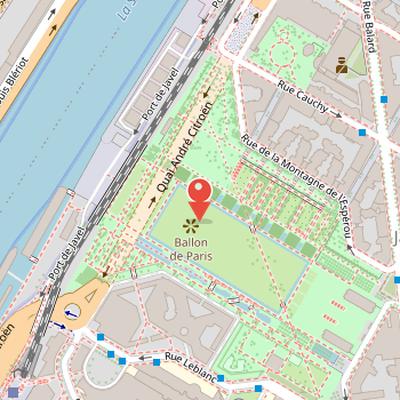
Nearby Objects
-
 Parc André Citroën 120 m away
 -
 Georges Pompidou European Hospital 300 m away
 -

-
 Statue of Liberty 1000 m away
 -
 Maison de la Radio 1300 m away
Design and Location
The Ballon Generali is a captive balloon in Paris that functions both as a tourist attraction and as a tool for air quality awareness. It is installed in the Andre-Citroen park. The balloon was designed and developed by the company Aerophile. Its public role combines leisure with environmental communication, making it a visible feature of the park and an urban object with a specific informational purpose.
Design and Operation
The Ballon Generali operates according to Archimedes' principle: one cubic meter of helium can lift a certain amount, and the balloon's lift is managed through its cable system. The balloon, together with its gondola, envelope, and net, weighs approximately a given amount, yet it can generate enough lift to make it the largest captive balloon worldwide. Its height and diameter are specified, and it can reach a stated altitude, sometimes rising higher when winds are calm.
Wind conditions play an important role in its operation. The balloon maintains lift in the cable to counteract wind force, and as wind increases, lift also increases to balance it, which in turn reduces passenger capacity. The cable is designed with a maximum traction resistance. The balloon is also notable in the Paris skyline, standing as one of the highest points in the city after the Eiffel Tower and remaining visible within a certain radius during flight.
In addition to its size and visibility, the balloon is presented as one of the least polluting aircraft worldwide because it is powered by an electric winch. It is seen daily by a large number of people, making it a frequent and highly visible presence in the urban landscape.
Launch and Sponsorship History
Histoire was presented to the press by the mayor of Paris, Jean Tiberi, and the creators of Aerophile on the first floor of the Eiffel Tower. It was launched during the New Year's festivities in 1999 and was first intended to remain in place only until February 28, 1999. Because of its success, its presence was extended beyond that date. In its early phase, Histoire served as an advertising support for Fortis. The balloon was deflated at the end of 2000, then returned to service on April 28, 2001, with a new sponsor, Eutelsat.
Color Changes, Sponsorship, and Renewals
A new balloon named Histoire was inaugurated on April 20, 2004, in collaboration with Banque Populaire and Airparif. At that time, it changed colors according to air quality in Paris, ranging from green for good air quality to red for bad air quality, with orange used for mediocre air quality. The system also included independent lighting to indicate air quality near traffic using the same color code. Histoire was deflated on November 3, 2007, before a new blue balloon of the same name was inaugurated on December 15, 2007, in the presence of explorer Jean-Louis Etienne. After more than 10 years of partnership with the Italian insurance company Generali, it was renamed Observatoire atmospherique Generali. The balloon was deflated again on October 10, 2013, then returned to service on April 26, 2014 as a new white balloon sponsored by Generali. In 2014, it was equipped with a self-cleaning system and continued to embark passengers yearly for a show lasting approximately 20 minutes. Over twenty years, between 1999 and 2019, Histoire welcomed one million visitors. It was deflated in 2019, with its helium recycled for the first time, and resumed flight in 2021 with a new envelope still sponsored by Generali.
Scientific Uses of the Ballon de Paris
Qualite de l'air uses the Ballon de Paris as a research platform for several CNRS laboratories studying the lower atmosphere. Under the direction of LPC2E and Jean-Baptiste Renard, the balloon was equipped with the LOAC device, which counts and identifies ultrafine particles smaller than PM. The device was initially designed to operate at 30 km altitude in the stratosphere. In 2018, new instruments were added for real-time ozone studies with the Laboratoire Inter-Universitaire des systemes Atmospheriques. Since 2024, the balloon has also been used to measure major greenhouse gases with LSCE - ICOS sensors, including methane, carbon dioxide, and water vapor as part of the ICOS Cities program. Qualite de l'air also measures pollens under LPC2E CNRS direction.