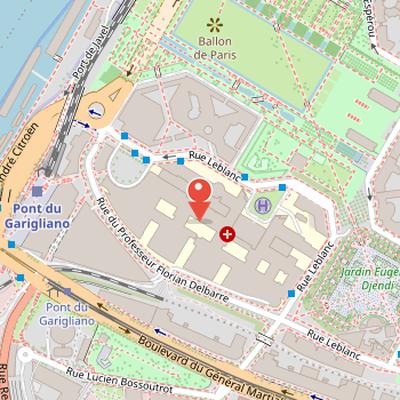
Georges Pompidou European Hospital is a hospital of the Assistance publique - hôpitaux de Paris (AP-HP) in the 15th arrondissement of Paris, between rue Leblanc and rue du Professeur-Florian-Delbarre. It stands on the banks of the Seine near the Pont du Garigliano, close to parc André-Citroën and the offices of France Télévisions. Opened in 2000, it is the youngest major hospital in Paris. Designed in the 1990s by architect Aymeric Zublena, the hospital grouped services from the former hospitals Boucicaut, Broussais, Laennec, and orthopedics-traumatology from Rothschild. It was named after former President Georges Pompidou and called “European” mainly for image reasons, as AP-HP sought to emphasize links with European hospital networks in the early European Union period. The hospital has three clinical poles: Pôle du cœur, Pôle Cancérologie, and Pôle Urgences Réseau. It is also noted for cardiac surgery and cardiology within Pôle du cœur, and it was the site of the world’s first implantation of a Carmat artificial heart on 18 December 2013.
Nearby Objects
-
 Parc André Citroën 200 m away
 -

-
 Ballon Generali 300 m away
 -
 Statue of Liberty 1300 m away
 -
 Stade Pierre-de-Coubertin 1300 m away
Location of the Georges Pompidou European Hospital
The Georges Pompidou European Hospital is a hospital of the Assistance publique - hopitaux de Paris (AP-HP). It is located in the 15th arrondissement of Paris, between rue Leblanc and rue du Professeur-Florian-Delbarre. The site stands on the banks of the Seine near the pont du Garigliano, and is also close to parc Andre-Citroen and the offices of France Televisions.
Hospital Structure and Notable Events
The Georges Pompidou European Hospital is the youngest major hospital in Paris, having opened in 2000. It was named after former President of the Republic Georges Pompidou and was designed in the 1990s by architect Aymeric Zublena. The hospital brought together services from the former hospitals Boucicaut, Broussais, and Laennec, as well as orthopedics-traumatology from Rothschild. AP-HP gave it the name European mainly for image reasons, while also seeking to emphasize connections with European hospital networks during the early period of the European Union.
The hospital is organized into three clinical poles: Pole du coeur, Pole Cancerologie, and Pole Urgences Reseau. It is described as one of the most efficient hospitals in Europe, and it is especially distinguished by its cardiac surgery and cardiology services within Pole du coeur. On December 18, 2013, it was the site of the world's first implantation of a Carmat artificial heart, performed by Professor Christian Latremouille's team.
The hospital was also affected by a legionellosis outbreak in 2000 and 2001, for which AP-HP was prosecuted. The outbreak infected about ten patients and caused five deaths.