Rue Grenette is a street in Lyon first attested in 1193. Its name comes from the halls of the Grenette, which were used for grain storage and sale. The building of these halls still exists along Rue de Brest, between Rue Grenette and Rue Tupin. The street was previously called Rue des Albergeries (Auberges).
Until the 18th century, Rue Grenette connected Place des Cordeliers to Rue Basse-Grenette. In 1764, Jean-Antoine Morand proposed a north-south street at the location of Rue Basse-Grenette to link Terreaux to Place Bellecour, with an extension of Rue Grenette toward the Saône. The project was resumed by Louis Benoît Coillet between 1814 and 1821, and Rue Centrale, now Rue de Brest, was opened to traffic. The extension of Rue Grenette west of the new road was later declared of public utility. The street was straightened and aligned during major works led by Prefect Vaïsse, which continued until 1904. Most buildings on the street date from the second half of the 19th century.
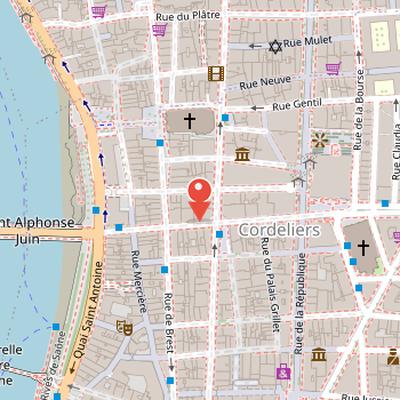
Nearby Objects
-
 rue Édouard-Herriot 20 m away
 -
 Rue de Brest 90 m away
 -
 Rue Mercière 130 m away
 -
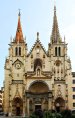 Église Saint-Nizier 150 m away
 -
 Rue de la République 160 m away
Historical Origins of Rue Grenette
Rue Grenette was first attested in 1193. It takes its name from the halls of the Grenette, which were used for grain storage and sale. The building of these halls still exists along Rue de Brest, between Rue Grenette and Rue Tupin. Before adopting its current name, the street was called Rue des Albergeries, or Auberges. Until the 18th century, it connected Place des Cordeliers to Rue Basse-Grenette. In 1764, Jean-Antoine Morand proposed a north-south street at the location of Rue Basse-Grenette to link Terreaux and Place Bellecour, and his proposal also included extending Rue Grenette toward the Saone.
Street Realignment and Later History
Rue Grenette was reshaped during major urban works in Lyon led by Prefect Vaissse, alongside the openings of Rue du President-Edouard-Herriot and Rue de la Republique. Louis Benoit Coillet resumed the project between 1814 and 1821 as city surveyor. After Rue Centrale, now Rue de Brest, was opened to traffic, the extension of Rue Grenette west of the new road was declared of public utility, and demolitions were begun to open the new section. During these works, the existing street was straightened and aligned, and the project continued until 1904.
Most of the buildings on Rue Grenette date from the second half of the 19th century. The street is also noted in connection with a clash that took place on the eve of a Derby between Olympique Lyonnais and AS Saint Etienne, when about one hundred supporters from each team confronted each other there. On that day, the Lyon supporters won the confrontation.
Traffic Use and Transit Changes
In the Presqu ile a vivre city center project, rue Grenette was reserved for motorized traffic limited to buses in both directions. Cyclists were invited to circulate on the bus lanes, and the street carried many network lines, including the new BHNS line TB11. Urbanisme also created a new bus stop, Terrasses Presqu ile, at the west end of the street to provide a connection with the Navigone line on the Saone. Urbanisme later announced the reopening of the street to all vehicles, in parallel with a plan to reopen north rue de la Republique to buses after the election of Veronique Sarselli.