Rue de la République is a more than one-kilometer street in Lyon, extending from Place Bellecour to Place de la République and then to Place Louis-Pradel. It was created in 1853 alongside the urban works associated with Baron Haussmann in Paris, when Claude-Marius Vaïsse, prefect of Rhône and mayor of Lyon, decided to create two new roads linking Place Bellecour to other major places in the Presqu’île. Along its route, two squares were created, Place Impériale and Place de la Bourse, and Place des Cordeliers was significantly enlarged.
The street is also associated with several layers of urban change. In the 1970s, line A of the Lyon metro was built using shallow covered trenches along its length. Parts of the street were later pedestrianized, while other sections were reserved for buses and authorized vehicles. Its last redesign was in 1995 by Alain Sarfati, using gray slabs near the facades, white slabs in the center, and maple trees. In 2025, new temporary pedestrian and greening measures were introduced under the “Presqu’île à vivre” project. The street also contains memorial and built heritage elements, including a red stone and plaque at number 22 marking the assassination of President Sadi Carnot, and buildings mostly constructed in the 19th century, including some earlier structures and the former headquarters of Le Progrès, now occupied by Fnac.
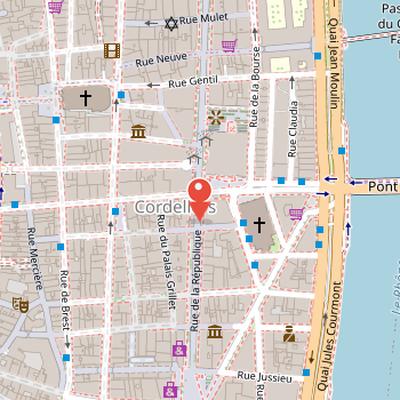
Nearby Objects
-
 Grand Bazar de Lyon 40 m away
 -
 Saint-Bonaventure Basilica 80 m away
 -
 Place des Cordeliers 120 m away
 -
 Anciennes Galeries Lafayette 130 m away
 -
 rue Édouard-Herriot 130 m away
Historical Development and Urban Form
Rue de la Republique was created in 1853 in the context of works associated with Baron Haussmann in Paris. In Lyon, Claude-Marius Vaisse, prefect of the Rhone and mayor of Lyon, decided to open two new roads linking Place Bellecour with other major places on the Presqu'ile. The street is more than one kilometer long, running from Place Bellecour to Place de la Republique and then to Place Louis-Pradel. Along its route, two squares were created, Place Imperiale and Place de la Bourse, while Place des Cordeliers was significantly enlarged.
The street is also marked by an important political event: French President Sadi Carnot was assassinated by the anarchist Santo Geronimo Caserio near the Palais du Commerce, close to Place des Cordeliers. A red stone and commemorative plaque at number 22 Rue de la Republique mark this event.
In the 1970s, line A of the Lyon metro was built using shallow covered trenches along the full length of the street. Later, a section between Place du Viste and Place des Cordeliers was pedestrianized at the request of merchants, while the rest of the street was reserved for buses and authorized vehicles. The last redesign of Rue de la Republique was completed in 1995 by Alain Sarfati.
Redesign and Recent Pedestrianisation
The 1995 redesign of Rue de la Republique used gray slabs near the facades and white slabs in the center, and maple trees were planted along the street. In 2017, cubic concrete blocks were placed at street ends and intersections to protect against vehicle-ramming attacks following the 2016 Nice attack. More recently, the street has been the subject of renewed redevelopment. Planned repairs between 2024 and 2025 include slab replacement and tree plantation to address deterioration. In 2025, the Metropole de Lyon launched the Presqu ile a vivre project, which established a limited traffic zone and began redevelopment of the northern part of Rue de la Republique between Place des Cordeliers and Place de la Comedie. In June 2025, this northern section was pedestrianized with fluorescent white paint bands and temporary urban furniture, including wavy light-colored concrete benches installed on the roadway. In November 2025, 22 trees were planted in 500 square meters of newly created vegetated pits, and old bus shelters were greened and converted into swings. These two renovation phases remain provisional pending a permanent slab design planned for 2030.
Notable Buildings and Memory Sites
Bâtiments remarquables et lieux de mémoire identifies a group of notable buildings and memory sites along Rue de la Republique, with most of the listed structures dating from the 19th century. It also notes that some buildings predate the creation of the street itself. Among the dated examples are one building from the first half of the 19th century and another from the early 19th century. The street also includes later identified landmarks such as Fnac, located in the former headquarters of Le Progres, and the Nouveau Grand Bazar, identified in 2008.
The street is also associated with several commemorative markers. These include a commemorative plaque of Sadi Carnot's assassination on the Palais de la Bourse in Lyon, a paving stone marking the location of the assassination on Rue de la Republique, and a commemorative plaque on the building described as the second cinema hall in the world. The Palais de la Bourse is presented in 2026 as part of this documented ensemble of places of memory.