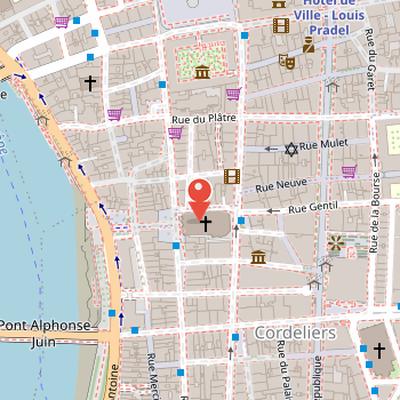
Église Saint-Nizier is a Catholic church in Lyon, located on place Saint-Nizier in the Presqu'île, between place des Terreaux and place des Jacobins in the Cordeliers district. Dedicated to Nizier, one of the bishops of Lyon, it is among the city’s most important places of worship and is notable for its antiquity, prestige, architectural interest, and monumental visibility. The church is attested from the Early Middle Ages, and its importance increased after the year 1000 alongside Lyon’s political and economic rise, creating tensions with Saint-Jean Cathedral and its canonical chapter. The building was entirely rebuilt in the flamboyant Gothic style in the 15th and 16th centuries. It was classified as a historic monument in the 1840 list. Historical traditions link the site to earlier religious structures and to the cult of the Lyon martyrs, although these accounts remain unsupported by archaeological evidence.
Nearby Objects
-
 Rue Grenette 150 m away
 -
 rue Édouard-Herriot 160 m away
 -
 Place de la Bourse 200 m away
 -
 Rue de Brest 250 m away
 -
 Palais Saint-Pierre 250 m away
History and Architectural Importance
Saint-Nizier Church is a Catholic church located in Lyon at Place Saint-Nizier, in the Presqu ile between Place des Terreaux and Place des Jacobins in the Cordeliers district. It is regarded as one of the most important places of worship in the capital of Gaul, with particular significance for its antiquity, prestige, architectural presence, and monumental visibility.
The church is dedicated to Nizier, one of the bishops of Lyon, and is attested from the Early Middle Ages. Its importance grew after the year 1000, following the political and economic rise of Lyon. This development increased tensions with Lyon's main church, Saint-Jean Cathedral, and its canonical chapter.
Saint-Nizier was entirely rebuilt in the flamboyant Gothic style in the 15th and 16th centuries. It was later classified as a historic monument in the 1840 list, underlining its recognized heritage value.
Early history and burial traditions
The early history of Saint-Nizier is shaped by several traditions, but many remain uncertain. According to the history of the site, the first religious building there may have been a Roman monument, possibly a temple of Attis, although Jean-Francois Reynaud does not support this hypothesis. A later legend says that Pothin founded a chapel on the site, but these accounts lack archaeological support because no serious excavation has been carried out beneath the present building. What is established is that Saint-Nizier was built on an ancient cemetery of Lugdunum, like other churches in Lyon, and finds near the site include epitaphs to the Manes gods and a Christian epitaph dated 495.
Medieval and later traditions also gave the church an important place in the memory of Lyon's early Christianity. A bull of Innocent IV from 1252 claimed, without proof, that Saint-Nizier was the city's first cathedral. In the 20th century, historians often considered it the first basilica built by Bishop Patient in 469, and Amable Audin rejected Saint-Jean as the basilica described by Sidonius Apollinaris in 1947. More recent studies, however, confirm that Patient's basilica was built on the site of the current cathedral. Another tradition, reported by Bishop Adon of Vienne, says that Saint Eucher built a basilica on the ruins of Saint Pothin's oratory to house the relics of the Lyon martyrs executed in 177. Adon's Martyrology named it the Church of the Holy Apostles Peter and Paul and of the forty-eight martyrs, although the Maxima Ecclesia was Saint-Jean rather than Saint-Nizier.
The basilica became a burial place for bishops of Lyon during the whole 6th century, including Saint Nizier and Sacerdos, and the crypt where these burials took place still exists beneath the floor of the current church. It is a structure shaped like a Greek cross, with each arm ending in a half-dome apse. The body of Nizier drew large crowds and was associated with many miracles, and the church eventually took his name. In the 9th century, relics of Saint Nizier were transported from Lyon to Troyes cathedral by Gallomagne, the twelfth bishop of Troyes. During Priscus's episcopate, the church was served by several clerics, including at least one deacon.
Medieval Parish and Bourgeois Church
The history of Saint-Nizier begins with uncertainty about whether it or Notre-Dame de la Platiere served as the parish church of the Carolingian burgus. It may have been damaged during conflicts between Saracen forces moving up the Rhone valley and Frankish counter-attacks, before being rebuilt in the 9th century by order of Bishop Leidrade under Charlemagne. Leidrade installed a chapter of canons in the rebuilt church and informed the emperor.
By the 12th and 13th centuries, the church district had become the center of the city's bourgeoisie. The bourgeoisie made Saint-Nizier their main church, in opposition to Saint-Jean and Saint-Just, and met there as well as at the nearby Saint-Jacqueme chapel to take common decisions. The building remained part of a collegiate abbey until the 18th century, with members living communally but not in poverty. Pierre Valdo was a parishioner in the 12th century, and in 1253 his followers set fire to the church, destroying many relics.
In the second half of the 13th century, the bourgeoisie wanted to enlarge and renovate the church so that it would have equal prestige with Saint-Jean. In 1306, Archbishop Louis de Villars erected the church as collegiate and instituted a canonial chapter open to bourgeois families. Medieval parishioners of Saint-Nizier were largely bourgeois, and inhabitants of the presquile sought emancipation from the direct control of the right bank and from the influence of the cathedral chapter. They also claimed Saint-Nizier as the first cathedral established in Lyon, a claim supported by documents written in the 16th or 17th centuries and later treated as historical testimony in the 19th century.
Construction History and Building Techniques
The current church of Saint-Nizier began construction in the 15th century, and the main building campaign continued until the end of the 16th century. Progress depended heavily on the fortune of donors, and construction was repeatedly interrupted by major events, including the 1348 epidemic and the conflicts associated with the Hundred Years' War in the mid-14th century. Funding came from irregular donations, concessions to confraternities, and the rental of spaces for shops along the north walls.
The building was started in the usual sequence, with the choir first, then the transept, and finally the nave bays. The north belfry was built in 1481, the same year a first clock was made and maintained by Lyonnais artisans. Recent archaeological studies also indicate close interaction between stonemasons and carpenters during the works, and suggest that carpenters may have held an important role in relation to stonemasons' privileges.
Several construction techniques can be identified in the fabric of the church. The dowel technique was used for the keystones of the double arches, while the squared-off technique appears in the triforium and nave vault by Philibert Delorme and on the fourth double arch. Although the dowel technique was technically well executed, it used low-quality limestone, which suggests the work of an artisan more experienced in carpentry than in masonry. From an urban point of view, the building also breaks the alignment rules seen in the perspective of the two bridges.
Saint-Nizier and the City of Lyon
In the second half of the Middle Ages until the Revolution, Saint-Nizier was the church of the Lyonese people, and it stood in opposition to a cathedral associated with urban elites. The two buildings competed architecturally as well, each seeking to impress spectators, visitors, parishioners, and donors. This rivalry also reflected broader struggles of power, including the choice of church used for municipal official ceremonies under absolutism, where the selection of a church signaled conflict between municipal and aristocratic authority.
The church underwent major losses and rebuilding over several centuries. Between 1360 and 1390, the cure of Saint-Nizier was destroyed. Earlier historiography attributed this destruction to damage from the Hundred Years War, but recent studies instead connect it to local revolts against urban elites and royal officials. The artistic heritage of the church was then almost entirely dispersed or destroyed at least twice: first in 1562 by the Huguenot bands of the baron des Adrets, who pillaged the tombs of the bishops of Lyon and statues, and again during the French Revolution. Only a minority of the artworks survives today.
Despite these losses, the chapter maintained an important material and financial life. The medieval book of accounts of the chapter of Saint-Nizier has been preserved. It shows that the church possessed a rich collection of precious fabrics for ceremonies since 1305. Each canon swore to provide new fabrics to the chapter treasury, and the rental of funeral cloths became a source of income. In 1338, no coffin could enter the church choir without cloth worth ten gold florins. Candle wax sales also generated significant revenue. Georges Guigue published the chapter accounts in 1899, and the register includes both Latin accounts and a death list of the parish. In 1912, doctor J. Drivon identified the register as evidence for the onset of the Black Death in the parish, which J. N. Biraben later estimated normally held three to four thousand inhabitants and lost 25 to 30 percent of its population within months in 1348.
Saint-Nizier also had a strong presence in the citys social and religious life. From 1486, the Lyonese archers company under Saint Sebastien settled in the Saint-Germain chapel. In the late 16th century, the district was mostly Protestant, and about half of the population declared themselves Huguenots. The church was supported by wealthy city elites and had an abundant clerical staff; around 1680, more than sixty religious served there. After the 1562 destruction, the church was enriched with bells taken from the Basilica Saint-Just by the baron des Adrets, although the chapter of Saint-Just demanded them for the new church rebuilt on the old basilica site. Saint-Nizier was finally completed in 1590 with only one bell tower on the north tower, where the bell known as the gros Seral was used to call citizens to municipal meetings.
The church continued to be maintained and updated. In the 18th century, the Flemish painter Adrien Dassier was commissioned to paint six works illustrating the life of the Virgin, though none of the original six survive today except one now in the Saint-Pierre church of Vaise. At the end of the 18th century, the chapter decided to replace the clock with a new pendulum clock made by the Mayet brothers from Jura. The new clock measured more than one meter. Saint-Nizier parish itself contained a large share of Lyons population, about 41 percent in 1700 and 33 percent in 1785, but it also faced sanitary problems and an annual death toll of about seven hundred parishioners.
Cemetery Conditions and Expansion
Health inspections carried out in 1777 and 1778 reported that no bodies were buried in coffins in the church cemetery. The same records note that the soil covering the bodies varied between four inches, or 10 cm, and one inch, or 2.5 cm. The adjacent cemetery measured 692 square meters, and it almost doubled in size because of a funerary crypt of 568 square meters. The continuous addition of bodies led to serious sanitary consequences in the cemetery.
Revolutionary Conflict at Saint-Nizier
According to the history of the church, Saint-Nizier became the scene of a confrontation during the revolutionary period involving a refractory priest who refused the Civil Constitution of the Clergy. He continued his ministry clandestinely or in public, and, without taking the oath to the Constitution, illegally delivered a Lenten conference. During this preaching, he explicitly asked his parishioners to pray for the abolished title of Archbishop of Lyon. His presence and words provoked a fight inside the church, leading to the intervention of the National Guard. The disturbance ended with the evacuation of the church and the arrest of Linsolas and two other priests. They were imprisoned for three months. While Linsolas was detained, the constitutional priest Antoine-Adrien Lamourette celebrated the feast of Saint Nizier in the church, and he was verbally challenged during the ceremony by two women linked to Linsolas's group.
Revolution, Restoration, and 19th-Century Works
In 1791, when the National Assembly reduced Lyons parishes to ten, Saint-Nizier remained central to its parish, with Saint-Bonaventure as a subsidiary church. The building was then badly affected by the siege of Lyon, which damaged the vaults and bell tower, while anti-clerical riots ransacked the interior. It was also used as a flour depot, and in 1796 there was a plan to turn it into a commercial passage. By the end of the Revolution, its condition was described as very poor: stained glass had been removed or destroyed and the sculptures were dilapidated.
Despite this decline, worship gradually returned. Saint-Nizier was temporarily used as a cathedral by a constitutional clergy, and churchwardens began the first restoration work on the bombardment damage. Mass resumed with the juring priests, and Bishop Claude Primat made Saint-Nizier the metropolitan seat for the sworn clergy. Worship was reestablished in the cathedral on Pentecost, and major Lyon ceremonies were held there while Saint-Jean cathedral was under repair. The building also benefited from the recovery of local bourgeois wealth and renewed religious fervor, which supported further repairs and the completion of the west facade. Shops were installed against the apse to provide rental income.
Restoration work was carried out in a Gothic style linked to the romantic movement. The sacristies were built by the city architects Pascal Gay and Louis Cecile Flacheron, while the chapels received decorations by Lyonnais artists Pierre Revoil and Joseph Chinard. The south bell tower was constructed between 1843 and 1857, at the same time as the central pediment. The current crypt was completed in 1883, and the stained glass windows were rebuilt at that time. Numerous interior adjustments and furnishings further enriched the church. In 1847, part of the Saint-Nizier parish was attached to it because of financial deficits, but the expected support from wealthier faithful proved insufficient. Saint-Nizier is also listed among the first historic monuments.
Occupation and Later Management
On March 2, 1975, between one hundred and two hundred Lyonnaise prostitutes occupied the Saint-Nizier church. Histoire reports that they presented themselves to journalists as women and mothers, and that their testimonies were shown on screens outside the building for passersby. Their demands included a protest against excessive police repression and police abuse, including pimping policemen, as well as criticism of the lack of effort in finding the murderers of three prostitutes. They also called for a law sentencing repeat offenders of passive soliciting to prison. Their slogan framed the protest as a feminist demand, arguing that all women suffer a masculine yoke resembling prostitution. Earlier, starting in 1973, renovation work had been undertaken by the Directorate of Historic Monuments and the city of Lyon. Later, the parish was managed by the monastic fraternity of Saint-Nizier from 1983, and in 1996 the Emmanuel community took over management.
Architecture and FaCades of Saint-Nizier
The church of Saint-Nizier is mainly built in flamboyant Gothic style, with a silhouette marked by two asymmetrical spires. Its lower parts use hard limestone from Roman buildings or from Villebois, while the original upper parts are made of Lucenay type stone and later additions use Tournus stone. The exterior decoration follows the flamboyant Gothic vocabulary closely, with numerous ornaments, twisted or flame motifs, and many figurative sculptures, including gargoyles.
The west face is particularly complex. It includes a large central portal supporting a pediment, flanked by two towers with spires. This facade does not belong to a single unified style, but combines three successive styles. Even so, architects succeeded in creating a harmonious ensemble. At the center of the facade is a Renaissance style portal, described as rare in Lyon, and attributed to Jean Vallet, a student of Philibert Delorme. The porch around the central door has four fluted Doric columns and an original cul-de-four shape. Inside the porch cavity are more than two hundred stone coffers decorated with flowers or angel faces, with a bust of God the Creator at the top. The central entrance is surmounted by a Latin inscription meaning God is the creator of all things, while Bible extracts from Exodus chapter 20 and Mark chapter 12 are placed to the left and right of the door.
The north tower was completed at the end of the 15th century and is shaped in flamboyant Gothic style. It is divided into three levels: the lower part contains the portal, the middle houses the clock with a gallery, and the top holds the bells and a pink brick spire. The north bell tower also contains a pendulum clock mechanism built in 1684 by the Mayet brothers from Haut-Jura, commissioned by the chanoines of the collegiate to replace an older clock from the end of the 16th century. The mechanism measures more than 4 meters.
The south tower was built in the mid 19th century and was designed in neo-Gothic style by Benoit pere, who followed Viollet-le-Duc's principles for its inspiration. Its body is symmetrical to the north tower, with a flamboyant style bell tower in Tournus stone. Its construction led to the demolition of an older Renaissance style gate, which was replaced by the current Gothic gate with unfinished ornaments.
Above the porch, three statues represent Saint Anne on the left, Saint Joachim on the right, and Saint Nizier in the center, all by Joseph-Hugues Fabisch. A Virgin and Child statue on the gable is by Jean-Marie Bonnassieux. The oldest parts of the building are the pentagonal chevet and the transept arms. Near the chevet, a sacristy was built in 1817 in Lombard style by architect Flacheron, but the sacristy space along the church is now occupied by a shop.
The north facade along rue de la Fromagerie has five large side windows with tracery and double flying buttresses resting on large piers with empty niches. A balustrade encircles the entire church, and the north transept includes a rose window above and a blocked window in its lower part. The south facade is symmetrical to the north facade, but the south side remains completely inserted in adjacent buildings, the former canonical complex of the 19th century, now vanished. A trace also remains at the south transept of a passage to the cloister through a room called the chapter house.
Altars and Statues in the Transepts
The transept altars of Saint-Nizier are marked by two notable marble statues. In the south transept, the Virgin altar is topped by a marble statue sculpted by Antoine Coysevox in 1676. The work was originally intended for the exterior of Coysevox's house at the corner of rue Sirene and rue du Bat-d'Argent, where the Child Jesus and Mary were positioned to face the two streets of the corner. The statue was later bought by the Confrerie Notre-Dame de Grace in 1771, hidden in a sack of flour to avoid destruction during the Revolution, and eventually transferred to Saint-Nizier church. The Virgin altar is also associated with Marian devotion, which Louis Querbes promoted in response to religious indifference and Freemasonry. Pauline Jaricot is buried next to this altar, where she consecrated herself to God.
In the north transept, the altar is topped by a white marble statue by Joseph Chinard depicting Saint Pothin. The sculpture shows Saint Pothin presenting a representation of the Virgin Mary to the audience.
Crypt and Chapel Decoration
The chapel contains two stained glass windows by Lucien Begule dating from 1894. These windows are identified as rare examples of the master glassmaker's historical iconographic program. They depict the reading of the statutes of the confraternity of the Holy Trinity, founded in 1358, as well as the confraternity's bread distribution on the day of the Holy Trinity.
The crypt lies at an unspecified depth and has a square plan with semicircular apses on the north, east, and south sides. It is accessed by two lateral staircases. The ancient crypt was restored by Renouard, a merchant, and the body of Saint Ennemond was placed there in 1528. The crypt also contains five large 19th century mosaic paintings, made by Ennemond Mora from cartoons by Gaspard Poncet. Their decoration evokes the origins of the Church in Lyon and includes the forty-eight martyrs of Lyon of 177. An apse fresco shows the Virgin Mary surrounded by Saint John and Saint Pothin. The mosaics have been under restoration since 2013, and the epitaph of Saint Sacerdos, bishop of Lyon from 549 to 552, is displayed at the back of the crypt.
The Merklin Organ of Saint-Nizier
The organ of Saint-Nizier Church was built in 1885 by Joseph Merklin and inaugurated in 1886 by the titular organist, Jule Ruest. Architecture et decoration describes it as an instrument of 45 stops, with three keyboards and one pedalboard. It was conceived as a grand organ that combined the tribune organ and the choir organ, which were located about 60 meters apart. From a single console placed behind the altar, the organist could play both organs at the same time. A second console, equipped with two keyboards and one pedalboard, was also installed inside the main case and later moved below into the nave. This arrangement allowed the tribune organ to be played independently without sound delay issues.
The publication notes that Merklin had recently built the organ of the Grand Temple of Lyon using electric technology, and that the Saint-Nizier organ employed the Schmoele and Mols electro-pneumatic system, which had an exclusive concession in France. This electrical innovation made it possible to separate the console from the pipes. The instrument was restored in 1942 thanks to donations, despite requisitions under the Third Reich. Around 1975, major interior restoration works damaged the organ and it became silent. Both consoles were then disconnected and removed for storage. Since then, the instrument heard at celebrations has not been the pipe organ. The Merklin organ of Saint-Nizier, including its grand buffet and instrumental part, is classified as Monuments Historiques and remains awaiting restoration.
Memorials and Parish Figures
Saint-Nizier is linked to a number of religious and cultural figures through birthplaces, parish service, burial, and commemorative plaques. Jean-Marie Leclair, the violinist and composer, was born in the parish between 1697 and 1764, and a commemorative plaque dedicated to him is located at the chevet of the church at the corner of rue Edouard-Herriot and rue de la Fromagerie. Beden Morange, a singer and canon of Saint-Nizier, was born in 1703.
The parish was also connected to Sainte Claudine Thevenet, who was born there in 1774 and died in 1837. Abbé Andre Coindre entrusted her with two abandoned girls on the church porch, after which she founded the Congregation of the Religious of Jesus and Mary. She was later canonized. Louis Querbes served as vicar of the parish from 1793 to 1859 and founded the Clerics of Saint-Viateur, devoted to youth education in parishes.
Pauline-Marie Jaricot, founder of the Work for the Propagation of the Faith and the Living Rosary, is buried in the church. Pope John XXIII declared her venerable in 1963, and she was beatified on May 22, 2022, in Lyon. Frédéric Ozanam, founder of the Saint Vincent de Paul Conference, married Amelie Soulacroix at Saint-Nizier. A plaque in the church once commemorated this marriage without naming Amelie Soulacroix, and a new plaque later replaced it, correcting the omission and adding information about his beatification. Other parish figures include Suzanne Aubert, who was a parishioner before becoming a religious in New Zealand and founding the Daughters of Our Lady of Compassion, and Paul Couturier, who made his first communion at Saint-Nizier in 1881 and later promoted the Week of Prayer for Christian Unity and co-founded the Dombes ecumenical group.
Parish Life and Current Use
Today, the parish of Saint-Nizier is animated by priests from the Community of Emmanuel, working at the request of the Archbishop of Lyon. A chapel located against the church apse on Rue Saint-Nizier houses perpetual adoration of the Blessed Sacrament. The parish also organizes an annual evangelization mission in honor of the Immaculate Conception. In addition, the church frequently supports the Fete des Lumieres event, reflecting its continuing role in local religious and cultural life.
Saint-Nizier in Pierre Revoil's Painting
L'eglise dans l'art reports that painter Pierre Revoil depicted Saint-Nizier Church and its north bell tower in 1812. The work is titled Le Tournoi, and the church appears in the top left of the canvas. The painting is currently held at the Musee des Beaux-Arts de Lyon.