Rue Mercière is one of the oldest streets in Lyon, documented since the Middle Ages. It formed part of the city’s main artery on the left bank of the Saône River until the modern era and crossed the city along an axis linking the Rhône bridge, Bourchamin street, Confort street, rue Mercière, and the Saône bridge. The street belongs to the dense blocks of the presqu’île, including the Saint-Nizier district. During the Renaissance, it benefited from prosperity linked to fairs after the Hundred Years’ War, and between 1468 and 1470 the consulate authorized owners to renovate and raise buildings there. In the 16th and 17th centuries, rue Mercière prospered through trade in cloth, furs, and parchments, and later became known as a street of booksellers and printers. It was also associated with several Lyon families, workshops, artists, and a hospital founded in 1584. From the Renaissance until the Revolution, it remained the center of printing in Lyon.
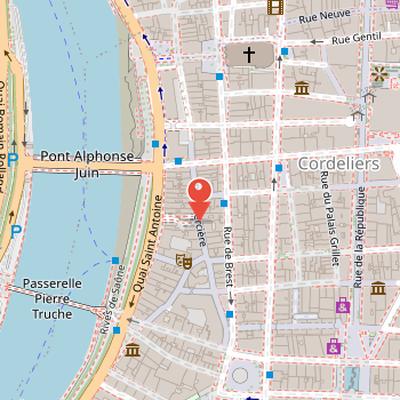
Nearby Objects
-
 Rue de Brest 40 m away
 -
 Rue Grenette 130 m away
 -
 rue Édouard-Herriot 150 m away
 -
 Passage de l'Argue 200 m away
 -
 Place des Jacobins 250 m away
Merciere Street in Lyon's Printing and Commercial History
Rue Merciere is one of the oldest streets in Lyon, confirmed since the Middle Ages. Histoire describes it as the main artery of Lyon on the left bank of the Saone River until the modern era, and it formed part of a dense urban sector of the presqu ile, including the Saint-Nizier district. The street also belonged to an important city axis linking the Rhone bridge, Bourchamin street, Confort street, Merciere street, and the Saone bridge.
Its importance grew during the Renaissance, when it benefited from the prosperity generated by fairs after the Hundred Years' War. Between 1468 and 1470, the consulate authorized owners to renovate and raise buildings on the street, reflecting its urban prominence. Merciere street also concentrated several Lyon families, including Le Maistre, Syvrieu, and Thomassin.
From the 16th to the 17th centuries, the street prospered through trade in cloth, furs, and parchments. It later became especially associated with booksellers and printers, as many printers settled there during the 17th century. From the Renaissance until the Revolution, it was the center of printing in Lyon, with major booksellers, publishers, and printers such as Horace Cardon operating there. The surrounding streets housed the rest of the printing profession and letter founders. Specific sites on the street included Sebastien Gryphe's workshop at the corner of Thomassin street at the beginning of the 16th century, the bookstore of Jean Caffin and Francois Plaignard at the corner of Merciere street and Ferrandiere street, and the workshops of Antoine Pillehotte and Simon Vincent at the other corner of the same intersection.
The street also had a cultural and social role. In the 17th century, it was the location of the Lyon Flemish nation, represented by several artists, including Guillaume Le Roy, Jean de Crane, Lievin Van der Meer, and Mathieu d'Anvers, who lived there. During the Renaissance, near Jacobins square, Jean Dorieu and Isabelle Ciron founded a hospital for widows and poor women on rue Merciere, which municipal authorities managed in 1584. The street's place in literary culture was further reflected in 1694, when Le Grand staged the comedy La rue Merciere ou les maris dupes, set on the street. Histoire also notes the historical novel La Colline aux corbeaux, co-written by Heliane Bernard and Christian-Alexandre Faure, about the printing world in Lyon during the 16th century.
From Planned Demolition to Heritage District
In 1925, the SEL contest aimed to transform the neighborhood, and F. Chollat proposed replacing rue Merciere with a modern district and a skyscraper of about fifty floors. In 1958, the city council decided to renovate the Merciere-Saint-Antoine district. The northern part of rue Merciere was then demolished between the street and the quay for a large real estate project, and architect M. Marot revised the project eighteen times in an effort to respect the charm of the old neighborhood. At the same time, the southern part of the street remained a center for prostitution and brothels until the 1970s. In the 1980s, the Lyon municipality rehabilitated the district with an urban plan around place des Jacobins. The Renaissance architectural heritage of this old Lyon street was renovated, enhanced, and highlighted spectacularly. Near Lyon's Hotel de ville district, the street was pedestrianized together with adjacent streets and became a tourist area with many restaurants, bouchons lyonnais, brasseries, bistros, and bars. It became a major place for Lyonnaise cuisine, favored by locals and international tourists. In 1998, the picturesque street helped Lyon be listed as a World Heritage site as an urban site with preserved historical quarters.
Recent Street Improvements
In 2019, the southern entrance of rue Merciere received the first plant containers for the Presqu'ile greening project. Histoire describes these containers as testers, indicating an initial phase of experimentation. Later, in 2025, the section of rue Grenette between rue Grenette and rue Dubois was pedestrianized. The pavement pattern in this area matches the rest of the pedestrianized street, which dates from about forty years before 2025.