Known locally as rue Édouard-Herriot, this street is one of the main shopping streets of Lyon’s Presqu’île district in France. It connects place Bellecour in the south with place des Terreaux in the north. The northern section is in the 1st arrondissement, while most of the street lies in the 2nd arrondissement.
The street was opened in the 1860s as part of the restructuring of the Presqu’île under Claude-Marius Vaïsse, following a plan that sought to create a new axis through the district. It was first named rue de l’Impératrice, then renamed rue de l’Hôtel-de-Ville in 1870, and later received its present name, rue du Président-Édouard-Herriot, in 1957. Usage often omits the title.
Its built environment largely dates from the second half of the 19th century. Two older buildings at numbers 21 and 23 interrupt the alignment and correspond to the eastern part of the former rue de la Sirène. The street was also widened to form place Francisque-Regaud and place Antoine-Rivoire.
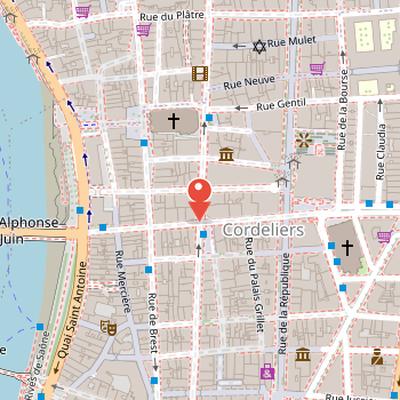
Nearby Objects
-
 Rue Grenette 20 m away
 -
 Rue de Brest 110 m away
 -
 Rue de la République 130 m away
 -
 Rue Mercière 150 m away
 -
 Grand Bazar de Lyon 150 m away
Location and Role in the Presquile
Rue Edouard-Herriot is a street in Lyon, France, known locally by that name. It is one of the main shopping streets of the Presquile district and connects place Bellecour in the south with place des Terreaux in the north. The northern part of the street is in the 1st arrondissement, with even-numbered addresses from 2 to 42 and odd-numbered addresses from 1 to 25. Most of the street lies in the 2nd arrondissement, where the even numbers run from 44 to 106 and the odd numbers from 27 to 105.
Street naming and widening
During its piercing in the 1860s, the street was named rue de l'Imperatrice in honor of Eugenie de Montijo. After the fall of Napoleon III in 1870, it was renamed rue de l'Hotel-de-Ville. A few months after the death of Edouard Herriot in 1957, it received its present name, rue du President-Edouard-Herriot. Odonymie notes that everyday usage tends to omit the title in the street name. The street was also widened at two points, creating place Francisque-Regaud in 1931 and place Antoine-Rivoire in 1934.
Street Configuration
Rue Edouard-Herriot is configured with one row of vertical parking along the street pavement, measuring 2 meters wide. It also includes one automobile traffic lane 3 meters wide and one shared bus-bike lane 3 meters wide, running in the same direction as cars. The street is bordered by two sidewalks. The left sidewalk is 3.5 meters wide, while the right sidewalk measures 3 meters.
Formation and Street Layout
In the mid-19th century, Claude-Marius Vaïsse, then prefect of the Rhone and also mayor, decided to restructure the Presquile following the model of Haussmann's Paris. A plan drawn up in 1853 proposed a new street linking place de la Republique to place des Terreaux, and in the 1860s a straight new axis was cut between place Bellecour and place des Terreaux. The avenue begins at the enlarged place Le Viste and crosses place des Jacobins in its final form. In the process, it partly absorbed existing streets.
Most of the buildings along rue Edouard-Herriot date from the second half of the 19th century. Two older buildings at numbers 21 and 23 interrupt the street alignment; they correspond to the eastern part of the former rue de la Sirene. Another earlier element is the northern facade of the abbaye Saint-Pierre, now the musee des beaux-arts de Lyon, which dates from the 18th century.
Recent street arrangements and uses
Rue Edouard-Herriot underwent several changes in the 1990s, when traffic direction was modified and some lamps were removed. A more substantial rearrangement took place in 2015, replacing bus-bike lanes and parking with a linear green space. This period also featured Presqu ile Nature, a vegetation scheme using wooden containers planted with trees, shrubs, and flowers. The initiative ended with the Covid-19 sanitary crisis, which led to increased bicycle use and the return of the lane in 2020. One month later, the bus-bike lane was reserved exclusively for cyclists, with yellow markings and poles, before later returning to its original use and appearance.
Since 2019, after noise linked to urban rodeo, the street has been closed to cars on Friday and Saturday nights from 22:00 to 04:00. The closure was first indicated by barriers and, since 2023, by signage. Between October 2025 and March 2026, the section between rue Joseph-Serlin and rue Pizay was remodeled with three trees, a planted strip, and benches on a widened sidewalk near the Terreaux tram stop. The street also had festive illuminations as part of the Fete des Lumieres program until 2019, and these illuminations have continued independently since then with more traditional light motifs.
Commercial Role and Luxury Retail
Rue Edouard-Herriot is reputed for its concentration of luxury stores in Lyon, including Louis Vuitton, Cartier, Dior, Longchamp, and Hermes. It forms part of the commercial heart of the city, with rue de la Republique to the east, rue de Brest to the west, and rue Victor-Hugo to the south. In its southern section, it crosses place des Jacobins, where additional luxury points of sale include Sonia Rykiel, Rolex, and Escada.