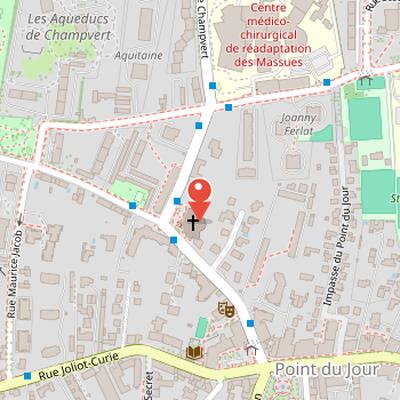
Église Notre-Dame-du-Point-du-Jour is a church building located in the Point-du-Jour district of Lyon. Completed in 1973, it replaced an earlier church known as des Massues. The new church was completed by Louis Beyssac in 1972, following a first church dedicated to Saint Patient that had been built around the middle of the 20th century by Tony Desjardins and demolished in 1973.
The church’s architectural features include a spire symbolizing the biblical tent. Its stained glass windows were made by Jean-Marcel Héraut-Dumas. Inside, the space takes the form of a conchoid surrounded by an ambulatory with an octagonal choir, a feature that symbolizes the resurrection of Jesus. The nave is decorated with an ivory Christ statue from the previous church, which had been brought during Napoleon’s campaign in Spain.
Nearby Objects
-
 Cimetière de Loyasse 1300 m away
 -
 ENSATT 1300 m away
 -
 Saint Irenaeus Church 1400 m away
 -
 Hospice Debrousse 1600 m away
 -
 Fourvière Hôtel 1600 m away
Location and History
The church Notre-Dame-du-Point-du-Jour is located in the Point-du-Jour district of Lyon. It was completed in 1973. The church replaced another church called des Massues, linking it to the later development of the local parish and its built environment.
Church History and Reconstruction
A first church dedicated to Saint Patient was built around the middle of the 20th century by Tony Desjardins. This earlier building was demolished in 1973. The new church, designed by Louis Beyssac, had already been completed in 1972, marking a replacement of the original church on the same site.
Interior Design and Symbolism
The interior of Eglise Notre-Dame-du-Point-du-Jour is shaped like a conchoid and is surrounded by an ambulatory with an octagonal choir. The octagonal choir is said to symbolize the resurrection of Jesus. The spire symbolizes the biblical tent, adding another layer of religious meaning to the building's design. The stained glass windows were made by Jean-Marcel Heraut-Dumas. In the nave, an ivory Christ statue from the previous church is preserved; it was brought during Napoleon's campaign in Spain.