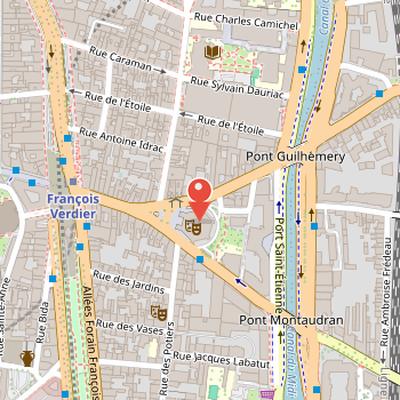
Located near the Canal du Midi in the center of Toulouse, the Halle aux Grains was built in 1861 to receive cereals transported by boats to the port Saint-Sauveur. Designed in 1864 by the city architect André Denat, it has a hexagonal form and is built of red bricks and pebbles. It served as a covered grain market until the 1940s, reflecting its original commercial function at a time when trade via the Canal du Midi began to decline from 1930. In 1952, it was fitted with stands and converted into a performance hall, later also used for events such as rock concerts, variety shows, circus acts, and boxing matches. Since the mid-1970s, it has been the home of the Orchestre national du Capitole de Toulouse, and it is one of the city’s main music venues alongside the Théâtre du Capitole. The hall is recognized for its exceptional acoustic quality, and the city improved its scenography, acoustics, and accessibility in 1988 and 2000.
Nearby Objects
-
 Place Dominique-Martin-Dupuy 50 m away
 -
 Monument aux combattants de la Haute-Garonne 200 m away
 -
 Toulouse Cathedral 350 m away
 -
 Hôtel de Lestang 400 m away
 -
 Palais Niel 400 m away
Concert Hall in Central Toulouse
The Halle aux Grains de Toulouse is a concert hall located in the city center of Toulouse. It serves as a cultural venue in the heart of the city and is home in residence to the Orchestre national du Capitole de Toulouse. Its present use is centered on musical performance, making it an important site for orchestral activity in Toulouse.
Architecture and Later Cultural Use
Located near the Canal du Midi in the center of Toulouse, the Halle aux Grains de Toulouse has a hexagonal architecture built of red bricks and pebbles. It was constructed in 1861 to receive cereals transported by boats to the port Saint-Sauveur, and it served as a covered grain market until the 1940s. Today, it is one of the main music venues in Toulouse, alongside the Theatre du Capitole, and it is known for its exceptional acoustics.
From Market Hall to Concert Venue
The Halle aux Grains de Toulouse was designed in 1864 by the city architect Andre Denat. Its later history reflects a major change in use: after commercial exchanges via the Canal du Midi began to decline from 1930, the building was converted in 1952 into the Palais des Sports, with stands fitted for performance use. From that point, it hosted a wide range of events, including rock concerts, variety shows, circus acts, and boxing matches.
The building became especially important for music in the mid-1970s, when it became the home of the Orchestre national du Capitole. Michel Plasson directed the orchestra there, and in 1974 Michel Plasson discovered the venue. The Orchestre du Capitole also performed the complete symphonies and concertos of Ludwig van Beethoven at Histoire. Since then, the hall has been recognized for its acoustic quality.
The city hall later improved the venue's scenography, acoustics, and accessibility in 1988 and again in 2000. The hall also accommodated the Victoires de la musique classique ceremonies on two occasions. Its stage includes mobile platforms designed to quickly place a piano on stage, and its seating layout allows an audience to gather around the orchestra.