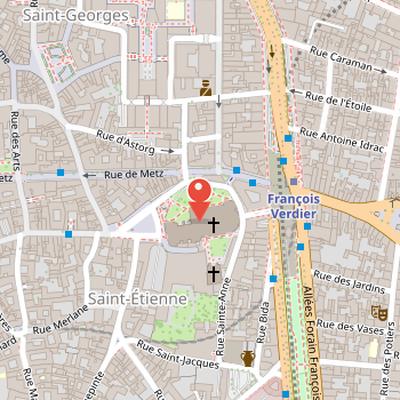
Toulouse Cathedral is a Roman Catholic cathedral located in the historic centre of Toulouse, in the Haute-Garonne department of France. It gave its name to the surrounding neighborhood and stands next to the former episcopal palace, now occupied by the prefecture. The origins of the cathedral are unknown, though the earliest traces date back to 1071. Histoire states that it was built on chapel foundations constructed by Saint Saturnin in the 3rd century and later rebuilt by Saint Exupère.
The building’s architecture brings together elements from different periods, reflecting a long history of modifications, renovations, and reconstructions. Plans of the Romanesque church were repeatedly altered until the 13th century, and the cathedral was later extended by a Gothic church begun in 1272 under Bishop Bertrand-de-L’Isle. The structure includes a southern Gothic section at the rear and a Gothic rayonnant choir, joined in the 15th century by the future cardinal Jean d’Orléans. Its choir is twice as wide as the nave, creating a broken line in the central aisle. The cathedral also preserves later changes, including a vaulted choir roof rebuilt by Pierre Levesville in 1609 after fire damage.
Nearby Objects
-
 Monument aux combattants de la Haute-Garonne 130 m away
 -
 Hôtel de Lestang 200 m away
 -
 Place Dominique-Martin-Dupuy 300 m away
 -
 Palais Niel 300 m away
 -
 Place Saint-Georges 300 m away
Location and Historical Layers
Toulouse Cathedral is a Roman Catholic cathedral located in the historic center of Toulouse, in the Haute-Garonne department in France. It gave its name to the surrounding neighborhood. The origins of the cathedral are unknown, but the earliest traces date back to 1071. When the building was in ruins, Bishop Isarn de Lavaur decided to rebuild it. Its architecture includes elements from various periods, reflecting this long history. The cathedral is adjacent to the former episcopal palace, which is now occupied by the prefecture.
Architectural History and Later Transformations
Histoire describes Toulouse Cathedral as a building shaped by successive modifications, renovations, and reconstructions. Its origins are linked to chapel foundations said to have been constructed by Saint Saturnin in the 3rd century, and the chapel was later rebuilt by Saint Exupere about 150 years after its initial construction. The plans of the Romanesque church were then modified constantly until the 13th century, and the south wall shows a visible revision in window height, while the later north wall does not present the same anomaly. A rose window on the western wall is described as being inspired by Notre-Dame de Paris.
The building contains two distinct parts: a southern Gothic style section at the rear and a Gothic rayonnant choir. The future cardinal Jean d'Orleans joined the two churches in the 15th century. The choir is twice as wide as the nave, which creates a broken line in the central aisle. The southern Roman wall was extended by the Gothic church, a project that began in 1272 under bishop Bertrand-de-L'Isle. Histoire also notes that the Gothic church underwent many additions and unfinished projects. The choir roof was vaulted by Pierre Levesville in 1609 after fire damage, and the original ceiling height planned at 32 meters is now vaulted at 25 meters.
The cathedral later received new furniture blending Baroque and Gothic styles to replace furnishings destroyed by fire. Its masonry, window, and facade were restored in the early 2000s, but urban pollution and tire burning blackened the restored stone again within a few years. The last major state transformation was the completion of the north transept facade in 1938. The Roman fortified tower houses a carillon of 17 keyboard bells and 5 swinging bells. Saint-Etienne cathedral is the seat of the local archbishop in Toulouse, gathers between 300 and 800 parishioners every Sunday, and receives about 1,500 people for major diocesan celebrations. The building was classified as a historic monument in 1862.
The Bells and Carillon
Toulouse Cathedral contains a notable set of bells distributed across the exterior of the building. The bell tower holds 17 sacred bells, and there are also 3 civil clock bells at the top of the tower. In addition, the cathedral includes a chapter bell in the campanile on the Gothic nave and a small sacristy bell. Its carillon was recast during the Revolution and then reconstituted in stages. In 1922, six bells were cast in Toulouse by A. Vinel, and at that time the instrument could be played with 13 bells on the keyboard and 6 at the bell ringer's bench. During the 1960s, electrification led to the abandonment of two manual modes of playing. The number of swinging bells later increased to five in 1992, when two Paccard bells from Annecy were added. The carillon can also be played from the sacristy at the other end of the cathedral using a small electric keyboard.
The cathedral in Toulouse is also noted for preserving the most ancient bells predating the Revolution. It served as the repository for large bells from Toulouse convents, including Flos Carmeli, la Cordeliere, and l'Augustine. The bells Cordeliere and l'Augustine are no longer present and were replaced by the bourdon Etienne-Florian, cast in 1876 by Amans Levque of Maison Louison in Toulouse and funded by future Cardinal Desprez.
Early Christian Origins and Medieval Construction
A Christian community has existed in Toulouse since Antiquity, and Saint Saturnin is identified as its first bishop, martyred in 250. The cathedral Saint-Etienne appears in texts in 844. Between 1071 and 1105, Bishop Isarn launched the construction of a Romanesque building dedicated to Saint Etienne. Toulouse Cathedral is also noted as the only church in Toulouse to preserve original stained glass from the 12th century, giving it a rare place in the citys architectural heritage.
Interior Architecture and Medieval Rebuilding
The Romanesque building was described as three vessels with a western massif and two towers. Parts of this earlier church still survive in the present structure, including the lateral walls of the nave with oculi made of alternate brick and stone, as well as remains of the north tower, which are embedded at the base of the great bell tower. Remains of the north gallery of the canons' cloister also survive, and the north side remains can be seen from Square Cardinal Saliège. The cloister and convent buildings of the canons were located near the northeast of the current choir, where rue Sainte-Anne and later buildings now stand, while the Saint-Jacques church closed the complex to the south.
In the 1210s, Bishop Foulques decided to rebuild the nave. He raised the lateral walls of the Romanesque church to launch rib vaults over the three vessels, and extended the cathedral by one bay to the west. This western addition was closed by a facade with a rose window of Cistercian influence, reflecting Foulques' membership in the Cistercian order. The Saint-Etienne nave was described as raymondine and long attributed to Count Raymond VI of Toulouse. It formed an early southern Gothic space with a large single-span volume supported by strong buttresses. The architecture was sober, with large wall surfaces balanced by large vaults that may have been the widest in western Europe at the time of completion. The vaults rest on pilasters that reuse Romanesque capitals from the earlier cathedral.
In 1275, under Bishop Bertrand de l'Isle-Jourdain, the great choir was built in radiating Gothic style. The project aimed to replace the old nave with a structure twice as wide and brighter, while preserving three of the five original bays of the mother gothic nave in southern lands. Access to the cathedral was through the western portal.
Interior Features and Artworks
The interior of Toulouse Cathedral contains several notable paintings and sculptural works arranged across different parts of the church. On the counter-faade are paintings including Christ on the Cross appearing to Saint Bernard, an oil on canvas classified as a historic monument. Above the door are The Last Supper and The Passage of the Red Sea, both oils on canvas and also classified as historic monuments. The right side includes the Chapel of the Agony, while the left side of the counter-faade contains the Chapel of Saint Anthony of Padua, from which access is available to the bell tower.
Among the sculptural works, The Virgin of Pity by Gervais Drouet is a painted terracotta piece with the dimensions h=203, l=155, d=104. It is classified as a historic monument and bears the date 1654 engraved on its base. The work was commissioned by the merchant Sebastien Taffin for the Saint Sernin basilica, first displayed in the choir, and later moved to the Sacred Heart chapel. During the Revolution it was sold in 1789 on the square, before sculptor Jean-Baptiste Julia acquired it and returned it to the cathedral nine years later. It was restored in 1992 by the Reynard Dubis company and again in 2012 by Elise Rachez and Stephane Moreau.
The pulpit is located on the way to the Raimondine nave altar and is crowned by a terracotta group by Antoine-Joseph Salamon representing Saint Stephen taken to heaven by angels.
Interior Features and Construction History
The interior of Toulouse Cathedral brings together elements from several periods of construction and later alteration. The building work is traditionally placed around 1272 to 1277, although the exact start date remains uncertain. Bishop Bertrand de L'Isle is linked to the initiation of the choir construction. The cathedral belongs to a group of major southern cathedrals influenced by the Ile-de-France style after the Albigensian conflict, and it is also related to the Cathedral of Narbonne, an early precursor in introducing Rayonnant Gothic to the Midi before Toulouse followed.
Construction continued over a long period. The last western bays were raised at the end of the 14th century and the beginning of the 15th century. The last piers were made thicker, which suggests that a transept was planned but never built. After a fire, the vaulting was completed in 1609. In the 17th century, the chapels were divided by partitions that blocked circulation.
Among the interior furnishings are the fonts on the left side, with a circular basin resting on a polygonal base. Several inscriptions are engraved on the basin, including the date 1305. These fonts are listed as historic monuments. The interior also contains two paintings: The Death of Saint Etienne by Nicolas Sebastien Froste in 1822 on the right, and The Stoning of Saint Etienne by Charles Thevenin in 1829 on the left. Another notable feature is the crypt of Pierre-Paul Riquet, promoter of the Canal du Midi, accessible under a slab near the pillar d'Orleans. The crypt slab is classified as a historic monument.
Interior Features of Toulouse Cathedral
The interior of Toulouse Cathedral combines Gothic architecture with later artistic additions. The choir is Gothic and contains wooden stalls that were formerly enclosed by a rood screen, together with a choir organ and a platform for the choir. It ends with an episcopal necropolis beneath the altar, reached by several steps bordered by a balustrade. In the choir, a stone retable was built between 1667 and 1670 by architect Pierre Mercier and sculptor Gervais Drouet. Its central scene represents the stoning of Saint Etienne, and its decoration includes the tetramorph, arranged as Luke with a bull, Matthew with an angel, Mark with a lion, and John with an eagle, with scallop shells at the two ends. Nearby, the altar and marble tabernacle are in Louis XV style and are classified as historical monuments, along with two white marble adoring angels. These elements were stolen in 2006 and restored in 2012 by Elise Rachez and Stephane Moreau.
The cathedral also contains notable paintings and choir fittings. The transept wall shows the organs and, below them, The Triumph of Joseph by Hilaire Pader, painted in 1657 and classified as a historic monument. On the same wall near the lateral door is La Visitation by Jean-Pierre Rivalz, also classified. Two further classified oil paintings by Hilaire Pader stand on both sides of the left lateral door: The Sacrifice of Abraham on the left and Samson massacring the Philistines on the right. The retable painting represents the Assumption of the Virgin by Jean-Francois Faure and is classified as a historical monument, and a classified oil on canvas of the Holy Family is placed on the right side. The main altar retable by Gervais Drouet, made between 1662 and 1670, and choir grilles by Bernard Ortet dating from 1766, also form part of the interior decoration.
Interior Chapels and Decorative Heritage
The interior of Toulouse Cathedral is organized around a series of chapels, each with its own history, dedication, and decorative elements. The choir is enclosed and serves the chapels, linking this interior ensemble into a coherent sacred space.
Several chapels preserve traces of changing dedications and later restorations. The Notre-Dame-des-Anges chapel was erected under the episcopate of Jean d'Orleans in the early 16th century and is dedicated to the Virgin, as indicated by the keystone symbol. Its gilded wooden retable representing the Assumption was destroyed, but the chapel was restored from 1872 to 1873 under the direction of architect Edmond Chambert. It also contains a sculpted group by Mathieu showing the Virgin surrounded by angels, along with a neo-Gothic altar and tabernacle created by the same artist.
The Saint-Vincent-de-Paul chapel began under Bertrand de l'Isle and was completed in the first half of the 17th century. Its keystone features Saint Dominic's effigy, reflecting its original dedication to Saint Dominic before it was later rededicated to Saint Vincent de Paul after the concordat. Saint Vincent de Paul studied theology at the University of Toulouse from 1597 to 1604. The chapel also contains a retable painting by Jean-Francois Faure dated 1820, which is classified as a historical monument, as well as relics of Jeanne de Toulouse.
Other chapels retain important artwork and memorial objects. The Saint-Augustin chapel was initially dedicated to Saint Catherine, whose image appears on the keystone and on stained glass below the Annunciation, accompanied by symbols of martyrdom. Above the altar are two copies of Perugino paintings representing Saint Augustine and Saint John. A marble bust of Jean-Augustin Germain, Archbishop of Toulouse from 1899 to 1928, is placed on the left side and is classified as a historical monument.
The Sainte-Germaine chapel has undergone several changes in dedication: it was initially dedicated to Saint Nicolas, then to Saint Francois de Paule, and in 1876 it was dedicated to Sainte Germaine de Pibrac. Its stained glass illustrates the life of Saint Francois de Paule, and the chapel was restored in 1878 with five painted panels by Bernard Benezet. It also contains the burial place of two inquisitors, canons of Saint-Etienne, killed in 1242 at Avignonet by Cathars from Montsegur. On the left side stands a life-size statue of Cardinal Florian Desprez by Henri Maurette dated 1898, classified as a historic monument.
Additional chapels preserve restorations, reliquaries, and classified furnishings. The Sainte-Croix chapel was restored in 1879 and contains a reliquary made of painted metal, registered as a historic monument. It also benefited from a restoration by architect Auguste Virebent from 1842 to 1847, who created its Gothic terracotta decor and niches closed by bronze grids holding relics of different saints. An oak wood confessional in the chapel is also classified as a historical monument. The former chapel of Notre-Dame des Brassiers, built by Archbishop Bernard de Rousergue in the 16th century, was modified by Jacques-Jean Esquie between 1850 and 1856 and is now dedicated to the Sacred Heart; the keystone of the first chapel, bearing the arms of Bernard de Rousergue, is preserved at the Musee des Augustins de Toulouse.
The cathedral also includes later memorial and devotional spaces such as the chapel of Sainte Jeanne d'Arc, dating from 1279 and redecorated in 1922 after the canonization in 1920. It became a memorial for soldiers of the parish fallen in 14-18, with statues of Sainte Clotilde on the right and Sainte Genevieve on the left. The Chapel Saint-Francois-Xavier, completed in 1279 and originally dedicated to Saint Martin, was remodeled and restored from 1843 to 1846 before being consecrated to Saint Francois-Xavier. It contains a painting by Faure showing Saint Francois-Xavier preaching to Indians, classified as a historical monument.
Other notable works include the cenotaph of Joseph and Jean Francois Sylvestre Roux de Puyvert in Chapel Saint-Roch, a polychrome marble work by sculptor Francois Lucas from the 18th century, and an oil on canvas attributed to Bertrand Francois depicting Saint Francois de Sales giving the rule to Sainte Jeanne de Chantal, which is listed as a historical monument. Chapel Saint-Pierre, completed in 1286 and hosting 24 canons whose group was created in 1259, preserves a 17th-century altarpiece with a painting of Saint Pierre healing a paralytic; both are classified as historical monuments. Other painted works in the cathedral include Jean-Baptiste Despax's Salomon holding the plan of Jerusalem, his painting of Zacharie visited by the angel announcing the birth of John, and two former ceiling panels from the chapel of the Black Penitents, all preserved within the interior ensemble.
Interior Monuments in the Cathedral
The interior of Toulouse Cathedral includes several funerary monuments and related sculptures. Behind the main altar is the monument of Henri de Sponde, identified as a bust and sepulchral monument of the former bishop of Pamiers. The cathedral also contains the funerary monument and funerary plaque of Henri de Sponde. Another important work is the tomb of Antoine de Lestang by Arthur Legoust. This monument was initially placed in the choir before being moved to the ambulatory surrounding the right portal. In connection with this tomb, the statue of Lestang's wife, Honor ee de la Chaluppie, was replaced by a Virgin and Child by the same artist, set opposite the statue of Lestang. The south ambulatory is also part of the cathedral's interior arrangement and forms the setting for these works.
The Cathedral Organs
The cathedral's organs are located in the Gothic part of Toulouse Cathedral and form an important part of its interior heritage. The initial organ dates from 1612, with the woodwork made by Antoine Lefebvre in the same year. Over time, the instrument was enlarged and restored several times: it was augmented by Jean de Joyeuse in 1677 and by Pierre de Montbrun in 1738, then restored by Jean-Francois L'Epine in 1761, Jean-Baptiste Micot in 1772, and Gregoire Rabiny in 1787.
The tribune organ is a large instrument, weighing about thirteen tons and measuring ten meters wide. It is hung on a vertical wall in a form described as en nid d'hirondelle. In 1852, Aristide Cavaille-Coll carried out a conservative reconstruction of the instrumental part, reusing much of the old pipework and adding new bellows and mechanics. The organ was completely restored by Alfred Kern in 1977, and Jean Ferignac restored the buffet. The tribune organ has 47 stops on 4 manuals and pedalboard, with mechanical key and stop actions. It is classified as Monument Historique.
The choir organ, by Aristide Cavaille-Coll, dates from 1868 and is also classified as Monument Historique. It has 12 stops on two manuals and pedalboard, and uses mechanical transmissions.
Tapestries, Relics, and the Choir
Toulouse Cathedral conserves four tapestries representing La Lapidation de saint Etienne, the birth of Saint Stephen, a baptism scene, and Bapteme. These works are classified and are the surviving pieces of a Tenture de l'histoire de Saint Etienne commissioned by the chapter around 1532 to 1534 from the licier Jehan Pechaut. They were made from cartoons by Charles and Comes Pinfault, then later augmented by a commission from Jean Daffis and woven between 1608 and 1661 by Jean Dumazet. The tapestries were intended to decorate the area above the paneling of the stalls.
The cathedral also preserves the relics of the blessed Jeanne de Toulouse. In 1805, during the destruction of the Carmes convent, the relics were found embedded in the church wall, together with documents placed there in 1688 that attested to their authenticity. The relics were transferred to the cathedral and placed in the Chapel of Saint Vincent de Paul. In 1893, they were exhumed and placed in a reliquary at the wall of the chapel.
A further feature of the cathedral's life is the singers of Saint-Etienne, created in 1936 at the request of Monseigneur Saliege. This choir consists of about forty singers aged between 8 and 20 years. They perform the mass and vespers, and wear a cross potenclee like that of the chapter.