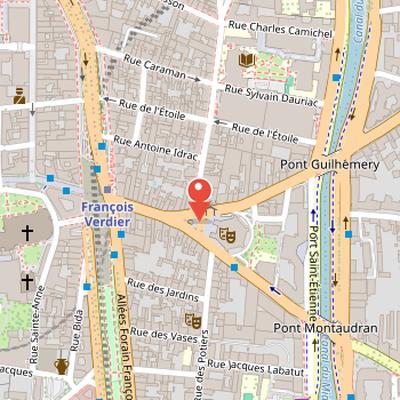
Place Dominique-Martin-Dupuy is a public square in Toulouse, the capital of the Occitanie region in southern France. It is located in the heart of the Dominique-Martin-Dupuy district, in sector 1 - Centre. The square connects Rue des Frères-Lion, Rue Pierre-Paul-Riquet, Rue du Pont-Guilheméry, Rue de la Charité, Rue du Pont-Montaudran, and Rue des Potiers. It is crossed and directly served by city bus lines, especially the Linéo network, and is located near the François-Verdier metro station. A VélôToulouse self-service bike station, named station place Dominique-Martin-Dupuy, is also located nearby. The square is named in honor of Dominique Dupuy, born in Toulouse, who served as a soldier, later became a merchant, and took part in the French Revolutionary and Egyptian campaigns. He was also appointed to govern Cairo before dying after being mortally wounded during a revolt there.
Nearby Objects
-
 Halle aux Grains 50 m away
 -
 Monument aux combattants de la Haute-Garonne 150 m away
 -
 Toulouse Cathedral 300 m away
 -
 Hôtel de Lestang 350 m away
 -
 Palais Niel 400 m away
Location of Place Dominique-Martin-Dupuy
Place Dominique-Martin-Dupuy is a square in Toulouse, the capital of the Occitanie region in southern France. The available information identifies it as a public urban space within the city, but provides no further details about its design, history, or use.
Location and Access
Place Dominique-Martin-Dupuy is a public square located in the heart of the Dominique-Martin-Dupuy district in sector 1, Centre. It acts as a connecting point for Rue des Freres-Lion, Rue Pierre-Paul-Riquet, Rue du Pont-Guilhemery, Rue de la Charite, Rue du Pont-Montaudran, and Rue des Potiers, all reached in ascending numerical order. The square is crossed and directly served by city bus lines, especially the Lineo network. It is also located near the Francois-Verdier metro station, with Lineo and bus services stopping nearby. In addition, a VeloToulouse self-service bike station, named station place Dominique-Martin-Dupuy, is available on site.
Naming and historical reference
The square is named in honor of Dominique Dupuy. He was born in the family house on rue des Arts in Toulouse, the son of Jean, a master baker, and Paule Bertrand. After serving as a simple soldier in the regiment d'Artois in 1784, he later established himself in Toulouse as a merchant. During the French Revolution, he became a member of the Societe des Amis de la Revolution and enlisted in 1791 in the first battalion of volunteers of Haute-Garonne. His battalion was later amalgamated into a demi-brigade in 1793 and then into another demi-brigade in 1796, where he rose to the rank of lieutenant-colonel. Dupuy also took part in the 1798 Egyptian expedition alongside Napoleon Bonaparte, fought in the Battle of the Pyramids, and was assigned to govern Cairo. He was mortally wounded during a revolt in Cairo and died on an unspecified date.
Naming History of Place Dominique-Martin-Dupuy
The place has undergone several name changes that reflect shifts in French political history. It was first named place Dauphine in 1781 to celebrate the birth of Louis-Joseph, son of Louis XVI and Marie-Antoinette. Odonymie identifies Louis-Joseph as the Dauphin of France, although his exact birth date is not specified.
During the French Revolution, the name changed in 1794 to place Beauvais. This new name honored Charles Nicolas Beauvais de Preau, who had served as a deputy to the Legislative Assembly in 1791 and to the National Convention in 1792. He was later sent on a mission to the Var, was overwhelmed by the insurrection in Toulon, and was imprisoned by royalists before being freed in 1793. He died of exhaustion in Montpellier in 1794 and was then declared a martyr of liberty.
The place reverted to the name place Dauphine in 1814 during the Restoration. In 1830, after the start of the July Monarchy, it was renamed Pierre-Paul-Riquet. At a later date, the city council led by Joseph Viguerie decided to give the place its current name in honor of General Dupuy.
The Dupuy Column at Place Dominique-Martin-Dupuy
The Dupuy column was built west of the square, aligned with rue des Freres-Lion and rue Pierre-Paul-Riquet. The project, honoring General Dominique Dupuy, was entrusted to architect Urbain Vitry in 1832, and the column was completed in 1834. Its base was designed with a round basin in Carcassonne stone to receive water from the fountain at the foot of the monument.
The pedestal consists of a double square base. The lower stone base is framed by four seated bronze griffins that expel water into the basin. Above it sits a second base of Saint-Beat marble. On the west side of the pedestal is a bas-relief of General Dominique Dupuy by Bernard Griffoul-Dorval, and the bust of the general is placed within an oculus surrounded by garlands. The bas-relief is flanked by two howitzers. Three faces of the pedestal carry inscriptions, including a homage attributed to Napoleon Bonaparte.
Rising above the pedestal is a cast iron column decorated with fluting on the upper two-thirds. The monument is topped by a bronze sculpture of Renommee by Jean Rancy, using the figure that originally crowned the Toulouse Capitole Archive tower. Renommee is shown as a nude female draped in antique style, standing on one foot and extending her arm to award a victory crown.
Halle aux Grains at Place Dupuy
Built between 1862 and 1864 at the center of Place Dupuy, the Halle aux Grains was designed by architect Andre Denat. Patrimoine et lieux d'interet gave the building a hexagonal plan, with four small pavilions at the corners and two lateral entrance wings. Decoration was concentrated on these entrance wings. The hall was built in brick and Garonne pebbles, originally covered with render and later left exposed after the 1985 renovation. In 1884 and 1885, the two entrance pavilions were raised by one floor. In 1946, under architect Jean Montariol, the Halle aux Grains was transformed into a sports and performance hall. During that conversion, the metal framework was replaced with concrete, with only the lantern and its metal covering preserved.