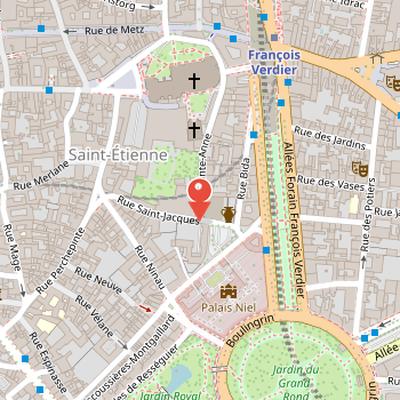
Hôtel de Lestang is an hôtel particulier in Toulouse, occupying a quadrilateral bounded by rue Saint-Jacques, place Saint-Jacques, rue Montoulieu-Saint-Jacques, and impasse Saint-Jacques. It was constructed after 1593 for Christophe de Guilhon de Lestang, bishop of Lodève, who acquired the property and assembled several parcels before beginning the work in 1593. The building belongs to the late Renaissance tradition of Toulouse’s hôtels particuliers from the late 16th and early 17th centuries. Its façade on place Saint-Jacques is comparable to the hôtels de Clary and de Chalvet, while the large portal on rue Saint-Jacques is styled after 17th-century classical architecture. The site was partially listed as a monument historique in 1947. From the mid-20th century, it was used by the rectorat of Toulouse, and the ninth administrative court of appeal was inaugurated in Toulouse in 1987.
Nearby Objects
-
 Palais Niel 90 m away
 -
 Toulouse Cathedral 200 m away
 -
 Monument aux combattants de la Haute-Garonne 250 m away
 -
 Grand Rond 300 m away
 -
 Hôtel Mansencal 300 m away
Architecture and Later Use
The Hotel de Lestang is an hotel particulier in Toulouse, located at rue Saint-Jacques and rue Montoulieu-Saint-Jacques. It was constructed after 1593 for Christophe de Guilhon de Lestang, bishop of Lodave. The building occupies a quadrilateral site bounded by rue Saint-Jacques, place Saint-Jacques, rue Montoulieu-Saint-Jacques, and impasse Saint-Jacques.
Its architecture belongs to the late Renaissance style typical of Toulouse's hotel particuliers from the late 16th century and the early 17th century. The facade on place Saint-Jacques is comparable to those of the hotel de Clary and the hotel de Chalvet. On rue Saint-Jacques, the building has a large portal styled after 17th century classical architecture. The Hotel de Lestang was partially listed as a monument historique in 1947.
From the mid-20th century, the building was used by the rectorat of Toulouse. The ninth administrative court of appeal was inaugurated in Toulouse in 1987.
16th-Century Ownership and Political Role
According to the history of the site, nine buildings belonged to several owners in the 16th century. Shortly after 1571, two of these buildings passed to Urbain de Saint-Gelais, bishop of Comminges. He was later appointed governor of Toulouse by the parliament. In 1572, he rang the alarm bell at the Dalbade church on a Sunday and gathered armed men to expel the marshal of Joyeuse from the archbishopric. These events place the property within a broader context of local power and conflict in Toulouse during the period.
Construction and Early Ownership
Christophe de Lestang began assembling the property in 1590, when he acquired a first house. He then brought together nine parcels to form the site for his hotel particulier, and construction began in 1593. The owner belonged to a noble family of the Limousin robe nobility. His father, Etienne de Guilhon, was an advocate to the Bordeaux parliament, lieutenant general, and president at the Brive presidial, while his maternal grand-uncle, Jean de Selve, had been first president at the Paris parliament. Christophe's brother Antoine de Lestang also held public office, serving as consul of Brive and president of the Ligue parliament in Toulouse in 1592.
Christophe de Lestang had an important ecclesiastical career alongside the creation of the residence. He was appointed bishop of Lodive in 1580 at the age of 21, met King Philip II of Spain in 1591 to thank him for sending troops to Languedoc, and later became bishop of Alet in 1594 and bishop of Carcassonne in 1604. He was also abbot of Uzerche, La Grasse, and Montoulieu, as well as a State councilor. He died in Carcassonne in 1621.
After his death, the hotel passed to Christophe Meynard de Lestang, his nephew, son of Jeanne de Guilhon de Lestang and Francois de Meynard. Christophe Meynard de Lestang left the hotel to his son Jacques in 1669. Jacques served as a counselor at the parliament from 1670 to 1680, and after his death the property was inherited by his son Daniel Meynard de Lestang. The hotel remained in the Meynard de Lestang family until the French Revolution.
Later Uses and Transformations
In 1857, the city of Toulouse bought the old Hotel de Lestang for the rectorate's services. Two years later, a monumental gate was built on Rue Saint-Jacques to serve as the rectorate entrance. The building was restored several times, notably in 1899 and 1909. Major works began in 1961 under rector Paul Dottin to enlarge the rectorate's premises, and a new building was constructed on the site of the old commons that same year. The rectorate remained in the Hotel de Lestang until 2015. Nearby, new premises were scheduled to house the Toulouse Administrative Court of Appeal in 2021, with jurisdiction over appeals from the administrative courts of Montpellier, Nimes, and Toulouse.