The Hôpital de la Charité de Lyon was a former hospital built in Lyon to receive orphan children and indigent people. Intended as a charitable institution, it formed part of the city’s response to social need. The hospital was destroyed in 1934 due to unsanitary conditions. Today, only the church bell tower has been preserved.
The bell tower was constructed based on a sketch by Bernini, making it the remaining architectural element associated with the former hospital. As the last surviving part of the site, it recalls the history of a place that was both a medical and charitable institution in Lyon. The Hôpital de la Charité de Lyon is therefore significant not only for its former function, but also for the survival of its tower after the demolition of the rest of the complex.
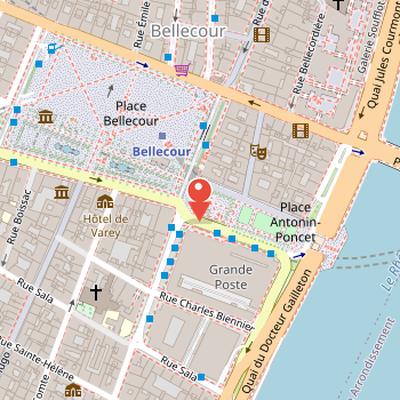
Nearby Objects
-
 Antonin-Poncet Square 80 m away
 -
 Rue des Marronniers 140 m away
 -
 Bellecour School 140 m away
 -
 Église Saint-François-de-Sales 200 m away
 -
 Place Bellecour 200 m away
Hopiital de la Charite de Lyon
Hopital de la Charite de Lyon was a former hospital in Lyon intended to receive orphan children and indigent people. The complex was destroyed in 1934 because of unsanitary conditions. Only the church bell tower was preserved. This bell tower was constructed based on a sketch by Bernini, making it the main surviving element of the former hospital.
Origins of the Aumone Generale
The origins of the Aumone generale between 1531 and 1533 were linked to a period of severe hardship in the Lyon region. Agricultural yields fell after the drought of 1529, while food prices rose sharply, leading to numerous riots that same year. In 1530, high food costs coincided with plague. The situation worsened in 1531, when famine affected Lyon and the surrounding area. Poverty also drove significant population migration into Lyon. These conditions formed the context in which the Aumone generale emerged.
From Temporary Relief to a Permanent Charity
The origins of the Aumone generale in Lyon began with a charitable office established at the Couvent des Cordeliers de Saint-Bonaventure during the period of 1531 to 1533. In its early phase, the initiative was organized through commissioners assigned to different parts of the city, including the right bank of the Saone and the Presquile. It also relied on a broad base of support, receiving financial contributions from the consulate, the clergy, Florentines, Lucquois, and many individual donors recorded in the gold book of the Hopital de la Charite.
The first major effort was temporary relief during the famine crisis of 1531. From March 15 to May 5, 1531, the office provided food to the needy for fifty-two days and is said to have saved 12,111 people from famine through temporary alms. When this emergency aid ended, the commissioners asked the needy to leave the city on May 5, 1531. The temporary campaign ended with a small financial balance of 2 sols and 7 deniers, and this fund was kept for the future constitution of the Aumone generale. Even after the temporary alms ended, poverty and begging continued in Lyon.
A large assembly held at the Couvent des Cordeliers de Saint-Bonaventure on May 22, 1531, marked an important step toward permanence. Pierre Dorlin presented the financial account management, and Jean Broquin proposed making the charitable office permanent. The assembly unanimously voted to create the Aumone generale. The planned framework included three ordinances: one for feeding the poor, one for appointing commissioners, and one for collection. The ordinance to feed the poor also included education and hospitalization for orphans and poor sick people. The collection ordinance provided for locked boxes for donations, while the commissioners ordinance regulated the election and appointment of officials to distribute alms tickets.
The institution aimed to stop begging in Lyon by distributing bread to poor and disabled inhabitants. It also excluded foreign migrants from the city, with one unspecified exception, and set rules for recipients of alms, including a ban on begging under penalty of whipping and a prohibition on frequenting games, brelans, and taverns. Weekly alms were to be given as bread and 12 deniers at five sites, while poor travelers and pilgrims received daily alms in money at the Couvent des Cordeliers de Saint-Bonaventure.
The charity extended its work to children as well. Legitimate orphan boys were hospitalized at Hopital La Chanal, and orphan girls at Hopital Sainte Catherine. These hospitals were prepared and equipped to receive orphan children, masters and mistresses were hired to provide education, and a barber-surgeon was assigned to care for the children. The institution began operating effectively from a Wednesday, and its financial results were positive, with a surplus of 1, 2 sous and 2 deniers for the fiscal year. This surplus supported the conclusion that the Aumone could continue its activities.
Its standing was strengthened further when it was presented by Cardinal de Lisieux to King Francois I during the king's visit to Lyon. During that visit, the rectors asked the queen of Navarre for financial assistance, and the institution received multiple financial contributions from Francois I himself. New privileges followed in a royal patent dated October 12, 1532, including exemptions from tolls, levies, and subsidies for all goods used in its work.
Charity, Control, and Child Care
De l Aumone a l hospice de la Charite was weakened by the wars of religion at the beginning of the 17th century, but it responded with a new general regulation titled Institution et Economie de l Aumone generale de Lyon. Its financial resources were increased by a court order from the Cour du Parlement, and city notables were required to collect funds for its benefit under penalty of a fine of one hundred livres. Despite disturbances, it continued the work of l Hopital de la Charite throughout the 18th century.
The institution carried a broad charitable mission. Between 1531 and 1534, it took charge of the poorest people, whether foreigners or Lyon natives, and from 1534 to 1791 it distributed money and bread to the indigent. It also created the passade allowance for pilgrims and poor travelers, gave alms to honest families, and distributed bread to poor fathers as well as bread and linen to prisoners. During the 18th century, famines led it to expand new charitable establishments in Lyon.
The hospice also had responsibilities in child reception and protection. Its Recteurs de l Hopital acted as legal tutors and were responsible for orphan maintenance and education costs. Children under its care were called Petits passants and Petites passantes. Reception documents were carefully recorded, with tickets divided into proces-verbaux by public agents and billets left by parents at abandonment. These billets could include the childs first name, sometimes the last name, age, clothing description, parents financial difficulties, requests for care, and promises of return, and they were fully transcribed in reception registers.
By 1758, overcrowding forced the relocation of all children regardless of status and caused a significant reduction in adoptions. From 1783, all child reception was transferred from the Hotel-Dieu to the hospice de la Charite, which was renamed Hôpital general des Enfants trouves et de la Maternite the same year. The institution also housed pregnant girls shortly before childbirth, after which they abandoned their children born out of wedlock. Its registers recorded the mothers civil status, address, profession, dates of entry and exit, and death when applicable, with brief physical descriptions added from the second half of a later century.
Medical Organization and Patient Care at the Charite
The Charite was operated by the service de sante as a primarily non-sick indigent assistance establishment until 1783. In that year, it began to receive pregnant women and newborns, which made it necessary to provide a more advanced medical service when its buildings housed additional categories of patients. The institution was distinguished from the Hotel-Dieu by its role as a hospice for healthy persons rather than for the sick.
Medical care at the Charite relied on a city-renowned doctor, a resident surgeon, several surgeon's assistants, and initially a pharmacist. The pharmacist was later replaced by a hospital sister assisted by several helpers. The doctor became an essential and omnipresent part of the Charite medico-surgical and pharmaceutical service. From the end of the 17th century, doctor visits were required twice weekly, on Mondays at 8 a.m. and Thursdays at 2 p.m.; in the 18th century, visits were scheduled every two days. The doctor could also be summoned for severe or urgent cases at the doctor's discretion.
The service de sante no longer requested Hotel-Dieu doctors for the Charite after 1531 and instead called upon city doctors. Pierre Tolet, a Hotel-Dieu doctor, was engaged at the Charite in 1539 for 10 livres per year. City doctors visited Charite patients on visiting days before returning to private patients. The Charite doctor was paid 10 livres annually until 1627, when a 60 livres lifetime annual pension donation from rector Jean-Jacques Pincetti supported the post. The compensation was increased to 1742 by 1742. The service de sante also customarily gave a small annual allowance to the Hotel-Dieu doctor treating Charite sick patients.
During visits, the doctor was accompanied by the service rector, chief surgeon, surgeon assistant, hospital pharmacy sister, and her student. The doctor examined new patients and recorded their status and medications. The doctor also decided whether patients should remain at the Charite or be transferred to the Hotel-Dieu. If patients stayed, a sister registered their names, room number, bed number, and the doctor's prescription.
Medical Supervision and Patient Management
The health service played a central role in the daily operation of Hopital de la Charite de Lyon. It ensured that dressings were properly applied and supervised the practical work of surgeon students, while also evaluating their skills. It conducted entrance examinations, including examinations for the surgeon-major, and granted approval for the surgeon-major to operate. The service was also responsible for the pharmacy, verifying that medicines were still usable and checking that preparations were correctly made and distributed. In patient care, it directed those with dangerous, long-term, or contagious diseases to Hotel-Dieu. Patients with minor illnesses and scrofula were placed in special infirmaries, and those needing better and more abundant nutrition were redirected to the surgeon-major. These responsibilities show that the health service oversaw both medical training and the management of patients and supplies within the hospital.
Practitioners at La Charite Over Time
The history of Hopital de la Charite de Lyon includes a series of practitioners recorded as having exercised there across several centuries. Pierre Tolet is noted in 1539, followed by Jean Broallier in 1574 and Laurent Dufay in 1585. Later records mention Claude Pons in 1631 and Andre Falconnet in 1642. Jacques Pestalozzi is also listed, although no date is given for his exercise at La Charite. The later sequence continues with Deville in 1697, Guillaume Rey in 1727, Rast in 1740, and Rast de Maupas in 1765. The latest named practitioner in the provided facts is Brac, recorded in 1774. Taken together, these references show recurring activity at La Charite over a long period, from the mid 16th century into the late 18th century.
Barber-Surgeons and Surgical Practice
At Hopital de la Charite, the first surgical practice was carried out by barber-surgeons who originally came from Hotel-Dieu. Their work extended beyond surgery: they were assigned to shave, crop, and care for the hospital boarders. This was a difficult and poorly paid role, with remuneration coming from Hotel-Dieu and from Aumone. In the hospital hierarchy, barber-surgeons held positions that were less respected than physicians, and they were valued more for their barbering skills than for their surgical abilities.
Aumone also regularly called on foreign or external surgeons until the 18th century. These surgeons were responsible for many delicate or common interventions, and the practice of bringing in outside surgeons continued into the 19th century. This arrangement shows that surgical care at La Charite relied on both its own barber-surgeons and outside practitioners over a long period.
Surgeons and Training at La Charite
By the 19th century, Aumone had an organized health service, and the role of surgeons at La Charite had become closely tied to its charitable functions. The service de sante noted that surgeons gained importance as the institution expanded its work among the poor. In 1614, the rectors decided to admit beggars at the Saint-Laurent des Vignes hospital, following the example of other cities. Because surgeons were required to examine beggars in order to avoid contagion risks, the hiring of a permanent surgeon became necessary. The rectors first approached city master surgeons, but they refused because of their contact with beggars. They then turned to a garcon-chirurgien for the permanent duties of surgeon.
The earliest hospital surgeons were recruited through a system that combined practical service and formal examination. Until 1739, candidates for garcon-chirurgien were chosen from orphans at least fourteen years old and had to pass a small exam before the hospital doctor and administration. Those accepted were appointed for two years, lodged and fed, and received 15 livres per month. After two years at La Charite, they received a diploma. In 1739, the rectors introduced a recruitment contest following the example of Hotel-Dieu. Winning candidates received surgery books signed by the hospital bureau and in the laureate's name.
The number of garcons-chirurgien remained limited. La Charite housed only one until the end of the 17th century, and up to four in the 18th century. From 1760, the number was limited to three for reasons of economy. Their daily schedule was strictly regulated from 5:00 AM to 8:00 PM. They maintained the barber shop, shaved and sheared hospital pensioners, carried out dressings, and gave prescribed enemas to girls only in the presence of a sister. They also received surgery lessons twice a week from the surgeon-major and were allowed two outings per week.
The hospital also used its surgeons as a training ground for advancement. In 1619, King Louis XIII authorized the hospital to appoint garcons-chirurgiens as chirurgiens-majors after six years of service. To obtain this title, they passed an exam at the hospital office attended by a physician, a maitre-chirurgien, the king's prosecutor, and the rectors. Success granted them the title of maitre-chirurgien of the city of Lyon and the right to maintain a medical office. Maite-chirurgiens could practice all surgical functions on the condition that they accepted to examine contagious patients, isolate at the hospital if necessary, and train two poor apprentices chosen by the rectors.
Several later reforms made the surgical path more formal and demanding. Candidates had to pass an entrance exam before starting their internship, in the presence of four maitres-chirurgiens, one physician, one counselor, and a substitute prosecutor of the general senechaussee. Exit exams were then held before fifteen maitres-chirurgiens, two physicians, one magistrate, and the king's prosecutor, and reception followed a carefully organized ceremony. After reception, Charity surgeons took the title chirurgien principal or chirurgien-major. In 1771, surgeons-major were required to give public anatomy and surgery lessons twice weekly. In 1783, pregnant women were transferred from Hotel-Dieu to La Charite, and childbirth courses were created, adding further responsibilities to the surgeon-major. In 1788, recruitment for surgeon-major was decided by examination, including oral and written tests on anatomy, physiology, surgical pathology, and childbirth, together with a surgical operation on a cadaver. Future surgeons were also required to train for two years in Paris at La Charite's expense before serving four years as assistant-major in the hospital.
The Surgeon-Major at La Charite
At Hopital de la Charite de Lyon, the service de sante surgeon-major was appointed for a six-year term before a successor was chosen. From 1788 to 1890, the service de sante held a surgeon-major examination every six years, and in 1890 this was replaced by a hospital surgical examination. In 1900, the birth practitioner examination was separated from the general examination. The surgeon-major lived in the hospital, with lodging, food, and laundry provided, and was not allowed to marry or practice outside the hospital.
The surgeon-major had a wide range of responsibilities within the hospital. Working alongside the physician, the surgeon-major took part in patient visits and, after mass, checked the dressings applied by assistants. The role also included verifying the distribution of medication and compliance with special diets, examining newly admitted children for contagious diseases, teaching students, and ensuring cleanliness in hospital spaces. At the physician's request, the surgeon-major performed surgical operations. The post also retained barber duties, including shaving hospital officers. In addition, the surgeon-major managed complex childbirths and taught midwifery students after pregnant women arrived at La Charite.
Pharmaceutical Care at La Charite
Before patients were admitted, the service de sante at Aumone generale and La Charite lacked a pharmaceutical service. At first, the medical service used only a few remedies supplied by Hotel-Dieu during the creation of Aumone. It later received most of the medicines and drugs needed free of charge from Hotel-Dieu, even though conflicts were frequent during the ancien regime. When tensions with Hotel-Dieu increased, the service de sante turned to city apothecaries. A pharmaceutical dispensary at La Charite is mentioned in 1698, managed by girls from the Saint-Lazare community who were serving their probation as hospital workers. The medicines prepared there were intended exclusively for the establishment's patients. The pharmacy sister was forbidden to dispense medicines to outsiders under penalty of losing her employment, and drugs could not be supplied to the chief surgeon or the surgeon's assistants for patients outside the hospital.
Hospital Staff and Religious Service at La Charite
The service de sante describes Hopital de la Charite de Lyon as a hospital with a relatively small staff, where many tasks were carried out by hospital residents. In its earliest form at Aumone generale, the staff included a secretary, solicitor, chaplain, four beadles, a miller, a baker, and schoolmasters. Female staff appeared after male staff and were initially few in number, with 19 women recorded in 1681.
A distinctive feature of the hospital was the presence of brothers and sisters who served directly under the administration. They did not take vows and had no superiors, and they could leave voluntarily or be dismissed, which was said to be rare among hospital communities. The first true hospital brothers arrived at La Charite in the early 17th century, and the first brother, Guillaume Bouchy, called Mauriac, was admitted on an unspecified date. Brothers were relatively few because orphans were mainly used for hospital maintenance. Their roles included assistant surgeons, workshop and manufacture supervisors, treasurers, and accounting clerks. They were gradually replaced by administrative staff and lay nurses. In 1790 there were 17 brothers, and in 1792 there were 9; around 1802 the number had risen to 22 brothers and candidates. Their wages were 18 livres per year, along with lodging, food, maintenance, and fifty low masses after death.
Women at the hospital formed a more structured religious workforce. The first sisters of the Providence of Paris worked at La Charite in 1697, followed by sisters of the Daughters of Charity of Saint Vincent de Paul of Paris in 1698. The hospital board was dissatisfied with their work in 1698 and asked Hotel-Dieu in 1699 to send three crossed sisters and three candidates to organize the service. The sisters were recruited mainly from the Catherines and Thereses, orphaned or abandoned young girls, and were divided into crossed sisters, candidate sisters, and novices. They underwent a long internship to assess their skills. Candidates who were admitted to crossing could wear a silver cross and gold ring. Crossed sisters received lifelong food, lodging, maintenance, cover for incurable illness, and fifty low masses after death. Their salary began at 12 livres per year and later rose to 36 livres, while candidate sisters received 18 livres per year.
The number of sisters increased over time. There were 18 sisters in 1705, 38 hospital sisters and novices in 1786, and 26 sisters in 1792, including five who were retired because of old age. In 1783, the hospital received pregnant women and abandoned children aged from birth to seven from Hotel-Dieu, which increased the number of sisters. Staff totals recorded for 1792 included a priest-economist, three chaplains, a chief surgeon, two surgery students, nine active hospital brothers, two retired brothers, five active hospital sisters, five retired sisters, a doctor, a secretary, an archivist, and an architect. In 1802 the staff included an archivist, notary, architect, economist, 12 clerks, a senior priest, two chaplains, 22 brothers and candidates, and 55 sisters and novices. During the Republic, sisters were required to abandon silver crosses for republican medals and small gold crosses in 1793, and the cross was restored in 1802.
Rules, Discipline, and Social Control
The service de sante at the Hopital de la Charite de Lyon combined religious, disciplinary, and administrative functions. It directed religious services and mass celebrations, administered sacraments, and handled funerals and death record keeping. It also oversaw catechism for Charite boarders and supervised spiritual retreats led by religious staff. During the French Revolution, it replaced chaplains and priests who refused to swear the oath with constitutional priests, then dismissed those priests after the abolition of the religious service.
The service de sante was also responsible for instruction, first for orphan girls known as Catherines and later for abandoned children named Thereses. Beyond hospital care, it took part in controlling begging in Lyon. It employed personnel to seek out and arrest beggars at house and church doors, and to detain repeat beggars at the Charite. Supervisors monitored food distributions and attended the general procession of the poor and major funerals.
Hospital life was regulated in detail. The service de sante issued regulations governing the operation of the hospital and the duties of each individual, and most of these rules were printed. The first Police de lAumone was published by Sebastien Gryphe in 1539, followed by further regulations in 1605, 1628, 1632, 1639, 1647, 1662, 1699, 1742, 1763, and 1766. These rules fixed schedules hour by hour, regulated dress, and required personnel to wear ribbons identifying their service or role.
Discipline was reinforced by rectors empowered by royal letters patent. They could punish those who disrespected the regulations, arrest mendicants inside and outside the hospital, imprison them, and compel work through corporal punishment. They also fined or imprisoned Lyon inhabitants who housed foreign mendicants. Other penalties included death sentences for preventing a Swiss from carrying out his duties, and a one-year banishment for insulting staff during bread distribution. Theft by residents and employees could lead to restricted movement, physical punishment, shaming garments, or dismissal. Women and girls who were dismissed could be confined in the Recluses prison. Rectors also maintained hospital cleanliness in order to limit the spread of disease.
Food Supply and Hospital Workshops
The service de sante provided meals to all individuals within the hospital and organized a structured food supply that changed over time. In 1640, it ordered large iron cauldrons for the kitchens. Hot meat was served to every individual, and by the end of the 17th century residents were eating meat five days per week. In 1742, hot soup was added to the meals. The sick and children received veal and mutton, while the youngest children were given milk and flour-based porridge prepared by hospital nurses. Other foods consumed by residents included eggs, herring, cheese, and potatoes, which were introduced before 1787. A small salary was also paid to all capable hospital inhabitants, equal to a quarter of their production.
Work was another important part of hospital life. Since the founding of the Aumone generale, the service de sante established factories and quickly set up a silk spinning factory. In the 17th century, it installed stocking, dyeing, and other workshops, and in 1672 Louis XIV authorized it to operate various workshops and manufactures. By the 18th century, the hospital was running workshops for dyeing, starching, stocking, hemp spinning, wool spinning, silk spinning, jewelry making, lace making, cloth making, and plaster production. Shoe and clothing tailoring workshops supplied residents and children sent to the countryside by the hospital.
Revolution, Crisis, and Reorganization
From 1790 to 1802, the hospitals in Lyon were placed under state surveillance and lost annual charity revenue, while also facing heavy taxes, irregular and insufficient aid, and growing pressure from general misery and unemployment. The Hôpital de la Charite de Lyon was described as being in a critical condition, without resources or provisions but still burdened with charges. Its finances worsened further when it obtained a national assembly loan guaranteed by the commune, which increased hospital debt, and when its rectors resigned in the face of an insurmountable financial crisis.
The situation was aggravated by wartime and social disruption. During the siege of Lyon, bombings damaged hospital premises and caused food shortages. The institution also had to respond to an increased number of patients and foundlings, and it requested government aid for foundlings whose numbers had risen since the Revolution. A law of the Interior Ministry authorized full repayment of expenses for food and maintenance of foundlings for 1791 and 1792, but the hospital still endured severe shortages, including infant deaths linked to a lack of wet nurses and funds for payment after artificial feeding.
Administration was repeatedly reorganized. Eleven administrators were appointed by the Rhône-et-Loire Directory and Lyon General Council, then reduced to four in 1794, at a time when the hospital fell into ruin and bankruptcy. Debts were later discharged by law in exchange for the nationalization of all property, making the hospital dependent on the state. In 1797, hospitals in the same district were merged under a single administration, and Hôtel-Dieu and Charite were united under one administration. After the Terror, administrators were responsible for reorganizing and rebuilding hospital establishments. Further measures, including the suspension of fiscal prosecutions and other financial arrangements after the First Consul's visit to Lyon, helped the hospitals leave financial deadlock and begin gradual reconstruction.
Charity Hospital Under Revolutionary Reorganization
During the period from the Revolution to the creation of the Hospices civils de Lyon, the Charite hospital was assigned new social and medical roles. It was designated for assisted children, pregnant women, the elderly, and the poor, and it was also described as serving children and pregnant women in particular. The hospital was renamed Hopital general de la Charite, Aumone generale et enfants trouves de Lyon, reflecting its broadened charitable mission. It also treated women with gynecological conditions.
The institution expanded significantly in capacity over time. In 1790, it was reported to have 216 hospital beds, with each patient having individual bedding. Later facts indicate a much larger capacity of 952 beds and 193 cradles. To support these functions, the provisional Charity commission assigned it in Year III to increase the number of womens beds and establish a school of clinical medicine. Architect Nicolas-Marie Clavareau, under the direction of Jean-Nicolas Corvisart, was entrusted with increasing capacity to 500 patients while also creating a clinical school and hospice.
This transformation included major changes to the building itself. The chapel was converted into a student promenade and a waiting room for doctors visits. The medical school was equipped with a pathology room, a morgue for anatomy courses, and an anatomical amphitheater with dissection tables. Before the new clinical school opened, operations were performed directly on patients beds. The school was later inaugurated by Interior Minister François de Neufchateau, and its first lectures were taught by Jean-Nicolas Corvisart.
Administrative changes accompanied these medical reforms. The municipality decided to unite two hospitals under common management in order to rebalance budgets, and the fusion took place in two stages, in 1796 and 1802. The law of 16 Vendemiaire Year V restored hospital properties and created a joint administration for Hotel-Dieu and La Charite, which became functional on 28 Ventose Year V. A decree on 28 Nivose Year X later created a general administrative council for the two hospitals, composed of the department prefect, three Lyon mayors, and fifteen citizens appointed by the minister. This reorganization is noted as having increased efficiency.
Reorganization and Building Campaigns in the 19th Century
After the French Revolution, the Hopital de la Charite in Lyon benefited from the more effective organization of the Hospices civils de Lyon, but it also faced major difficulties caused by the period of destruction. In 1802, the administrators were still dealing with the consequences of this damage, and the hospital had to respond to urgent spatial needs created earlier by the cession of the Bicetre buildings following the Conseil d'Etat arrangement of 1786. To improve both internal functioning and assistance, the hospital decided to construct new buildings, including a Porte and a building des officiers, and later a specific building for administrative and medical personnel.
The building de la Porte, planned in 1825 for rue de la Charite, was designed by architect Jean-Marie Pollet. The project was estimated in 1825, and the plans and estimates were finalized in 1828. The first stone was laid in the presence of prefet comte Rene de Brosses and maire baron Pierre-Thomas Rambaud. The building was completed in 1829 and quickly put into service. It formed part of a new wing bordering the first entrance courtyard of the hospital.
The hospital also sought to modernize specialized care. At the start of the 19th century, the crèche was described as unhealthy and cramped, with poor ventilation, caves, and insufficient light, conditions that encouraged disease spread. Its replacement was delayed by the Napoleonic wars and by expansion projects at the Hotel-Dieu until 1821. Architect M. Tissot was then assigned to design a new isolated and better ventilated building, with separate rooms for healthy and sick children. A balcony for outdoor walks was added as a notable innovation. In 1825, further modifications reorganized the cour Sainte-Madeleine and the baptismal fonts, the children's office, and the storeroom. These changes reflected the hospital's effort to adapt to medical advances while maintaining its main mission of welcoming the population until its destruction in 1934.
The Abandonment Wheel and Child Reception
Until 1934, the Hpital de la Charite regulated child abandonment very strictly, requiring declarations and investigations until the Revolution. On March 10, 1811, it decided to install a revolving abandonment wheel in the wall along rue de la Charite. The device was inspired by 13th century Italian initiatives designed to allow anonymous child abandonment while ensuring immediate hospital care.
The wooden revolving cylinder allowed a child to pass from outside to inside without direct contact between the person abandoning the child and hospital staff. A bell alerted the staff, who then withdrew. According to the available facts, the wheel helped reduce infanticides and dangerous abandonment conditions.
The Hpital de la Charite received around 200 to 300 abandoned children per year, including children from neighboring departments, until the end of the 19th century. In 1858, the abandonment wheel was discontinued and replaced by a publicly open children reception office, which remained in use until the end of the 19th century.
The Cemetery at the Hpital de la Charite
The Hpital de la Charite in Lyon had a cemetery until 1934 that eventually became saturated. Residents of La Guillotiere complained about it in 1841, 1842, and 1845, and requests were made to remove the cemetery because of its proximity to nearby homes. In 1850, the city council recognized the necessity and urgency of closing the cemetery. Later, in 1864, the city of Lyon allocated adjacent land to the Hospices civils to establish a new square near the new La Guillotiere cemetery. The first burials took place there on the day the Madeleine cemetery was definitively closed. The old Madeleine cemetery land was sold to the State in 1962, and in 1983 the Hospices civils square at La Guillotiere cemetery was retroceded to the city of Lyon.
Restoration and Interior Changes After the Revolution
The church of Hôpital de la Charite suffered significant damage during the French Revolution and was in an advanced state of ruin by 1800. The situation was worsened by the impact of the Terror and revolutionary confiscations, while the general alms and the Hospices civils administration lacked the resources needed for major repairs. In response, a public subscription was launched so that the inhabitants of Lyon could contribute to restoration funds. The rebuilding effort also benefited from particular donations, including an altar coming from the former Carmes-Dechausses church.
The church was officially reopened for worship on 16 Pluviose Year X, or February 5, 1802. Further furnishing of the interior continued in the following years: an organ by the luthier Janot was installed in the gallery in 1806 under a purchase condition, and it was definitively bought in 1812, with part of the payment covered by an anonymous donation. Later inspections revealed worrying degradation in the lantern roof truss, which threatened the stability of the upper structure, leading the administration to assign architect Alphonse-Constance Duboys to consolidation works and to the restoration of the chapel interior.
The exterior and decorative program also evolved in the 19th century. In 1839, sculptor Pierre-Marie Prost created a new pediment with the pelican motif, inspired by Nicolas Lefebvre's work for the hospice portal destroyed during the Revolution. In 1853, a clock was installed in the church belfry at the dome, fitted with four luminous dials. The hospice administration paid one third of the installation costs, and the clock remained in operation.
Administration, Dress, and Institutional Symbols
In the early 19th century, the administration of Hopital de la Charite de Lyon was designated by the general administration council of Civil Hospices. The institution had seven major functions: direction, child tutelage, elderly admission, maternity reception, child bureau operation, and the placement of children in town and countryside. Its administrator director governed staff and patients, supervised police, accounting, medicine, and surgery, enforced regulations, and carried out frequent inspections of the facilities. Administrators also rotated attending medical visits in order to verify staff performance and patient compliance.
The hospital established official dress codes by decree. Ceremonial dress consisted of a black cloth coat, colorful vest and breeches, a silk fringed belt, a braided hat, garter buckles, and shoe buckles. A simpler dress included a black tailcoat, vest, breeches, silk stockings, and a belt. These rules disappeared during the 19th century.
The hospital also restored its Lyon coats of arms in the 19th century. The coat of arms included a silver lion on an azure chief, a silver Virgin of Mercy, and a golden Charity emblem. A baron's crown on the coat of arms represented the former seigneurial rights of the general alms.
Care, Training, and Specialization
At the beginning of the 19th century, Hopital de la Charite mainly provided maintenance care for mothers, elderly people, and children, and it had a total of 911 beds. In the first half of the century, it treated many epidemic cases, including syphilis and puerperal fever. Its role, however, changed progressively as its services became more specialized.
Obstetric care was one of the earliest areas of development. Pregnant women were transferred to the hospital, and an obstetrical service was created in 1783. Training was closely linked to this activity: two hospital sisters were sent from Hotel-Dieu to train students in obstetrical care, and the chief surgeon was assigned to teach childbirth courses twice a week to the sisters. Free childbirth courses were made mandatory by law on 19 Ventose Year XI, in 1803. A midwife school was established in 1807, admitting six students for a two-year course ending in certification. In 1899, the hospital also created a nursing school, which midwife students were required to attend.
The hospital also educated children and hospital staff. In 1808, it operated two schools for children aged seven to sixteen, separated by gender. The boys' school was directed by a priest and two brothers, while the girls' school was managed by a sister. Children received two hours of classes each day in reading and writing, and outside this time they worked in workshops. Later, in 1859, schools for the general instruction of sisters and brothers were created, and in 1892 these were organized into four classes according to student level, including one class for brevet preparation.
Child care remained an important but changing part of the hospital's activity. In 1844, it ceased care of healthy children and freed 130 beds for pediatric patients. By the end of the 19th century, the hospital had developed a stronger pediatric and obstetric orientation. It created a gynecological outpatient service in 1873, moved the delivery rooms to the old grain attic the same year, opened an isolation room for diphtheria children in 1888, and created a treatment room for croup in 1889.
Other services reflected the hospital's wider social role. In 1836, it housed 393 indigent elderly people, but after the 1905 law, elderly people were transferred to Hopital Debrousse in 1909. The hospital also used the 'tour' system from 1804 to 1843, placing children in a small wooden rotating lodge with a bell to alert staff. This system later drew criticism because many children died before admission.
The hospital served military needs as well. Between 1814 and 1817, it received wounded soldiers from the Napoleonic and Austrian occupation armies. During World War I, it treated wounded and mutilated soldiers, evacuated eight wards to the XIXe military region, and freed 300 beds.
Decline and Replacement
Founded in 17th century Lyon, the Hopital de la Charite progressively lost its hospital role at the beginning of the 20th century as medical and hygiene standards changed. By the end of the 19th century it was already judged inadequate for hospital hygiene, and a 1883 report by Doctor Foville described it as outdated and in need of restructuring. The report noted that the hospital was too large, poorly ventilated, and unsuitable for separating patients by pathology. It was also criticized for having massive buildings and high crowding, conditions seen as unfavorable to preventing nosocomial infections.
In 1903, the hygiene commission of the Comite Medic o-Chirurgical de Lyon called it an hospital anachronism and concluded that it could not be modernized because of its central location in the city. This assessment fed a broader debate at the beginning of the 20th century between modernizing the existing hospital and building new hospitals in the periphery of Lyon. The Hospices Civils de Lyon administration favored modernization, while the Lyon municipality, led by Edouard Herriot, supported new hospitals outside the city center. In 1921, Herriot expressed concern about high infant mortality at the hospital and asked for a study on evacuation. The city and the Hospices Civils then planned to transfer patients to hospitals at Grange-Blanche, Debrousse, and La Croix-Rousse. Financial difficulties delayed modernization, and the municipality considered new construction more economical.
After several years of discussion, the decision to progressively close the hospital was made in 1924. Its medical services were transferred gradually to other hospitals, and it was closed in the 1920s. In 1932, the city sold the land to the French state for construction of a Post Office, and the site was later replaced by a Post Office and the future place Antonin-Poncet. Demolition began in 1934 and ended in 1935. Some architectural elements and artworks were transferred to the Hotel-Dieu.
The Demolition Debate and the Bell Tower
Postérite records that the demolition of the Hpital de la Charite de Lyon was completed in 1934, but not without public controversy. The chapel had been condemned for urban alignment reasons, and the bell tower became the focus of efforts to preserve part of the site. A citizen mobilization formed around this aim, and a petition gathered more than a number of personalities from Lyon, including doctors, artists, and architects. Opposition was organized with support from the Societe Francaise d'Histoire de la Medecine and the newspaper Le Nouvelliste, which opened a register for residents to sign. Popular pressure grew to more than a number of signatures, and the Lyon Municipal Council, initially hostile, agreed to temporarily maintain the bell tower until proof of the structure's fragility could be established. In a later step, a commission declared the structure inconsolidable. The dispute also reflected tensions partly linked to anticlerical motives, and opposition to the demolition helped fuel the controversy. Eventually, Mayor Edouard Herriot changed his position from support for demolition to preservation. An anonymous donation made consolidation of the bell tower possible, and Herriot obtained a vote in his favor by 15 against 13. The bell tower was saved, while the broader demolition proceeded to completion in 1934.
The Bell Tower and Its Heritage Legacy
The former Hopital de la Charite in Lyon continued to have a visible heritage presence through its bell tower, which was classified as a historical monument. According to Posterte, the decision to keep the bell tower was reached in 1934 after a long campaign. The Cafe de la Cloche, located at 4 rue de la Charite near the Clocher de la Charite, became a key meeting place in this effort. Founded in the 19th century, the cafe took its name from a bell used to signal the arrival of a newborn abandoned in the tour at the hospital. The tour is described as a movable wooden cylinder inserted into a wall linking the outside to the hospital interior. In the 1930s, the cafe played a major role in mobilizing support for preservation. Actors including Jean-Claude Dufresne, Paul Sordet, and Doctor Lyonnet, together with frequent visitors from the Societe Francaise d'Histoire de la Medecine, organized petitions and wrote to the Lyon municipality about the historical value of the bell tower. Posterte presents the cafe as a symbolic place where defenders of Lyon heritage gathered. After the demolition of the Hopital de la Charite, the Musee des Hospices civils de Lyon was created, and it now houses reconstructions of three rooms from the former hospital. The ensemble has been classified as a Monument Historique since 2011. A commemorative plaque was also installed to honor the former hospital.
Architectural Layout and Later Changes
The Hpital de la Charite de Lyon was originally designed around nine courtyards surrounded by arcaded galleries. The church was placed at the northwest corner of the hospital. In the second half of the 19th century, the Saint-Honore courtyard and the Hotel de Provence courtyard were merged into a single courtyard, and a new building was constructed at the center of this merged space. These changes altered the original courtyard-based layout while preserving the site as a complex of connected hospital spaces.