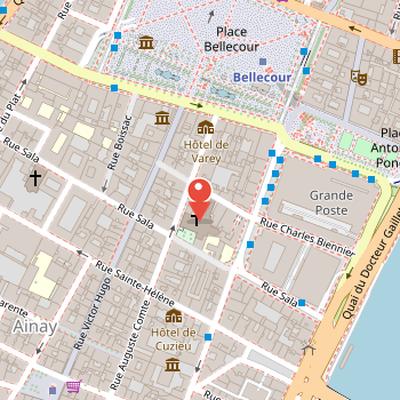
Église Saint-François-de-Sales de Lyon is a Catholic church located at 11 rue Auguste-Comte in the Ainay district of Lyon. Construction began in 1803 on rue Saint-Joseph, now rue Auguste-Comte, on the site of an earlier Sainte-Madeleine church. Before 1803, the site connected the Maison des Recluses to the north and the Couvent des filles pénitentes to the south. During the French Revolution, the surrounding buildings and possibly the church itself became the prison des Recluses. The church is dedicated to Saint François de Sales, who died in 1622 near the present-day junction of rue Sainte-Hélène and rue Saint François de Sales. Its interior includes decorated vaults and walls, with star patterns, arabesques with plants, flowers, and birds, and works attributed to Alexandre Denuelle. Other notable elements include panels by Louis Janmot, sculpture by Joseph-Hugues Fabisch, a painting by Édouard Ravel de Malval, and the baptismal fonts designed by Sainte-Marie Perrin.
Nearby Objects
-
 Bellecour School 40 m away
 -
 Hôpital de la Charité de Lyon 200 m away
 -
 Rue Victor-Hugo 200 m away
 -
 Textile Arts Museum 250 m away
 -
 Saint-Marc Lycée 250 m away
Location and Dedication
The Church of Saint Francois de Sales in Lyon is a Catholic church dedicated to Saint Francois de Sales. It is located at 11 rue Auguste-Comte in the Ainay district of Lyon. The available facts identify it primarily by its religious dedication and its urban setting within the city.
History and Site
The church was constructed starting in 1803 on rue Saint-Joseph, now rue Auguste-Comte, on a site that had previously been occupied by a smaller Sainte-Madeleine church. Before 1803, the site connected the Maison des Recluses to the north and the Couvent des filles penitentes to the south. The church was placed under the patronage of Saint Francois de Sales, who died in 1622 near rue Sainte-Helene and rue Saint Francois de Sales. During the French Revolution, the surrounding buildings and possibly the church itself became a prison known as the prison des Recluses.
Interior Decoration
The interior decoration of Saint-Francois-de-Sales de Lyon is associated with Alexandre Denuelle and Louis Janmot. Denuelle is credited with murals in Lyon, including work at Saint-Martin d'Ainay and the Saint-Polycarpe church, and he also decorated the vaults and walls of Saint-Martin d'Ainay and the Hotel-Dieu chapel. In this church, the vaults in the nave and aisles are decorated with a pattern of stars set against dark neo-classical walls, and arabesques with plants, flowers, and birds are also attributed to him. Louis Janmot painted two large panels on the east and west sides, including La loi nouvelle enleve le voile qui recouvre l’ancienne, and he also painted the north and south panels showing four Old Testament prophets and four pendentives. Janmot is also identified as the author of Poeme de l ame, held at the Musee des Beaux-Arts de Lyon.
Interior Decoration and Liturgical Furnishings
The interior decoration of Eglise Saint-Francois-de-Sales de Lyon brings together works by several artists from the nineteenth and twentieth centuries, with few alterations since the nineteenth century. Among the principal elements is the Sacre-Coeur chapel altarpiece created by Louis Janmot in 1863. Joseph-Hugues Fabisch, described as a sculptor present in many Lyon churches, contributed several works, including the Assumption sculpture in the Virgin chapel in 1856, bas-reliefs for the Sacre-Coeur and Saint-Joseph chapels, and the former main altar, whose facade was later relocated to the left transept opposite the war memorial. This altar was eventually removed and replaced by a new black marble altar and a similar ambon of uncertain date.
The Virgin chapel also contains an altar with a bas-relief of the Nativity of the Virgin by P. Morel. Other devotional works include an 1866 painting by Edouard Ravel de Malval depicting the Flight into Egypt with angels serving the Holy Family, and a statue of Saint Joseph sculpted by J. Armand-Calliat in 1903. The baptismal fonts, designed by Sainte-Marie Perrin in 1900, are adorned with a Saint John the Baptist statue by Paul Dubois from 1880.
The Stations of the Cross are made from copper plaques with champleve enamel, designed by Antoine Sublet and executed by Armand-Calliat. They are located against the east wall of the north transept and were blessed in 1920, then decorated in 1932 by G. Decote. A large crucifix by Ferdinand Parpan was installed in 1957 between the main altar and the organ along the nave axis. Together, these furnishings reflect a layered interior history shaped by sculpture, painting, and liturgical design.
The Cavaillé-Coll Organ
The churchs second known organ was built in 1880 by Aristide Cavaille-Coll, following a parish order placed in 1879. It replaced the first organ, which had been built in 1835 by the Alsatian builder Callinet and installed on the tribune above the main entrance. The first instrument had as titular organist Francois-Charles Widor. After the new organ was completed, the Callinet organ was sold and moved to Eglise Saint-Bruno de Voiron, where it was inaugurated in 1883.
The Cavaille-Coll organ is installed in the apse of the church and has 45 stops distributed over three manuals and one pedalboard. At the inauguration concert, Charles-Marie Widor performed the premiere of his fifth symphony. The instrument has never been modified since its construction, apart from the installation of an electric blower in 1901. Various restoration actions carried out by Michel-Merklin Kuhn helped preserve its original features.
The organ bears witness to the design concepts of Aristide Cavaille-Coll and was classified as a Monument Historique in 1977.