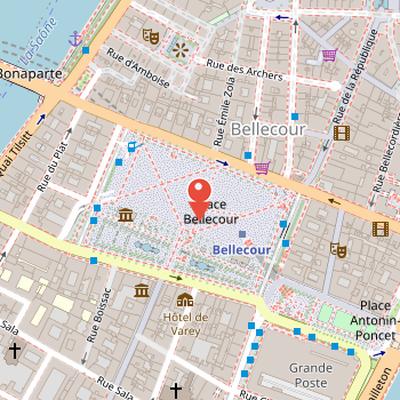
Place Bellecour is a square in the 2nd arrondissement of Lyon, France, located on the peninsula between the Saône and the Rhône. With an area of 63,000 square meters, it is the largest square in Lyon and the fifth largest in France. The square has a trapezoidal shape, measuring 300 meters in length and up to 220 meters in width. It is the kilometer zero point for roads starting from Lyon and for distances measured in the city.
The square includes a northern area the size of a football field kept empty for events, as well as a large surface covered with gorrhe du Beaujolais in red-orange color. At its center stands an equestrian statue of Louis XIV by François-Frédéric Lemot. Other features include a statue of Le Petit Prince and Antoine de Saint-Exupéry at the southwest end, two pavilions on the south side housing tourism office services, a small children's park, fountains, and kiosks with brasseries and florists. Rows of lime trees and horse chestnut trees surround the place. Place Bellecour also serves as an important junction, with access to major arteries of the Presqu'île de Lyon and connections toward the surrounding districts and bridges.
Nearby Objects
-
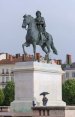 Equestrian Statue of Louis XIV 30 m away
 -
 Veilleur de pierre 100 m away
 -
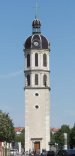 Hôpital de la Charité de Lyon 200 m away
 -
 Rue Émile-Zola 200 m away
 -
 Rue des Marronniers 200 m away
Location and Physical Layout
Place Bellecour is a square in the 2nd arrondissement of Lyon, France. It covers an area of 63,000 square meters, making it the largest square in Lyon and the fifth largest in France. The square has a trapezoidal shape, measuring 300 meters in length and up to 220 meters in maximum width. It also serves as the kilometer zero point for roads starting from Lyon.
Layout and Features of Place Bellecour
Place Bellecour is arranged as a broad urban square with several distinct zones and landmarks. A northern area, about the size of a football field, is kept empty for events. Another large section is covered with gorrhe du Beaujolais, which gives the surface a red-orange color. At the center stands an equestrian statue of Louis XIV by Francois-Francois Frederic Lemot. The southwest end includes a statue of Le Petit Prince and Antoine de Saint-Exupery. On the south side, there are two pavilions that house tourism office services, along with a small children's park, fountains, and kiosks with brasseries and florists. The square is also surrounded by rows of lime trees and horse chestnut trees, which frame its open expanse and help define its public character.
Location and Urban Role
Place Bellecour is located in the second arrondissement of Lyon, on the peninsula between the Saone and the Rhone. It lies on the east-west axis linking the right bank of the Rhone to the left bank of the Saone, and it serves as the origin of three major arteries of the Presqu'ile de Lyon, two of which are pedestrian streets. These routes connect the Terreaux district to the north with the Perrache district to the south.
The square also functions as a major point of reference in the city, since it constitutes the kilometer zero point of Lyon, from which all distances are measured. Two smaller squares connect with it, reinforcing its role as a central urban space. To the west, across the Bonaparte bridge on the Saone, are the Vieux Lyon district and the Saint-Jean cathedral, with access to the bridge via rue du Colonel-Chambonnet. To the east, across the Guillotiere bridge, lies the La Guillotiere district, reached from the square via rue de la Barre.
Place Bellecour is served by metro lines A and D as well as numerous bus lines. The Bellecour metro station is the busiest station in the Lyon metro, underlining the square's importance as a transport hub and a highly frequented public space.
The Names of Place Bellecour
The toponym Bellecour appears as early as the 11th century. Odonymie explains that it refers to the agricultural lands owned by the archbishop, described as bella curtis. In the 16th century, the pasture is named pre de Belle court. The site later becomes a public square and receives the name place Royale in 1715. It is then renamed place Louis-le-Grand in honor of Louis XIV.
The square's name changes repeatedly in response to political events. During the Revolution, it becomes place de la Federation in 1790, then place de l Egalite in 1793. In 1794, it is called place de la Fraternite, and in 1800 it becomes place Bonaparte during regime changes. It later takes the names place Napoleon and place Carnot. Under the Restoration in 1814, it returns to place Louis-le-Grand. The current name, place Bellecour, is adopted under the Third Republic. It is renamed place du Marechal-Petain after a Vichy regime visit in 1943, then reverts to place Bellecour at the Liberation.
History and Civic Role of Place Bellecour
Place Bellecour developed on alluvial land that was once a Gallo-Roman neighborhood, described as an island or peninsula. In this early period, the area witnessed Roman military and commercial activity, including canabae used as warehouses for Gallo-Roman merchants and sailors. The city was then centered on Fourviere hill before later shifting toward the Saone riverbank. By the end of the 13th century, the archbishop of Lyon owned the bella curtis area, including vineyards, but after abandonment the land became marshy. In 1562, during an attack on Lyon, Baron des Adrets placed armed men on the Bellecourt meadow. A major step in the square's urban history came in 1604, when Henri IV persuaded the city council to acquire the meadow for a public square, despite a long lawsuit involving the archbishop's heirs. Additional land between Bellecour square and the Rhone was later purchased by the Aumone generale to build a hospital, and the Hopital de la Charite de Lyon was constructed from 1617 to 1622, with its church opening onto the square. The site also became a place of royal presence, with Louis XIII staying there in 1624 and Louis XIV lodging there in 1658, after which Louis XIV issued an ordinance to preserve the square. Bellecour was definitively acquired by the city in 1708. During the Revolution, the square was marked by the Liberty altar in 1790 and a guillotine in 1792, while the royal statue was destroyed in 1793 along with the east and west facades after the siege of Lyon. Reconstruction began with the cornerstone laid by Bonaparte in 1800. The square continued to carry political and symbolic meaning, including passages by Pope Pius VII in 1805 and a commemorative plaque at number 3. A new Louis XIV statue by Francois-Fredric Lemot was inaugurated in 1825 and narrowly escaped destruction in the revolutions of 1848 and 1870. Bellecour square was also a place of public life, as shown by Madame Girard's renowned refreshment bar opened in 1829, and it was indirectly affected by the Presquile transformation works led by Prefect Vaisse.
Urban Changes and Public Uses at Place Bellecour
Place Bellecour was altered through a series of urban works that reshaped its edges and uses. According to Histoire, several buildings were demolished in the north to open new routes from the square, including rue Imperiale, rue de l'Imperatrice, and rue Gasparin. The adjacent place Le Viste was also widened because of the beginning of rue Imperiale and rue de l'Imperatrice. At the same time, two basin-fountains and chestnut trees were installed in the place.
The square also received built features that later changed function. In 1852, Tony Desjardins constructed two pavilions on the place. The western pavilion, next to the children's gardens, was first a cafe named La gargote du Pere Lathuille. It later became an exhibition room called Maison de Lyon before housing the tourism office Le Rectangle. The south-east pavilion began as a military pavilion, then became a police station and later the Syndicat d'Initiative in 1924. It housed the tourism office starting in 2008.
The site also remained linked to major historical events. In 1934, the hospital de la Charite was destroyed except for the church's bell tower, and the place de la Charite was enlarged and renamed place Antonin-Poncet. During World War II, Marshal Petain reviewed troops at the place. Histoire also notes that the Gestapo was located at number 32, where many acts of torture occurred, and that a cafe frequented by Nazis and French militia was bombed without casualties. German soldiers later executed five prisoner resistants there in reprisal the same day.
More recent changes included a project that slightly raised the surface and replaced gorrhe with tar on the western half. A metro station opened in 1978 on line A and was expanded in 1991 with the construction of line D.
Recent Interventions and Debates
In recent years, Place Bellecour has been the focus of several public projects and debates about its appearance and use. On April 23, 2021, the city hall announced the creation of an ephemeral artwork called Tissage urbain, imagined by artist Romain Froquet and architect Tristan Israel. The project, which cost 1.5 million euros, was installed between April and June 2022 and is scheduled to remain on view until 2030. It is composed of three alleys of shade structures, including a misting device intended to provide cooling in summer, as well as a night lighting system and video surveillance cameras.
The installation was contested because of the lack of vegetation and its high cost, and it was targeted by vandalism on February 11, 2023. On March 22, 2023, Jean-Michel Aulas proposed relocating the artwork and adding a French garden on the western half of the square together with new shrubs on the eastern half. A few days later, on April 4, 2023, the Lyon municipal council approved tree base greening of the northern alley oaks. This greening project is estimated at 1.3 million euros, with construction planned after the 2026 elections and delivery by the end of 2026.
Place Bellecour has also been the subject of debate over advertising space on scaffolding tarps during facade work, which has repeatedly drawn activist actions. The 2022 municipal participatory budget favored the place's greening project.
Statues and Memorials on Place Bellecour
The center of Place Bellecour has been marked by a succession of statues with a turbulent history. Statues first created in 1713 by Martin Desjardins were destroyed in 1793 during the Revolution, when they were removed as a royal symbol and their bronze was recovered for cannon making. In 1825, statues by Francois-Frederic Lemot were installed in the center of the square. Cast in Paris and transported to Lyon in twelve days by twenty-four horses, they arrived to public festivities that attracted many spectators. Their base came from the village of Le Perreon in Beaujolais.
Until 2021, the central statues were accompanied by two allegorical figures created in 1720: La Saone by Nicolas Coustou and Le Rhone by Guillaume Coustou. Since 2022, these allegorical statues have been exhibited at the citys Museum of Fine Arts. The central statues were found to be very damaged in a 2019 diagnosis and were restored between 2023 and 2024. This work took place on the square at a cost of 1.5 million euros, after the area in front of the statues had been restored following underground parking construction.
Place Bellecour also includes wartime memorial elements. At the corner with rue Gasparin stands the Veilleur de pierre statue, on the site of a bomb explosion placed by the Lyon resistance during WWII. The explosion, near the cafe Moulin a Vent frequented by German officers and Gestapo, killed no one, but it was followed by immediate German revenge executions. Five resistance members, including Albert Chambonnet and Gilbert Dru, were executed at the site. Created by architect Louis Thomas and sculptor Georges Salendre, the memorial lists the names of the five executed resistance members, massacre sites in Rhone, all Nazi deportation and extermination camps, and a commemorative inscription.
At number 1, near rue Antoine de Saint-Exupery, a monumental statue represents the Petit Prince and Antoine de Saint-Exupery. Created by Lyon sculptor Christiane Guillaubey, it was inaugurated on June 29, 2000, for the writers centenary. The statue stands on a 5 m tall, 7-ton marble block engraved with three quotes from the Petit Prince. Antoine de Saint-Exupery was born at number 8 rue Antoine de Saint-Exupery, formerly rue Alphonse Fochier.
Protest Activity at Place Bellecour
Place Bellecour is very often a passage or arrival point for numerous union and student demonstrations. It regularly witnesses clashes between law enforcement and protesters, and has seen police use tear gas and the illegal technique called the nasse. During the 2023 social movement, it was also targeted by protesters attacking symbolic elements of capitalism and authoritarianism. These events have made the square a recurrent site of public confrontation and political expression.
Events and Seasonal Uses at Place Bellecour
Place Bellecour, referred to in these event-related uses as E venements, serves as a major public space for recurring cultural and sporting activities. It is the closing location of the inaugural parade of the Biennale de la danse de Lyon every other year, and it also hosts artistic choreographic performances during the festival. The site has taken part in the Fete des Lumieres with artistic installations, including luminous objects, modifications of the Louis XIV equestrian statue, and projections on a giant screen on the Ferris wheel. These displays can be combined in a single project, and one installation portrayed the statue as if trapped in a snow globe. The festival has also highlighted Lyon's heritage, and the square hosted a 2014 installation dedicated to Antoine de Saint-Exupery.
The square has long been used for public gatherings and sporting events. It hosted the traditional Pentecost boule lyonnaise tournament from 1900 to 1967 and again from 2002 to 2019. A Ferris wheel is installed on the east side in winter, usually in November and dismantled in March, although it was present during summer months in some years, including 2008. Since 2005, it has been received from place Antonin-Poncet after memorial construction there. Three different Ferris wheels have remained for more than one season: a 60-meter wheel with open cabins from 2006 to 2009 and from 2012 to 2019, a 55-meter wheel with closed cabins from 2021 to 2023, and a 50-meter wheel with closed cabins since 2024. Its orientation changed from north-south between 2006 and 2018 to east-west from 2019 onward, following complaints from neighbors.
Place Bellecour also functions as a gathering point for football supporters, supported by a giant screen. It was a place where locals followed France's 1998 World Cup victory, and although there was initially no fan zone during the 2018 World Cup because of budget reasons, a policy change allowed a giant screen installation for the 2018 World Cup final. The square hosted a large crowd despite stormy weather, and it later witnessed clashes between police and supporters after the 2022 World Cup final. In winter, it can also host an ice rink.
Since 2024, the site has hosted the festival du velo organized by the Lyon city hall and Metropole, and it also accommodates concerts, book fairs, and the distribution of the Le Petit Paume guide. A food court has been organized on the west side since the 2022 edition.