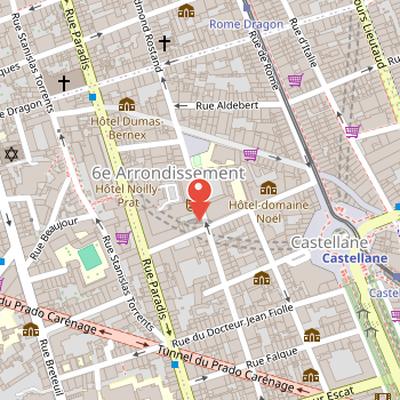
Couvent Saint-Lazare is a Dominican convent in Marseille, located at 35 rue Edmond-Rostand, at the corner of rue Edmond-Rostand and rue Sainte-Victoire. Built by Pierre Bossan between 1868 and 1880, it belongs to the church Notre-Dame-du-Rosaire. The church was financed by Anne Rosine Noilly-Prat, and the project was led by Father Hyacinthe-Marie Cormier, then provincial of the newly founded Province of Toulouse. The church was completed in 1878, while only the west wing and part of the south wing of the convent had been finished by that date.
The site is part of a longer Dominican history in Marseille. The Dominican brothers arrived in Provence in 1225 and established a house near the Italy road, serving pilgrims under the name hôpital Saint-Michel des Ytiers. Later, the convent hosted the general chapter of the order in 1300. After the buildings outside the city walls were demolished in 1524, the Dominicans resettled in Marseille in 1862. The current church was enlarged in 1889 by the purchase of a house from the Marists. The community also faced expulsions in 1880 and 1903, which halted the expansion of the convent.
Nearby Objects
-
 Castellane Square 200 m away
 -
 Basilique du Sacré-Cœur de Marseille 650 m away
 -
 Musée Cantini 700 m away
 -
 Notre-Dame de la Garde 850 m away
 -
 Opéra de Marseille 900 m away
Construction and Religious Function
The Couvent Saint-Lazare is a Dominican convent in Marseille, built in 1868 by Pierre Bossan. It served as the convent of the church Notre-Dame-du-Rosaire, also built by Bossan. The available facts identify it as a religious building associated with the Dominican order and with the church it supported.
Location of the Couvent Saint-Lazare
The Couvent Saint-Lazare is located in Marseille at 35 rue Edmond-Rostand. More precisely, it stands at the corner of rue Edmond-Rostand and rue Sainte-Victoire. This identified location places the convent within the urban fabric of the city and provides a clear point of reference for its site.
History of the Couvent Saint-Lazare
The Dominican Order Brothers arrived in Provence in 1225 and established a house at the edge of Marseille, near the Italy road. This first foundation was called the hopital Saint-Michel des Ytiers and served pilgrims in Marseille. The convent was located near the former Bernardines church at the site of the current lycee Thiers, and it became an important Dominican center: it hosted the general chapter of the order in 1300. In 1361, Bishop Guillaume Sudre, who became bishop of Marseille that year, recruited within the convent.
The buildings outside the city walls were demolished after the attacks of Charles de Bourbon in 1524. A second establishment later included a church dedicated to the Annunciation, which lasted until 1794. In 1802, the conventual church became the Saint-Cannat parish. Its facade is still visible from rue de la Republique. The Dominicans resettled in Marseille in 1862.
Construction and Early History
The church dedicated to the Rosary was designed by the architect Pierre Bossan. According to the historical record, the church and the present convent were built between 1868 and 1880, with Anne Rosine Noilly-Prat financing the construction. Father Hyacinthe-Marie Cormier, as provincial of the newly founded Province of Toulouse in 1865, led the effort, and the church was the first foundation project of that new province. The church was completed in 1878, while only the west wing and part of the south wing of the convent had been finished by that date.
The site continued to evolve after the initial campaign. In 1889, the church was enlarged through the purchase of a house from the Marists. However, the Dominican community faced expulsions in 1880 and 1903, and these persecutions halted the expansion of the convent. At one point, the convent was auctioned on a Thursday and bought back from the State by the children of Mme Noilly-Prat. The Dominicans returned to their convent in 1921. The west wing was later joined to the rest of the buildings during the 1930s.
The church and convent were built before the 1905 law of separation of Churches and State, and they remained private property of the Dominican Province of Toulouse.
World War II Resistance and Shelter
The history of Couvent Saint-Lazare includes a significant wartime role played by the Dominican community of Marseille. Although the community was initially favorable to the Vichy regime under Father Reginald de Parseval, its position changed as the reality of persecutions became clear. During World War II, the Dominicans sheltered Jewish refugees who had escaped from the camp des Milles and hid them in the convent basement. This protection was made possible through a discreet network linked to the Sainte-Baume hotel school.
The convent was also involved in spiritual and intellectual resistance. The Dominicans cooperated with a small Catholic group at the Jesuit college in Avignon and helped disseminate La Voix du Vatican, a mimeographed publication that criticized collaboration. This initiative anticipated the later spread of the clandestine magazine Cahiers du Temoignage chretien, founded in Lyon.
The convent parlor was also a place of important meetings, including the encounter in Marseille where Joseph-Marie Perrin presented Simone Weil to Marie-Louise David. Simone Weil remained active in intellectual and spiritual resistance until her departure from Marseille. Joseph-Marie Perrin was later recognized by Yad Vashem as Righteous Among the Nations for protecting several dozen Jews. A commemorative plaque placed in the convent recalls the individuals protected there during the war.
Later Dominican Alterations
In 2004, the Dominican community carried out a project to close the cloister in a style associated with Bossan. This intervention is noted in the historical record as part of the convent's later development. The result is described as a coherent church-convent complex that the Dominicans currently enjoy, indicating that the site functions as an integrated religious ensemble.
Architecture and Later Additions
The Couvent Saint-Lazare was constructed between 1867 and 1899 by architect Joannis Rey, a disciple of Pierre Bossan. Its East wing, completed in 1888, follows the plan by Pierre Bossan. The West wing was added in the 1930s, and the South wing was completed in 2010. The church and crypt are registered as historical monuments by official decree.