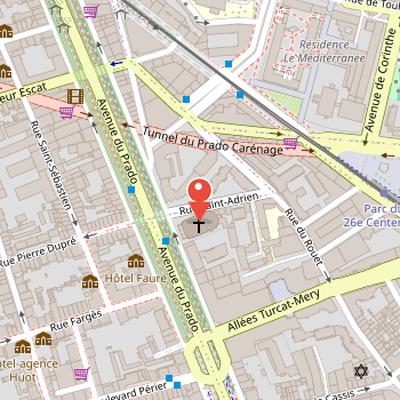
The Basilique du Sacré-Cœur de Marseille is a minor basilica of the Roman Catholic Church dedicated to the Sacred Heart of Jesus Christ. It stands on Avenue du Prado in the Rouet district of Marseille and was built in the first half of the 20th century in a Romano-Byzantine style. The building was constructed to commemorate the plague of 1720 and also serves as a memorial for the First World War. Its history is linked to the decision to build the Basilica of Sacré-Cœur after the First World War, replacing the church of Saint-Adrien and Saint-Hermès. The first stone was laid for the second centenary of François-Xavier de Belsunce’s vow during the plague of 1720. Designed by architect Théodore Dupoux, the construction was later continued by his son after Dupoux’s death. The basilica was consecrated by Cardinal Roques, Archbishop of Rennes, and was later erected as a minor basilica by Pope John Paul II.
Nearby Objects
-
 Castellane Square 500 m away
 -
 Couvent Saint-Lazare 650 m away
 -
 Notre-Dame de la Garde 1300 m away
 -
 Cathédrale des Saints-Traducteurs 1300 m away
 -
 Musée Cantini 1300 m away
Construction and Purpose
The Basilique du Sacre Coeur de Marseille is a minor basilica of the Roman Catholic Church dedicated to the Sacred Heart of Jesus Christ. It is located in Marseille on Avenue du Prado in the Rouet district. Built in the first half of the 20th century, it was designed in a Romano-Byzantine style. The basilica was consecrated by Cardinal Roques, Archbishop of Rennes, and later erected as a minor basilica by Pope John Paul II. It was constructed to commemorate the plague of 1720 and also serves as a memorial for the First World War.
Construction and Ecclesiastical History
The construction of the Basilica of Sacre-Coeur in Marseille was decided after the First World War as a replacement for the church of Saint-Adrien and Saint-Hermes. Its launch was announced by Joseph Antoine Fabre in his Christmas 1918 pastoral letter, and the first stone was laid for the second centenary of the vow made by Francois-Xavier de Belsunce during the plague of 1720. The building was designed by architect Theodore Dupoux in a Romano-Byzantine style. After Dupoux died, his son continued the work, which was later overseen successively by bishops Daniel Champavier, Maurice-Louis Dubourg, and Jean Delay. Under Jean Delay, realization was entrusted to Paul-Marie Barthelemy Dejean, who later earned the privilege of burial in a chapel vault of the building. Although the construction began with an initial Romano-Byzantine project, its final architectural aspect is described as more modernist than planned, in part because the original architectural plans remained incomplete. The basilica was consecrated by Cardinal Roques, archbishop of Rennes, after the Second World War, following a period of works whose duration is not specified. It was also elevated to the rank of minor basilica by Pope Pius XII on a later date not provided here.
Architecture and Materials
The basilica was built above a crypt that occupies one quarter of the total surface area. Its construction used several kinds of stone from different places: La Roche d'Espeil quarries in Sanary-sur-Mer, Var were used for the substructures and exterior parts, Saint-Symphorien near Bonnieux, Vaucluse for the crypt interior and the bases of pillars and columns, Buxy for the interior, and Saint-Gengoux in Saone-et-Loire. The general plan of the nave, collaterals, and axial chapels is identical to Pierre Bossan's plan for Notre-Dame-du-Rosaire church, which features a wide ogival vaulted nave open on perpendicular barrel-vaulted collaterals with lateral chapels. Granite columns support a vault, and the basilica was planned to rise with a central bell tower and spire. However, construction of the central bell tower was abandoned because of financial constraints.
Stained Glass and Mosaic Decoration
The stained glass windows of the basilica were created by Ateliers Champigneulle in Paris from designs by Henri Pinta, a Prix de Rome winner and designer at the workshop who was originally from Marseille. In the north and south aisles, the windows present the history of the Sacred Heart in six documented tableaux. Among these, Tableau IV shows Francois-Xavier de Belsunce consecrating Marseille to the Sacred Heart of Jesus, while Tableau V depicts the vow of the city council in 1722 during the plague epidemic.
The choir also uses stained glass to honor the fallen soldiers of World War I. This cycle is distributed across six bays, with each bay corresponding to a specific period or theme: Bay 5 represents August-September 1914; Bay 3, September to November 1914; Bay 1, 1915-1916; Bay 2, 1917-1918; Bay 4, July 14 to November 11, 1918; and Bay 6, events after 1918, including Orient and Captivity themes. Henri Pinta also created the large mosaic adorning the vault of the choir.
Interior Devotions and the Organ
The basilica contains several elements tied to local religious devotion and later additions to its interior. A pieta sculpture by Louis Botinelly was installed on the inauguration day of the Notre-Dame de Pitie chapel by Jean Delay. The heart of Anne-Madeleine Remusat (1696-1730) is preserved in the basilica. Remusat, a Visitandine of Marseille, initiated the consecration of the diocese and city to the Sacred Heart of Jesus, while Henri-Francois-Xavier de Belsunce de Castelmoron carried out that consecration during a plague epidemic.
The basilica also has an organ with a mixed history. Some of its stops come from the organ of Saint-Charles church in Algiers, built in 1936 by Manufacture Lorraine de Grandes Orgues de Boulay. Saint-Charles church became a mosque in 1981. New stops and mechanical parts for the basilica organ were made by Laval-Thivolle establishments. The organ has electrical transmission, with the console placed near the choir.