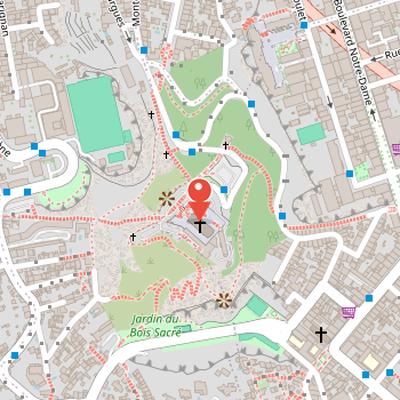
Notre-Dame de la Garde is a Catholic basilica in Marseille, France, known locally as the city’s best-known symbol. It stands on a limestone outcropping on the south side of the Old Port, at the highest natural point in Marseille, and is a site of a popular Assumption Day pilgrimage. Construction began in 1853 and continued for more than 40 years, transforming an earlier medieval chapel at the request of Father Bernard, the chaplain. The plans were developed by architect Henri-Jacques Espérandieu. The basilica was consecrated while still unfinished on 5 June 1864. Its lower church, or crypt, is carved from rock in the Romanesque style, while the upper church is Neo-Byzantine and decorated with mosaics. A square bell tower supports a belfry and a monumental statue of the Madonna and Child in copper gilded with gold leaf. Extensive restoration took place from 2001 to 2008.
Nearby Objects
-
 Couvent Saint-Lazare 850 m away
 -
 Abbey of St. Victor 850 m away
 -
 Théâtre National de la Criée 1000 m away
 -
 Castellane Square 1000 m away
 -
 Musée Cantini 1100 m away
Architecture and Restoration
Notre-Dame de la Garde is a Catholic basilica in Marseille, France, built on the foundations of an ancient fort at the highest natural point in the city. It stands on a limestone outcropping on the south side of the Old Port of Marseille and was originally an enlargement of a medieval chapel. At the request of Father Bernard, the chaplain, it was transformed into a new structure, with plans developed by architect Henri-Jacques Espendieu. Construction began in 1853 and continued for more than 40 years. The basilica was consecrated on 5 June 1864 while still unfinished.
Its design combines a lower church, or crypt, carved from rock in the Romanesque style, with an upper church in Neo-Byzantine style decorated with mosaics. Above this rises a square bell tower topped by a belfry that supports a monumental statue of the Madonna and Child, made of copper gilded with gold leaf. The basilica underwent extensive restoration from 2001 to 2008. That work addressed mosaics damaged by candle smoke, green limestone from Gonfolina corroded by pollution, and stonework hit by bullets during the Liberation of France. The mosaic restoration was entrusted to Marseille artist Michel Patrizio, whose workmen were trained in Friuli, north of Venice, Italy, and the tiles were supplied by the Venice workshop that made the originals.
Early History and Site
Notre-Dame de la Garde stands on a rocky outcrop of Urgonian limestone from the Barremian, rising to 162 metres above sea level. Because of this height and its coastal position, the hill became an important stronghold, lookout point, and sailing landmark. In 1302, Charles II of Anjou ordered a minister to set beacons along the Mediterranean coast of Provence, and the hill of Notre-Dame de la Garde was one of the beacon sites.
The religious history of the site began in 1214, when a priest of Marseille, maitre Pierre, was inspired to build a chapel dedicated to the Virgin Mary on La Garde hill. The hill belonged to the abbey of Saint-Victor, and the abbot granted Pierre permission to plant vines, cultivate a garden, and construct a chapel. The chapel was completed in 1218 and was listed in a papal bull by Pope Honorius III on June 18, 1218. After Pierre's death in 1256, Notre-Dame de la Garde became a priory, and its prior was one of four claustral priors of Saint-Victor.
Surviving wills show that gifts in favor of the chapel were made from its foundation. Toward the end of the 16th century, sailors also began depositing ex-votos at Notre-Dame de la Garde, following a practice already associated with Notre-Dame of the Sea in Notre-Dame-du-Mont church. In the early 15th century, the first chapel was replaced by a larger building with a chapel dedicated to Saint Gabriel.
The Fort and Sanctuary on La Garde
Notre-Dame de la Garde stands on foundations of a 16th century fort erected by Francis I of France. Francis I visited the sanctuary with Louise of Savoy and Queen Claude of France on January 7, 1516, and later accompanied them to the chapel on January 22, 1516. During his visit, he noted that Marseille was poorly defended, and he later built a fort at the top of La Garde that included the chapel. This fort and place of worship was constructed to resist the 1536 siege of Marseille by Emperor Charles V, and it helped repel the troops of Charles Quint. Completed in 1536, it was built using stone from Cap Couronne, as well as materials taken from demolished city buildings to prevent enemy shelter and from the monastery of the Mineurs brothers, where Louis of Toulouse was buried.
The site is described as the only known example of a military fort sharing space with a public sanctuary. Its plan was triangular, with two sides of about 75 meters and a third side of 35 meters. The fort remains visible on a spur west of the basilica, and it was restored in 1993 to its original state when a 1930 watch tower was removed. Architectural details that survive include a damaged escutcheon of Francois I above the door, showing the arms of France and a salamander below, and a rounded stone near the door, weathered by time, representing the lamb of John the Apostle with its banner.
Notre-Dame de la Garde as Fort and Chapel
From the 16th to the 18th centuries, Notre-Dame de la Garde functioned both as a fort and a place of worship, and it repeatedly appeared in the political and military history of Marseille. In 1585, Hubert de Garde de Vins sought to seize Marseille and combined forces with the second consul of the city and Claude Boniface. On the night of April 9, 1585, Daries occupied La Garde in order to use its guns against Marseille, but the attack failed and Daries and Claude Boniface were executed.
The site was again drawn into conflict in 1591, when Charles Emmanuel I, Duke of Savoy, attempted to seize the Abbey of Saint Victor. Pierre Bon, baron de Meolhon, governor of Notre-Dame de la Garde, was charged with the operation and took possession of the site on November 16, 1591. It was quickly retaken by the first consul of Marseille. Around 1594, two priests, Trabuc and Cabot, were sent to celebrate mass in the chapel. During one ceremony, Trabuc reportedly wore armour under his cassock and killed the captain of the fort. Later that year, Charles de Casaulx took possession of the fort and named his son Fabio as governor. Fabio was driven out by his own soldiers after the assassination of Charles de Casaulx on February 17, 1596.
The fort and chapel also received visitors of high rank. Louis XIII visited Marseille on November 9, 1622, and was received there by governor Antoine de Boyer, lord of Bandol. After Boyer's death on June 29, 1642, Georges de Scudery was named governor and took up the post in December 1644. The site was described in letters by Madeleine de Scudery, and processions included a statue of Notre-Dame de la Garde carried by eight shoeless penitents veiled like ghosts. Georges de Scudery reportedly scorned the site and preferred to live in the aristocratic quarter, while stewardship was entrusted to sergeant Nicolas.
In the 1650 Caze affair, the Count of Alais bribed sergeant Nicolas to install David Caze on August 1, 1650. David Caze temporarily occupied the site before being forced to leave by the consuls of Marseille. In 1701, the Dukes of Burgundy and of Berry visited the site, and Sebastien Vauban studied it for defense improvements after succeeding Louis Nicolas de Clerville. Vauban presented a proposal on April 11, 1701, for an enclosure connecting Fort Saint Nicolas to Notre-Dame de la Garde, but the plan was not carried out. The site was also affected by the Great Plague of Marseille in 1720, which killed 100,000 people in the city.
Bishop Henri de Belsunce and the Chapel
Bishop Henri de Belsunce went three times on foot to the chapel at Notre-Dame de la Garde. He visited it on September 28, 1720, on December 8, 1720, and on August 13, 1721. On each occasion, he went to the chapel to bless the inhabitants of Marseille. These visits show the chapel's role as a place of religious significance for the city during this period.
Revolutionary Upheaval and Reopening
During the Revolutionary period, Notre-Dame de la Garde underwent a series of disruptions that altered both its religious use and its objects. On April 30, 1790, anti-clerical revolutionaries invaded the fort. Demonstrations disturbed the traditionally large procession on June 7, 1792, Trinity Sunday. The Virgin statue was wrapped in a scarf in the revolutionary tricolour, and a Phrygian cap was placed on baby Jesus. In April 1793, Louis Phillipe, Duke of Orlans, and family members were imprisoned there before being transferred to Fort Saint-Jean.
The church buildings were closed and worship ceased on November 23, 1793. The silver statue of the Virgin, made in 1661, was melted down at the mint of Marseille on March 13, 1794. The last objects from the sanctuary were auctioned on April 10, 1795. After that, the chapel was nationalized and rented to Joseph Escaramagne. In September 1800, he requested that the sanctuary be reopened from Minister of War Lazare Carnot, despite opposition from prefect Charles-Francois Delacroix. The chapel was reopened for worship on April 4, 1807.
Escaramagne later bought an 18th century statue of the Virgin and child from a demolished monastery and offered it to the La Garde church. The scepter of the Virgin was replaced by a bouquet of flowers, creating the Virgin of the bouquet statue. This statue was moved away and later returned to the sanctuary in 1979, and it is now displayed on the altar in the crypt.
Restoration, Visitors, and the New Statue
The sanctuary at Notre-Dame de la Garde underwent a period of renewal in the 19th century marked by processions, new donations, and major changes to its chapel and statue. In 1814, the traditional procession of the Fete-Dieu was resumed. A procession also began from Marseille Cathedral, bringing the statue Escaramagne had bought to the sanctuary. The site received several notable gifts, including a silver statuette offered as an ex voto by the Duchess of Berry on June 14, 1816, and 3000 francs from the Duchess of Orleans in Marseille in May 1823. The sanctuary was also visited by Marie Therese of France in 1823, by Francois-Rene de Chateaubriand in 1838, by Pope John Paul II, then Father Karol Wojtyla, in 1947, and by Pope Francis on September 22, 2023.
A new statue of the Virgin was commissioned to replace the one melted down during the French Revolution. Marseilles goldsmith Jean-Baptiste Chanuel worked on it based on a model by sculptor Jean-Pierre Cortot in 1829, and the delicate gold work was completed in 1834. In the same year, the chapel was consecrated by the bishop of Marseilles. The chapel had already been extended in 1833 with a second nave, bringing its area to approximately 250 square meters. On July 2, 1837, the statue was blessed and carried to the top of the hill, where it replaced the Virgin of the Bouquet. The Virgin of the Bouquet was later returned to the crypt in 1979, and before the basilica was built, both the Virgin of the Bouquet and the silver Virgin statues were displayed at the sanctuary.
The Bourdon Bell and Sanctuary Renaissance
The Renaissance of the sanctuary rebuilt the bell tower in 1843 and added a major bourdon bell as part of the site. The bell was purchased from the Lyons foundry of Gedeon Morel through a special collection among the faithful. It was cast on February 11, 1845, and received in Marseille on September 19, 1845. The bell was placed in Jean-Jaures square, where it was blessed by Eugene de Mazenod on October 5, 1845, and baptized Marie Josephine on the same day. Its godfather was then the mayor of Marseille, and its godmother was the wife of the shipping magnate born Canaple; their names were engraved on the bell.
The transport of the bourdon bell became a notable event. On October 7, 1845, it was placed on a harnessed carriage drawn by sixteen horses and taken down Thiers Street, Leon Gambetta Alley, Rue du Tapis-Vert, the Canebiere, and other streets. Ten additional horses were later added to the convoy, bringing the total to twenty-six. Beginning on October 8, the bell was raised up the hill with the help of capstans, and its ascent to the summit was completed on October 10. It was set up on October 15, and its first notes were rung on December 8, the day of the Immaculate Conception.
The sanctuary is described as containing a vast bell that produces a powerful harmony, and it also includes statues of the Virgin inside the basilica. The facts also note the presence of a bell established before the current building construction.
Construction and Design of the Basilica
The construction of the current basilica began with a request on June 22, 1850, for authorization to expand the existing building. This first request was denied by Minister of War Alphonse Henri d'Hautpoul on October 22, 1850. A more precise proposal for a new larger church was then submitted on April 8, 1851. The design called for doubling the area of the existing building, which would have left no room for military buildings inside the fort. Support came from General Adolphe Niel and the fortifications committee on January 7, 1852, and permission to build a new chapel was granted by the Minister of War on February 5, 1852.
Fundraising and planning continued through the end of 1852. Monseigneur Eugene de Mazenod requested offerings from parish members on November 1, 1852, and the administration council met with him on December 30, 1852. On that same day, after a tied vote, Leon Vaudoyer's Romano-Byzantine style project was commissioned. The plans were drawn up by Henri-Jacques Espérandieu, a former pupil of Vaudoyer, and he was named architect on June 23, 1853. The committee awarded labour directly to Pierre Bérenger on August 9, 1853, while also imposing the artists Joseph-Marius Ramus and Karl Muller without consulting the architect. Karl Muller's commission was rejected so that the architect could direct the mosaics as decor.
The first stone was laid by the bishop of Marseille, Monseigneur de Mazenod, on September 11, 1853. Construction then faced financial difficulties because the foundations had to be laid in very hard rock. A government lottery authorized in 1855 brought in less revenue than expected, and a further shortfall arose when the sanctuary commission decided to enlarge the crypt under the entire higher vault. Work stopped from 1859 to 1861, despite a loan secured by the personal assets of the bishop, and resumed after the arrival of a new bishop at the end of August 1861. The basilica was completed through the generosity of citizens, including Emperor Napoleon III and Empress Eugenie, who visited on September 9, 1860. The sanctuary was dedicated on Saturday June 4, 1864, by the Cardinal of Villecourt in the presence of forty-three bishops.
The Statue and Upper Works
By 1866, mosaic flooring had been laid in the upper church and the square bell tower had been finished. A bell was installed in the tower in October of that year, and in 1867 a cylindrical pedestal, or belfry, was added to support the monumental statue of the Virgin. The statue was financed by the town of Marseille, and several designs were reviewed by a jury that included Esperandieu, the mayor of Marseille, Philippe-Auguste Jeanron, and Luce. The committee selected the proposal by Eugene-Louis Lequesne. Copper was chosen as the material because of cost and weight, and galvanoplasty, a form of electroplating, was adopted instead of hammered copper. A scientific report of November 19, 1866, stated that electrotype copper would allow irreproachable reproduction and desirable solidity, although Eugene Viollet-le-Duc warned that galvanoplasty might not resist atmospheric pollution in Marseille for long. Because the statue had to be brought up the hill and to the bell tower, it was made in four sections. An iron arrow was placed in the center of the sculpture as the core of a spiral staircase to the Virgin's head, and the metal structure supported and assembled the statue by connecting it to the tower body. The workshops completed the work in August 1869.
Construction and Completion of Notre-Dame de la Garde
The construction of the current basilica began on May 17, 1870, when the first elements were assembled. The statue was dedicated on September 24, 1870, but the ceremony was held without fanfare because of the defeat by the Prussian army. The statue was gilded with gold and later regilded in 1897, 1936, 1963, and 1989.
Work continued through a turbulent period marked by the Commune of Marseille in March 1871. Rebels seized the Prefecture of the Rhone delta, and the general retreated to Aubagne on March 26 before beginning to retake the city on April 3. Rebels fired from batteries installed in the basilica and Notre-Dame de la Garde, and they capitulated on April 4. After this, the Virgin statue was called Notre-Dame of bombardment by the rebels.
Following the death of Esperandieu on September 11, 1874, Henri Revoil was charged with finishing the interior. The major crypt was built and mosaics were installed in the choir in 1882. A fire on June 5, 1884 destroyed the altar and the choir mosaic and damaged the Virgin statue. The statue and mosaics were restored, and the altar was rebuilt according to Revoil's drawings. Cardinal Charles Lavigerie consecrated the new crypt on April 26, 1886, and walnut stalls were built in the choir the same year. The last mosaics in the side vaults were finished between 1887 and 1892. In 1897, two bronze doors of the upper church and a mosaic above them were installed, and the Virgin statue was regilded for the first time. The basilica was completed more than forty years after the first stone was laid.
The Notre-Dame de la Garde Funicular
A funicular was built in 1892 to reduce the effort of scaling the hill, and it became known as the ascenseur, or elevator. Construction took two years. Its base was located at the lower end of the hill, while the upper station led directly onto a footpath to the terrace beneath the basilica. The line covered a vertical distance of 108 meters.
The system consisted of two cabins, each weighing 13 tons when empty and moving on parallel cogged tracks. The cabins were linked by a cable and powered by a hydraulic balance system. Each cabin had two floors and could hold fifty passengers in total. They were fitted with a 12 cubic meter tank of water. To start the system, the descending cabin was filled with water while the ascending cabin tank was emptied. Water collected at the foot of the line was returned to the top by a 25-horsepower steam-powered pump.
Travel time was two minutes, but filling the upper tank took more than ten minutes, so waiting times occurred between departures despite often considerable crowds. On August 15, 1892, visitor numbers exceeded 3000. After the ascent, passengers still faced a final walk across a 100-meter footbridge up the steep slope. This bridge was built by Gustave Eiffel, was 1.20 meters wide, and was very exposed to mistral winds.
The funicular declined with the advent of the automobile and was shut down as unprofitable on September 11, 1967 at 18:30. It was later demolished after transporting 20 million passengers over 75 years.
The 1944 Assault on Notre-Dame de la Garde
On August 24, 1944, the Liberation of France ordered General Aime Sudre to take Notre-Dame de la Garde, while stipulating that the attack should avoid both air raids and large-scale artillery fire. The primary assault was entrusted to Lieutenant Pichavant of the 1st company, and troop movement toward the hill began at 6 am on August 25, 1944. Progress was slow because of sniping by German riflemen. The attackers used Pierre Chaix-Bryan's knowledge of a hallway at No. 26 Cherchel street, and Algerian riflemen advanced through the hallway and staircase under Roger Audibert's command. Other soldiers climbed the staircases up the Notre-Dame slope from the boulevard of the same name. On the northern face, the assault came under fire from blockhouses and rear gunfire. Tanks provided essential support, including vehicles from the 2nd regiment of cuirassiers of the 1re Division Blindee advancing from Boulevard Gazzino and the church slope. One tank, Jeanne d'Arc, was hit and stopped at place du Colonel Edon, with three occupants killed. Another, Jourdan, struck a mine but continued firing from a rocky overhang; its fire killed the German specialist in charge of the flame throwers. The attack also forced a young German soldier to ignite the flame throwers prematurely, which exposed the gun positions.
Architecture and Interior Layout
Notre-Dame de la Garde is characterized by layered stonework using white Calissane limestone and green sandstone from Golfolina near Florence. The upper church is decorated with marble and pictorial mosaics in various colours. Access is arranged through a double staircase leading to a drawbridge that grants entry to the crypt and the church's main entrance, while staircases on both sides of the entrance lead up to the church above. Under the bell tower, the entrance hall contains marble statues of Bishop Eugene de Mazenod and Pope Pius IX carved by Joseph-Marius Ramus.
The crypt is Romanesque in style and consists of a nave with low barrel vaults and six side chapels corresponding to those of the upper church. These chapels contain plaques naming various donors, and the side altars are devoted to saints Philomena, Andrew, Rose, Henry, Louis, and Benedict Labre. The main altar is built of Golfolina stone with columns of Spanish marble, and behind it stands the statue of the Madonna holding a bouquet, known as the Vierge au Bouquet. This statue was obtained by Joseph-Elie Escaramagne for the original chapel in 1804, and its sceptre was later replaced by flowers because the sceptre was in poor condition.
The bell tower above the entrance porch rises through several distinct stages. It has two storeys of five blind arches, with the central arch containing a window and small balcony. Above this is a belfry with three-light windows divided by red granite mullions and abat-sons, then a square terrace enclosed by a stone balustrade bearing city arms and four statues of angels with trumpets carved by Eugene-Louis Lequesne. A cylindrical tower rises from the terrace to sixteen red granite columns supporting a tall statue of the Virgin Mary. Bronze doors by Henri Revoil at the base of the tower provide access to the church, and their central panels bear the monogram of the Virgin within a circle of pearls resembling the rosary.
Interior Decoration and Spatial Design
The interior of Notre-Dame de la Garde combines mosaic decoration, colored stone, and a carefully organized plan. The nave measures 32.7 m in length and 14 m in width, while each side chapel is 3.8 m by 5.4 m. The nave is higher than the side chapels and is lit by a clerestory with two-light windows. Its aisles are divided into three equal parts, each with a central window that illuminates a side chapel. The floors are covered with Roman mosaics with geometric patterns.
The interior decoration includes mosaics and alternating red and white marble columns and pilasters. Espandier selected red marble with yellow and white veins from La Celle near Brignoles in Var for the building, while plaster was used for parts higher up inside. The mosaics were made between 1886 and 1892 by the Mora company from Nimes. Their tesserae came from Venice and were manufactured by craftsmen. Each panel contains nearly ten thousand tesserae per square metre, and the basilica contains approximately 12 million small mosaic squares.
The nave is topped by three cupolas decorated inside with similar mosaics of flowers and doves. The southeastern cupola has white flowers, the middle cupola blue flowers, and the northwestern cupola red flowers. The northwestern cupola also includes a grapevine, a lily among thorns, an olive branch with silver leaves, and a date palm. Medallions on the pendentives depict scenes from the Old Testament. Above the transept crossing stands an octagonal tholobate supporting a dome nine meters in diameter. The dome has thirty-two ribs and is crowned by a cross, and its inside is decorated with a mosaic of four angels on a field of gold. The transept runs east to west and is lit by two paired windows with a rose window above each pair.
Other exterior elements continue the same decorative emphasis. The external pilasters and arches are made of alternating green and white stones and voussoirs. The semicircular apse has five blind arches on the outside, each flanked by two red granite columns, although sacristy buildings added later hide part of it. At ground level, basement windows allow daylight into the underground crypt chapels. Above the main entrance, the tympanum is decorated with a mosaic of the Assumption of the Virgin patterned after a painting.
Symbolic Interior Decoration
The architecture uses religious symbolism in its interior decoration. At the center of the composition, the Virgin Mary is represented by her monogram. At the base of the dome, the pendentives include representations of the Four Evangelists: Mark, Luke, John, and Matthew. Each Evangelist is symbolized by an animal or figure: Mark by a lion, Luke by a bull, John by an eagle, and Matthew by a man. These elements combine to give the structure a layered symbolic program within its architectural design.
Interior Decoration and Chapels
The interior decoration of Notre-Dame de la Garde centers on a carefully arranged altar and apse program, together with six side chapels in the aisles on either side of the nave. The white marble altar was designed by Henri Revoil and constructed by Jules Cantini between 1882 and 1886. Its base is formed by five gilded bronze arches resting on colonettes of lapis lazuli. A silver-gilt tabernacle stands above it, framed by two columns and by two mosaics showing doves drinking from a chalice. Behind the altar is a red marble column topped by a gilded capital, which supports a statue of Mary in hammered silver made by the goldsmith Chanuel of Marseille.
The apse is also richly decorated. Its tympanum above the apse depicts the Annunciation of Mary, with the archangel Gabriel on the right announcing the birth of Jesus and Mary on the left. In the semi-dome mosaic, a ship appears in the central medallion, with the monogram of Mary on the sail and a star containing an intertwined A and M for Ave Maria. This composition is surrounded by rinceaux and thirty two birds, including peacocks, parrots, hoopoes, bluethroats, herons, and goldfinches. A band below the semi-dome contains nine medallions representing titles of Mary from the Litany of Loreto: Foederis Arca, Speculum Iustitiae, Sedes Sapientiae, Turris Davidica, Rosa Mystica, Turris Eburnea, Domus Aurea, Vas Spirituale, and Ianua Coeli.
The six side chapels also follow a coordinated decorative scheme. Their altars were designed by Henri Revoil and constructed by Jules Cantini. Cantini also created the statue of Peter and gave it to the sanctuary. Each altar tomb bears the coat of arms of the respective saint, and each chapel ceiling is decorated with a mosaic showing the name and arms of the financer on one side and a symbol of the saint on the other.
Restoration of the Basilica, 2001 to 2008
In 2001, a major restoration project was launched under architect Xavier David, with work financed by local government agencies and private donations until 2008. The campaign addressed extensive material damage and aimed to stabilize both the exterior and interior fabric of Notre-Dame de la Garde. Survey work found that the green stone had corroded to a depth of 3 to 5 cm, leading to the replacement of defective sections with treated stone designed to resist pollution. For this purpose, 150 cubic metres of Golfolina stone were sourced from a vineyard quarry near Chianti.
The restoration also dealt with structural concerns in the bell tower, where reinforcements girdling the top and upper part were identified as problematic. Some metal reinforcements were treated with cathodic protection, while others were replaced with stainless steel. Inside the building, water-damaged stuccos in the higher areas were redone, and mosaics at risk of collapse were consolidated with resin injections. All gold mosaics in the central cupola of the nave were replaced. Mosaic restoration was entrusted to Marseille artist Michel Patrizio, supported by workmen trained at the school of Spilimbergo in Friuli, north of Venice, and mosaic tiles supplied by the Orsoni Venezia 1888 workshop in Venice.
2025 Restoration Work
In March 2025, additional restoration work began at Notre-Dame de la Garde, with an expected duration of eight months. The project includes re-gilding the statue of Madonna and child atop the bell tower with gold leaf, as well as restoring some stones and the metal structure inside the bell tower. The bell tower is covered in scaffolding during the work, but the basilica remains open to the public. The restoration is estimated to cost 2.8 million euros and is being funded by donations and government funds.
Notre-Dame de la Garde in Marseille's Artistic View
Notre-Dame de la Garde appears repeatedly in artworks connected with Marseille, often as part of views of the city and its port. In 1904, two canvases featured the landmark: The Old Port with Barrels and The Old Port and Notre-Dame de la Garde. Later works continued this interest in the same subject. A painting titled The Port of Marseille was made in 1908 and is now shown at the Fine Art museum of Le Havre. In 1916, an oil on canvas entitled The horse at Marseille was produced and is now at the Museum of Fine Arts in Bordeaux, while a drawing executed in ink from the same year is shown at the Musee National d'Art Moderne in Paris. Around 1920, the silhouette of Notre-Dame de la Garde appears in The Canal from Fort St. John, also at the Musee National d'Art Moderne in Paris. In 1920, a pastel drawing called Notre-Dame de la Garde Seen from the Town Hall was shown in the Petit Palais museum in Geneva. The motif also appears in The Port of Marseille in fog, shown at the Annonciade museum at Saint-Tropez, and in a wood engraving entitled Marseille from 1936. These works show the landmark as a recurring element in artistic representations of the city.
Devotion and Ex-Votos
For the people of Marseille, Notre-Dame de la Garde is regarded as the guardian and protectoress of the city. The basilica is also known by the nickname Bonne Mere, or Good Mother, a title shared with Mary, mother of Jesus. This association is reflected in a Mediterranean-style religiosity marked by numerous votive candles and ex-votos offered to the Virgin. These offerings are made to thank her for spiritual or temporal favours, and to proclaim and recall the grace received at the basilica.
The devotion is documented early in the history of the site. A deed dated August 11, 1425, mentions Jean Aymar paying five guilders for wax images offered in gratitude to the Virgin. In the early 19th century, Aubin-Louis Millin de Grandmaison noted many ex-votos at Notre-Dame de la Garde and described the chapel as decorated with tributes from pious mariners.
The basilica today preserves this tradition in its decoration. The ceiling of the upper church features many scale models of recently restored boats and planes. The walls of the side vaults of the two sanctuaries are covered with a first level of marble slabs, above which painted ex-votos are hung in several rows. The most recent ex-votos are placed on the walls of the terraces. Most of these offerings date from the second half of the 19th century, since earlier ex-votos disappeared during the Revolution.
Their subjects are varied but often focus on danger and rescue. Most depict shipwrecks and storms, while others show fires, car and railway accidents, bedridden patients, and political and social events. Among them is a drawing inspired by the events of May 68, as well as an ex-voto in the form of an Olympique de Marseille flag commemorating the players' pilgrimage after a victory.
Visibility and Public Significance
Notre-Dame de la Garde, often called Bonne Mere, is one of the most visible and recognizable landmarks in Marseille. It can be seen from the motorways entering the city and from the gare Saint-Charles train station. It is also described as the most well-known symbol of Marseille and the most-visited site in the city, drawing around one and a half million visitors each year and hundreds of daily visitors. Pilgrims come for various reasons and record them in a guestbook, showing that the site continues to attract both religious and general public interest.
The monument holds a central place in the diocese of Marseille, even more than the cathedral. Public attention to Bonne Mere has also been reflected in cultural and civic life. The logo of the French soap opera Plus belle la vie depicts it, and in 2017 Compagnie Maritime d'Expertises used a model of Bonne Mere for a maritime test launch that sent it to near-space at 20 km altitude.
Its importance has also shaped events and renovations. On August 30, 1944, Bishop Jean Delay expressed hopes for deep reforms benefiting the poorest at Bonne Mere. In May 1978, Etchegaray compared the ravages of unemployment to the plague of Marseille of 1720 there. A museum opened at Bonne Mere on June 18, 2013, retracing its eight-century history, and it was officially inaugurated on July 11, 2013 with civil and military authorities. Fundraising appeals for renovation work received support from the public and public agencies.
Despite its strong associations with Marseille, Bonne Mere has no association with a saint, vision, miracle, or famous person.
Interior Features and Decorative Elements
The gallery of Notre-Dame de la Garde includes several notable interior and structural elements. Its design features a cupola and a transept, and the interior contains a basilica. A detailed cupola is also part of the gallery, adding to the overall architectural emphasis of the space. Decorative and commemorative details appear throughout the interior, including a statue of the Virgin, lateral chapels, and a mosaic on the floor of the choir. The entrance is marked by a bronze door, while the entrance to the crypt includes a statue of Mazenod. The gallery also shows traces left by a shrapnel impact, indicating visible evidence of damage within the structure.