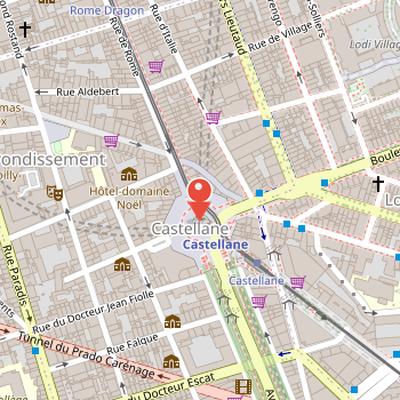
Castellane Square is a plaza in the 6th district of Marseille, near the city center. It is named after Henri-César de Castellane-Majastre, who offered the land and funding in 1774. From 1811 to the early 20th century, the square’s center was marked by an obelisk installed on the occasion of the birth of Napoleon I’s son, the King of Rome. Joseph Conrad later mentioned the square and its obelisk in La flèche d'or, set in 1875. The obelisk was moved to the Mazargues district on 12 November 1911 and replaced by the Jules Cantini fountain. Sculpted by André-Joseph Allar in Carrara marble between 1911 and 1913 at the request of Jules Cantini, the fountain represents Marseille atop a column and allegorically refers to the Mediterranean and the Rhône. The square is also an important transport point, where the two metro lines intersect and where tram line 3 terminates.
Nearby Objects
-
 Couvent Saint-Lazare 200 m away
 -
 Basilique du Sacré-Cœur de Marseille 500 m away
 -
 Musée Cantini 850 m away
 -
 Notre-Dame de la Garde 1000 m away
 -
 Place Jean-Jaurès 1000 m away
Place Castellane and Its Monumental Center
Place Castellane is a plaza in the 6th district of Marseille, near the city center. It was named after Henri-Cesar de Castellane-Majastre, who offered the land and funding in 1774. From 1811 to the early 20th century, the square's center was marked by an obelisk installed to commemorate the birth of the son of Napoleon I, the King of Rome. Joseph Conrad later mentioned the square with this obelisk in La fleche d'or, which is set in 1875. On 12 November 1911, the obelisk was moved to the neighborhood of Mazargues and replaced at Place Castellane by the Jules Cantini fountain. Sculpted by Andre-Joseph Allar between 1911 and 1913 in Carrara marble at the request of Jules Cantini, the fountain represents Marseille on top of a column and allegorically represents the Mediterranean and the Rhone. Beyond its monumentality, Place Castellane is also an important transport node, where the two metro lines of Marseille intersect and where line 3 of the tram terminates.