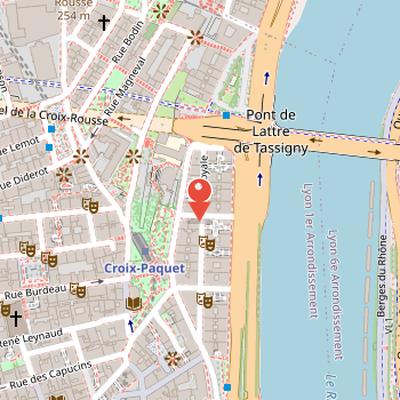
Rue Royale is a street in the 1st arrondissement of Lyon, France. It begins between Place Michel-Servet and Rue de Provence and ends by joining Grande Rue des Feuillants. The street has many closed traboules connecting it to Quai André-Lassagne and Rue d'Alsace-Lorraine, and it is served by the Croix-Paquet metro station.
Opened in 1740, rue Royale was the main street in the quartier Tolozan created by Jacques-Germain Soufflot. Other streets in the district included rue Dauphine, rue de Berri, and rue de Provence. Over time, wealthy merchants settled there and many restaurants opened along the street. Rue Royale was originally longer, but its northern part was demolished for the sortie du Tunnel de la Croix-Rousse. The street also once included a bathhouse called Le Clavecin at its beginning. Its name changed several times, becoming rue de la Convention in 1792, rue de la Démocratie in 1848, and rue Nationale in 1849, before being renamed rue Royale by mayoral decree.
Nearby Objects
-
 Église Saint-Polycarpe 300 m away
 -
 Place Louis-Pradel 350 m away
 -
 Morand Bridge 350 m away
 -
 Église Saint-Bernard 350 m away
 -
 Passage Thiaffait 350 m away
Rue Royale in Lyon
Rue Royale is a street in the 1st arrondissement of Lyon, France. It begins between Place Michel-Servet and Rue de Provence, and ends by joining Grande Rue des Feuillants. The street is notable for its many closed traboules, which connect it to Quai Andre-Lassagne and Rue d'Alsace-Lorraine. It is also served by the Croix-Paquet metro station.
History of Rue Royale
Histoire describes the opening of rue Royale in 1740 as the main street in the quartier Tolozan, created by Jacques-Germain Soufflot. Other streets in the same district included rue Dauphine, rue de Berri, and rue de Provence. The street attracted many wealthy merchants, and many restaurants opened there. It was also associated with a famous bathhouse, Le Clavecin, at the beginning of the street, constructed by Gary. Rue Royale was originally longer, but its northern part was demolished for the sortie du Tunnel de la Croix-Rousse.
The street also underwent several name changes. After the death of King Louis XIV, it was named rue de la Convention, as attested in 1792. It was renamed rue de la Democratie in 1848 for a short time, then rue Nationale in 1849. It later returned to the name rue Royale by a mayoral decree.
Rue Royale and La Mere Brazier
Rue Royale lies at the foot of the Croix-Rousse hills and is lined with five-story sandstone buildings with signed facades. The street also features several painted monumental doors, and its western end is marked by a last building with one floor and a rooftop terrace. Along the street, a cabinet of architecture, a nightclub, and the Theatre de l'Anagramme are also located. In the nineteenth century, rue Royale housed many silk manufacturing companies, including Maison Baboin around 1838.
At number 12 rue Royale is the restaurant La Mere Brazier. It was established in 1921 by Eugenie Brazier, who arrived in Lyon in 1914. The restaurant received three Michelin stars from 1933 to 1939 and was later purchased by Mathieu Viannay in 2007. Brazier was further honored in 2003, when rue Marceau was renamed rue Eugenie-Brazier on the occasion of the restaurant's 80th anniversary.
Traboules along Rue Royale
Rue Royale contains 14 traboules, most of which are open and direct. Several of them are identified by distinctive architectural details. At number 5, one traboule has three entrances and features five medallions, stained glass doors, head and crouching lion sculptures, lanterns, and painted vases. Number 11 includes curved access, three metal balconies, and plants in the courtyard. Number 15 has a triangular courtyard with three balconies, while number 17 is marked by a large door. At number 21, an elevated entrance leads to a courtyard with two columns, and number 23 has a door of style indicated in the record. Numbers 25-27 include a restored courtyard, a large door, and a repainted facade. Number 29 is notable for a tall fountain with an unusual pendulum topped by a Virgin and Child. Number 31 contains a small glazed courtyard and stone balconies, and number 33 has an entrance in the Louis XVI style. The street also includes curved traboules at numbers 11, 29, 31, and 33, contributing to the variety of passages found along rue Royale.