Église Saint-Bernard de Lyon is a church located in Lyon, on montée Saint-Sébastien, and belongs to the city of Lyon. It was consecrated in an unspecified year and is described as having no bell tower or parvis. The church’s history is linked to the development of the hill of La Croix-Rousse after its attachment to Lyon in 1852. In response to requests from the canuts, and because Saint-Polycarpe church was considered insufficient for the population, the municipality agreed to support the construction of an additional church. Land was donated by the family of Jean-Baptiste Willermoz in 1854 for a provisional chapel. The building was temporarily closed in 1891 because underground galleries and a tunnel affected its foundations, and it later remained unstable. It was desacralized in 1999 and totally closed in March 2004. In 2016, the city of Lyon planned to transform it into an office building, while also receiving purchase proposals from the Fraternité Sacerdotale Saint-Pie-X. The city later announced that Colbert, a subsidiary of Carré d’Or, would rehabilitate the building.
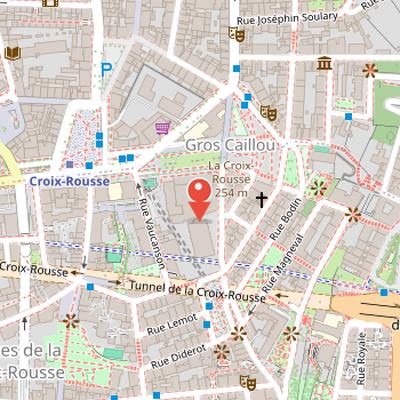
Nearby Objects
-
 Gare de Lyon-Croix-Rousse 250 m away
 -
 Rue Royale 350 m away
 -
 Maison des Canuts 400 m away
 -
 Bon-Pasteur Church 400 m away
 -
 Église Saint-Polycarpe 400 m away
History and Later Use
L'eglise Saint-Bernard de Lyon is located in Lyon, on the Montee Saint-Sebastien, and belongs to the city of Lyon. It was consecrated in an unspecified year and was built without a bell tower or a parvis. In 1891, it was temporarily closed because underground galleries and a tunnel affected its foundations. The church was desacralized in 1999 and has been totally closed since March 2004. In later years, the city considered new uses for the building: in 2016, it planned to transform it into an office building. The city also received purchase proposals from the Fraternite Sacerdotale Saint-Pie-X, and later announced that Colbert, a subsidiary of Carre d'Or, would rehabilitate the site.
Origins and Early History
In 1852, the hill of La Croix-Rousse was attached to the city of Lyon, and the canuts asked the municipal authorities to build an additional church. The Saint-Polycarpe church was considered insufficient for the population, and the municipality agreed to the request in order to appease conflicts after the canuts' revolt. It then looked for land suitable for a new church. In 1854, the family of Jean-Baptiste Willermoz donated land in the present-day montée Saint-Sebastien for a provisional chapel. Later, in 1867, the municipal council voted a subsidy to stabilize the church steps. The church was closed in 1891 for a restoration phase, which continued until 1900.
Closure, Instability, and Restoration Studies
The building became unstable because of the construction of the tunnel de la ficelle under its southwest angle. It remained unstable until 1992, when it was definitively closed. In 2001, a study was carried out to assess the full cost of restoring the building and to compare that amount with the cost of destruction.
Rehabilitation Project and Legal Dispute
The city of Lyon engaged a rehabilitation project for the ruined church, with the aim of maintaining its religious function through a traditionalist Catholic association. The project was approved by the city in 2016 and assigned to the Colbert company, a subsidiary of the Carré d'Or group. Its budget was estimated at about 5 million euros. In 2017, the Saint-Bernard de Lyon association contested the project before the Lyon tribunal, but the challenge was rejected in 2021.