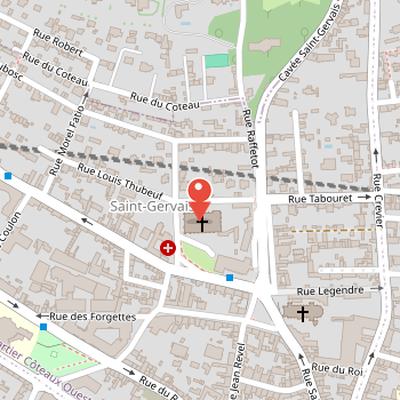
Saint-Gervais Church in Rouen is a Catholic church of the Archdiocese of Rouen. The current building was constructed between 1868 and 1874 in a neo-Romanesque style by architect Martin Pierre, and it features pointed vaults. It succeeds an earlier priory dependent on the abbey of Fécamp. According to tradition, the first bishops of Rouen are buried in the church crypt, which is a rectangular crypt under the choir and predates the year 1000. The site is connected to a large palaeochristian cemetery extending to Renard street, where many sarcophagi were found; two sarcophagi are displayed in the church. The priory was known for hosting Thomas Becket during illness, and was regularly visited by Henry II of England and Louis VII of France. The church’s history includes demolition in 1418 before the English siege, reconstruction in 1434, and later damage in 1560, 1562, and during the 1591 siege of Rouen. The church is listed as a French historical monument since 1840. The choir fresco was painted by Savinien Petit, and the central panel with a cross is surrounded by six painted panels representing saints Thomas Becket, Mellon, Gervasius, Protasius, Victricius, and Andrew.
Nearby Objects
-
 Musée Flaubert 500 m away
 -
 Synagogue de Rouen 750 m away
 -
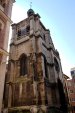 Saint-Patrice Church 750 m away
 -
 Place du Vieux-Marché 800 m away
 -
 Jeanne au bûcher 850 m away
Construction and Style
The Church of Saint-Gervais in Rouen is a Catholic church of the Archdiocese of Rouen. It was constructed between 1868 and 1874. The building was designed by architect Martin Pierre in a neo-Romanesque style, giving the church its distinct architectural character within the town of Rouen.
History and Architectural Features
The current church of Saint-Gervais de Rouen is built in a Neo-Romanesque style with pointed vaults. It succeeds an earlier priory dependent on the abbey of Fecamp, which lasted until the 15th century and was known for hosting Saint Thomas of Canterbury during illness. Kings Henry II of England and Louis VII of France were also regular visitors to the priory. The site has a long earlier history, including a rectangular crypt beneath the choir that predates the year 1000. Tradition states that the first bishops of Rouen are buried in this crypt. Nearby, a large Paleochristian cemetery extends to Renard Street, and many sarcophagi have been found there; two sarcophagi are displayed in the church itself. The place is also linked to the death of William the Conqueror, who died outside the priory on September 9, 1087. The church was demolished in 1418 before the English siege, rebuilt in 1434, then damaged in 1560 and 1562 during civil and religious revolts, and again during the 1591 siege of Rouen by Henry IV of France.
Interior Decoration and Heritage Status
The church contains notable interior decoration linked to its artistic history. In 1823, Charles Marie Bouton made a drawing of the crypt of Saint-Gervais. The choir fresco was painted by Savinien Petit. Its central panel, decorated with a cross, is surrounded by six painted panels representing Saint Thomas Becket, Mellon, Saints Gervasius and Protasius, Saint Victricius, and Saint Andrew. The church has also been listed as a French historical monument since 1840.