Place du Vieux-Marché is a square in which several historical periods are visible in its present layout and monuments. Its fame is closely linked to the execution of Jeanne d’Arc by burning alive on the square, and the site later became a place of memory and worship connected with her martyrdom. A cross was erected near the stake location, and it bears an inscription honoring Jeanne d’Arc. The square also contains the remains of the former Saint-Sauveur church, whose substructures were uncovered during renovation work. The former church was destroyed during the Terror, and the parents of Pierre Corneille were buried there. The square was also an active commercial center during the Second Empire, when two market halls were built. Its current appearance largely results from redevelopment in the 1970s, and it includes the Sainte-Jeanne d’Arc church, inaugurated in 1979, as well as a reconstructed butcher’s hall built in 1928-1929.
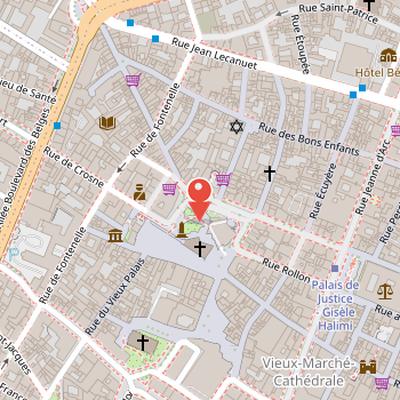
Nearby Objects
-
 Jeanne au bûcher 30 m away
 -
 Church of St Joan of Arc 30 m away
 -
 Place de la Pucelle-d'Orléans 140 m away
 -
 Synagogue de Rouen 140 m away
 -
 Saint-Éloi de Rouen 200 m away
Access and Surroundings
Place du Vieux-March e is served by the streets de la Pie, du Vieux-Palais, de Crosne, Cauchoise, and du Gros-Horloge, as well as by a street of the place de la Pucelle. The site also includes an underground parking area and a Lovélo station. These access arrangements indicate that the square is integrated into a network of nearby streets and transport facilities.
Historical Layers and Jeanne d'Arc Memorials
Place du Vieux-Marché has a layered history that combines commerce, religious memory, and public commemoration. The square once housed the former Saint-Sauveur church, which was destroyed during the Terror in 1794-1795. During the renovation of the square, the substructures of this church were uncovered and are now visible on the south side of the current Sainte-Jeanne d'Arc church. The parents of Pierre Corneille were buried in the former Saint-Sauveur church, adding another historical association to the site.
The square is also strongly linked to the execution of Jeanne d'Arc by burning alive, an event that became central to its later identity. The place of public executions, including the pillory and the firewall for the stakes, was excavated alongside the church foundations between 1970 and 1976. A cross was erected near the stake location as stipulated during the rehabilitation trial in 1456, and it later became a national monument honoring Jeanne d'Arc, with the inscription: "A Jeanne d'Arc LE PEUPLE FRANCAIS RECONNAISSANT." Since the Second Empire, the memory and worship of Jeanne d'Arc intensified, with efforts to emphasize her martyrdom site. The Jeanne d'Arc statue at the stake, created by Maxime Real del Sarte in 1927, is part of this commemorative landscape.
The square also served as a commercial center. During the Second Empire, two market halls were built there, and the site remained associated with food trade and popular activity. A reconstructed butcher's hall, built in 1928-1929 by architect Edmond Lair, further reflects this commercial role. In 1935, Lucien Dorin, owner of La Couronne restaurant at 31 place du Vieux-Marché, initiated the Fete du Ventre.
The present appearance of the square results from redevelopment work by the municipality in the 1970s. In the late 1970s, the Sainte-Jeanne d'Arc church was built by architect Louis Arretche and inaugurated on May 18, 1979, by President Valerie Giscard d'Estaing. Its design evokes both a Viking ship and a fish, and it allows the viewing of thirteen stained glass windows preserved from the choir of the former Saint-Vincent church. Until 2012, a Jeanne d'Arc museum was located south of the square near the oldest inn in France.
Market Hall Changes and Nearby Theatre Site
The old metal market halls and the butcher's hall were demolished in 1973. A small market continues to operate under the rebuilt hall, which has roof trusses shaped like wheat sheaves and slate coverings similar to the adjoining church. Nearby, the Theater-Francais had been located at 563 Rue Saint-Romain until 1944, when it was bombed. In 1960, it was replaced by modern buildings with half-timbered facades modeled on 16th-century forms.