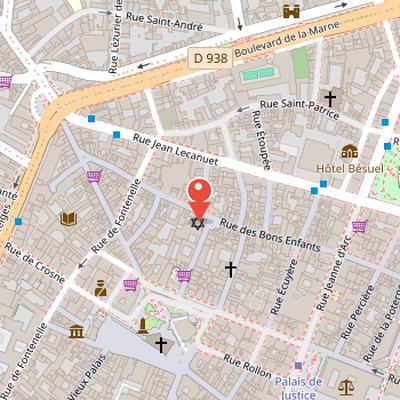
The Synagogue de Rouen is a consistorial synagogue of Sephardic rite located at 55 rue des Bons-Enfants. A commemorative plaque stands in front of the entrance in memory of the deported dead of the Jewish community of Rouen. The site is accessible by the Palais de Justice metro station and by bus at the Square Verdrel stop.
The present synagogue was built at the corner of rue des Bons-Enfants and rue de l'Ancienne-Prison after the earlier building had been almost entirely destroyed on 6 June 1944. The new synagogue, completed in 1964 and designed by architects François Herr, Robert Duménil, and François Gilbert, has a quadrangular plan and is enclosed on the north side by a low wall. Its main facade includes a large entrance porch with a western door and four tall rectangular windows. On the lateral facade, a projection with a square window features tracery forming a Star of David. Stained glass windows by Gabriel Loire depict the Star of David and the Ten Commandments. In 2001, the synagogue received the label of Remarkable Contemporary Architecture.
Nearby Objects
-
 Place du Vieux-Marché 140 m away
 -
 Jeanne au bûcher 150 m away
 -
 Church of St Joan of Arc 150 m away
 -
 Saint-Patrice Church 250 m away
 -
 Place de la Pucelle-d'Orléans 250 m away
Location and Memorial Significance
The synagogue de Rouen is a consistorial synagogue of Sephardic rite located at 55 rue des Bons-Enfants in Rouen. In front of the entrance, it has a commemorative plaque honoring the deported dead of the Jewish community of Rouen. This plaque gives the building an added memorial function, linking the synagogue not only to religious life but also to the remembrance of the local Jewish community.
Access and Location
The synagogue de Rouen is accessible by public transport through the Palais de Justice metro station. It can also be reached by bus at the Square Verdrel stop. These access points indicate its connection to the surrounding urban transport network and its placement within the city center.
The Medieval Jewish Quarter of Rouen
In the Middle Ages, Rouen's historic territory was structured around two main streets: the cardo, now rue des Carmes, running north to south, and the decumanus, now rue du Gros-Horloge, running east to west. Within this framework, the Jewish street, or Vicus judaeorum, extended for about 300 meters in the northwest sector, parallel to the decumanus. It was first mentioned in 1116 in Les Annales de Rouen and served as the center of the neighborhood known as terra judaeorum.
The Jewish quarter covered approximately one-twelfth of the city's intra muros area during the Middle Ages. By the end of the 13th century, its Jewish population is estimated at between 3,000 and 5,000 residents, representing 15 to 20 percent of the total population. After the Jewish expulsion in 1306, the place aux Juifs was renamed clos aux Juifs. The community also had a cemetery outside the city walls, beyond the current boulevard de la Marne and uphill toward Mont-Saint-Aignan. This burial ground was called cimetière as Juieulz or juif, a naming pattern typical of Jewish cemeteries in medieval Europe.
Reconstruction of the Rouen Synagogue
The synagogue in Rouen has a complex history of destruction, reuse, and reconstruction. Its former church building was deconsecrated and sold during the French Revolution, then used as a warehouse and school before becoming a synagogue in 1865. That building was later destroyed in 1886, and archivist Charles de Beaurepaire described it in an article published between 1891 and 1893. During the early Occupation, the synagogue was closed by the Germans and converted into a first aid post. It was then almost entirely destroyed by a powerful English bomb on June 6, 1944, causing many casualties inside. The porch was the only surviving structure, but it was demolished in 1954 during city reconstruction.
A new synagogue was built at the corner of rue des Bons-Enfants and rue de l'Ancienne-Prison, designed by architects Francois Herr, Robert Dumenil, and Francois Gilbert. Construction was completed in 1964. The building has a quadrangular plan and is enclosed on the north side by a low wall. Its main facade consists of a principal building with an attached large entrance porch, a western door, and four tall rectangular windows. On the lateral facade along rue de l'Ancienne-Prison, a projection includes a square window whose tracery forms a Star of David. The stained glass windows, created by Gabriel Loire, depict themes of the Star of David and the Ten Commandments. In 2001, the synagogue received the Remarkable Contemporary Architecture label.
Jewish History in Rouen
Sources on the history of the Israelites of Rouen describe a Jewish presence in the city dating back to Roman colonization, when the community settled in Rothomagus in the area of the cardo and decumanus. According to these accounts, Roman power encouraged this installation in support of the military conquest of Gaul. The community is presented as continuous for one millennium, despite repeated episodes of violence, until its expulsion in 1306.
The history recorded for Rouen includes a pogrom in 1007 that decimated part of the Jewish population, followed by persecutions under the dukes of Normandy between 1010 and 1035. The pope ended persecution in 1010, and the Jew Reuben ben Isaac later fled Rouen to Palestine. Around 1070, William the Conqueror brought Jews from Rouen to London. In 1096, Norman crusaders persecuted the Jews of Rouen, offering death or Christian conversion, but William Rufus allowed Jewish converts to return to Judaism in 1099, after which the community and its institutions were reconstructed.
By the 12th century, the community appears as part of a wider intellectual and political history. In 1131, Jews gave gifts to Pope Innocent II in Rouen through King Henry Beauclerc. Hebrew studies flourished in Rouen between 1140 and 1200, and scholars such as Samuel ben Meir, Menahem Vardimas, and Abraham ibn Ezra produced Bible exegeses and Talmud commentaries. Later royal measures tightened the situation: Philip Augustus expelled the Jews from the French royal domain, including Normandy, in 1182, recalled them in 1198 with limited freedom of status, and after his conquest of Rouen in 1204, Norman Jews came under French kings' jurisdiction. Further restrictions followed, including the distinctive sign imposed by the Fourth Lateran Council in 1215 and limits on financial activities between 1220 and 1250.
By the late 13th century, Calot de Rouen served Philippe le Bel as procurator of the Jews of France from 1296 to 1299. The final expulsion of Jews from France by Philippe le Bel in 1306-1307 ended the community's long presence, and the king then granted Rouen the clos aux Juifs and its dependencies. A later account in the Journal de Rouen devoted two pages to synagogues israilites a Rouen and outlined the history of Judaism in Normandy's capital.
Marrano Families in Rouen
According to L'histoire des Israelites de Rouen, Marrano families settled in Rouen at the end of the 16th century, followed by other waves of arrivals. The same source notes that some of these families later emigrated to Amsterdam, Anvers, Hamburg, or London. It also documents the near disappearance of the Marrano community in Rouen. These movements show a community that was present in the city but remained small and unstable over time.
The Jewish Community of Rouen
A new Jewish community appeared in Rouen after the Revolution, mainly composed of Alsatian Jews. Two representatives of this community took part in the creation of the Consistoire central israelite de France in 1806. By the mid-19th century, the Rouen community had about 300 members.
At the start of the Occupation, the situation for Jews in Rouen and the surrounding area worsened progressively. Arrests and deportations began early, and German forces considered the region strategically important because of its proximity to the Manche coasts. A fanatic section of the Police aux questions juives, designated by the Vichy regime, was responsible for handling the Jewish question in Rouen. The community suffered about 500 victims, representing approximately 90 percent of the Jews present in 1939, compared with about 25 percent in France overall.
As of 2016, the current Jewish community in Rouen mainly comprised Sephardic Jews from North Africa and included about 250 families, or roughly 700 persons.
Exhibition for the Reopening of the Maison Sublime
During the summer of 2018, the Musee des Antiquites de Rouen organized an exhibition titled Savants et Croyants. Les juifs d'Europe du Nord au Moyen Age. The exhibition was dedicated to Jewish intellectual life and material culture in the Middle Ages. It was held on the occasion of the reopening of the Rouen Jewish monument called the Maison sublime.
2024 Arson Attempt
In 2024, the synagogue de Rouen was the target of a criminal arson attempt. The attack involved an attempt to set the building on fire using a knife and an iron bar. A police officer who was called to the scene was also attacked. The incident caused partial damage to the furniture inside the synagogue, and some walls were blackened by the incendiary device that had been thrown from outside.