The Nantes Museum of Arts is an art museum located in Nantes. Formerly named the musée des Beaux-Arts de Nantes, it presents a comprehensive overview of major French and European artistic movements from the 15th century to the present. Its collections are among the most important public French collections outside Paris and are comparable to those of the museums of Beaux-Arts in Valenciennes, Grenoble, Lyon, Lille, and Montpellier.
The museum is associated with the creation of the musée d’Arts de Nantes by consular decree, alongside fourteen other provincial museums. Its history includes the receipt of works purchased by the State and deposits from the Musée central, as well as the purchase of the Pierre and François Cacault collection, which was later supplemented by donations and acquisitions supported by the Société des amis du musée des Beaux-Arts de Nantes. The museum’s development also reflects the challenges of finding a suitable location in the city during the 19th century, leading to decisions about housing the collection and, later, to plans for a dedicated building for the museum and municipal library.
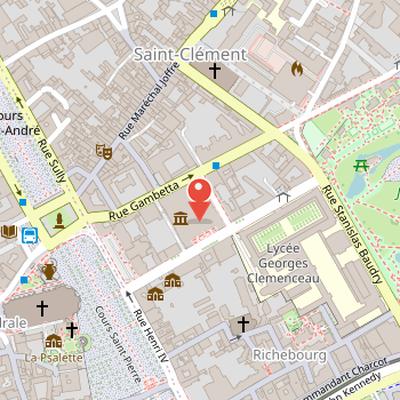
Nearby Objects
-
-
 Cours Saint-Pierre and Saint-André 150 m away
 -
 Place Maréchal-Foch 200 m away
 -
 Colonne Louis-XVI 200 m away
 -
 Saint-Clément 200 m away
Collections and Role
The Nantes Museum of Arts is an art museum located in Nantes. Formerly called the musee des Beaux-Arts de Nantes, it presents a comprehensive overview of major French and European artistic movements from the 15th century to the present. Its collections are among the most important public French collections outside Paris and are comparable to those of the museums of Beaux-Arts in Valenciennes, Grenoble, Lyon, Lille, and Montpellier.
Early Formation of the Museum Collection
The museum was created by consular decree as one of fourteen provincial museums. Its early holdings were formed through works purchased by the State and deposits from the Musee central. It gained importance for French public collections with the purchase of the Pierre and Francois Cacault collection, which was then supplemented by donations and acquisitions supported by the Societe des amis du musee des Beaux-Arts de Nantes. The museum also received artworks from the State in 1804 and 1809 from the reserves of the Musee central. These works came from the ancient royal collection, churches and convents of Paris, as well as from revolutionary and Napoleonic conquests. In 1810, the city of Nantes bought the Cacault brothers' collection, further enriching the musee de Nantes. The artworks sent by the State in 1804 and 1809, together with those bought in 1810 by Pierre Cacault, were later dispersed across various public buildings in Nantes.
From Dispersed Collections to the Palais des Arts
In the early 19th century, Nantes faced repeated difficulties in assigning a permanent museum location, despite State insistence. The municipal council did not succeed in fixing a site, and several location projects, including Mathurin Crucy's 1820 proposal, failed while the city was under financial pressure. At that time, the dispersed artworks were mainly kept in the offices of the Hotel de ville, with other works also housed in the Prefecture, the Civil Tribunal, and churches.
A turning point came in 1829, when the city decided to install the museum on the upper floor of the Halle aux Toiles. This choice responded to practical constraints: the building was recently built, centrally located, municipally owned, and expected to require only limited refurbishment. It was also one of the largest buildings in Nantes and had many windows, while the collection already exceeded a size that required substantial exhibition space. However, the Halle aux Toiles later proved problematic enough that the municipal council wanted the museum to endure in a different setting.
Pressure for a new solution continued in the 19th century. On a specific date, Mayor Louis-Hyacinthe Levesque opened a council session with a statement on the museum project, and on another date the Minister of the Interior and Fine Arts, Leon Bourgeois, sent a severe letter to the prefect of Loire-Inférieure demanding action from the mayor of Nantes. He threatened to withdraw State deposits of approximately a certain number if no solution was found.
In 1891, the city decided to build a dedicated museum and municipal library. A quadrangular plot near the lycee and the Jardin des plantes was selected for the future Palais des Beaux-Arts. The project was organized through a two-stage national competition called musee de peinture et de sculpture, and the new building was inaugurated as the Palais des Arts. Since 1900, it also housed the main collections of the municipal library until 1985, when those collections were moved to the new Mediatheque Jacques-Demy on quai de la Fosse.
Renovation, Expansion, and Public Access
In the 1980s, Historique renovated the ground floor spaces to display modern and contemporary art, but the museum remained overcrowded in the 21st century. Its contemporary art collections were still largely kept in storage because of limited space, and the building lacked modern infrastructure such as an auditorium and educational rooms. It also failed to meet international standards for conservation, presentation, and accessibility. On the recommendation of Blandine Chavanne, mayor Jean-Marc Ayrault decided to renovate and expand the museum, and a European competition was launched for the project. In 2009, the international contract went to the British architecture firm Stanton Williams, which was also commissioned to work on scenography, signage, and the urban planning of the adjacent streets and public places.
The renovation was intended to open the museum to the city, including the redesign of rue Georges-Clemenceau and the creation of a large forecourt. The museum closed for what was planned as a maximum of two years for the expansion works, but the closure was extended and reopening was postponed to 2017. The delay was linked to underground water discovered in 2012 during connection works, and the cost rose from 25 million euros to 46 million euros. The museum finally reopened on May 25, 2017, after six years of works.
The expansion increased the surface area from 7,000 to 13,000 square meters and added the Oratory Chapel for temporary exhibitions nearby. Technical spaces were relocated to the Cube, an extension created to address defects in the original Palace as an enclosed place. The architects worked on the connection between the museum and the chapel and the forecourt, using large windows to open the museum toward the city. They also removed the fences around the main facade and replaced them with a large terrace staircase open to the street. The original entrance and aesthetics, including the staircase, were preserved, while the patio underwent structural changes such as climate control installation and glass roof restoration. The project also included a comprehensive heritage rehabilitation: stone wall facades were cleaned, all facade sculptures of the Palace were restored, all ancient parquet floors were repaired, and all glass roof elements were replaced with an advanced climate control system.
The materials chosen for the new elements were metal in bronze color, raw oak wood furniture, and concrete, which provided the only color. The renovated museum now includes an auditorium, four educational rooms, basement storage, a renovated bookstore-shop, and a renovated cafe-restaurant. It gained 30 percent additional exhibition space for presented artworks compared with the previous 600, and it now meets international standards for artwork presentation and conservation while prioritizing public access.
Architecture and Historic Fabric
The Nantes Museum of Arts includes several architectural components that reflect different periods and uses. The new Cube building was designed as a modern structure integrated into the older environment, with architects seeking a link between the past and the present. It is described as monolithic and sculptural, with four levels of fully modular exhibition spaces. Its facade combines marble and laminated glass, including a translucent marble side that illuminates at night. Natural light enters through narrow fissures in the north wall and through the south facade. Portuguese marble and plaster were used in a finish intended to resemble tuffeau and match the light color of the surrounding buildings.
The Cube is connected by the basement to the building at 14 rue Clemenceau, a new construction that contains no public areas. This part of the complex respects modern conservation standards and houses the graphic arts office and the library, which includes collections such as the Documentation Internationale d Art Contemporain fonds.
The museum also incorporates a chapel that was classified as a historical monument by decree. It became property of the city of Nantes in 1963, reopened to the public in 1989 after a long restoration, and now serves as an exhibition space. Access is limited by grids at each end for exclusive museum use. The museum name was decided in 1899 and honors the painter Jules Dupre, who lived from 1811 to 1889.
The Museum Collections
The collections of the Nantes Museum of Arts have been enriched with artworks by living artists since 1801 and now comprise more than 900 paintings, sculptures, photographs, videos, and installations. They also include deposits from the Fonds regional d'art contemporain des Pays de Loire and the Centre Pompidou, as well as numerous deposits from the Fonds national d'art contemporain since 2003.
A major strength of the museum is its significant fund of Italian primitives, largely formed from the collection assembled by diplomat Francois Cacault between 1785 and 1803. This group includes works from the Florentine and Siennese schools of the 14th and 15th centuries, with Renaissance Italian paintings by Bernardo Daddi, Bicci di Lorenzo, Mariotto di Nardo, Cenni di Francesco, Cosmè Tura, Jacopo del Sellaio, and Sano di Pietro. Other works in the collection include pieces by Ambrogio Borgognone, Andrea Solari, and Le Perugin, as well as a Saint Sebastien and a saint franciscain dating from before 1523. The collection is particularly rich in 17th-century art, reflecting the importance of the Italian school, and includes Caravaggesque works, classic-inspired masterpieces, and small devotional paintings and sketches sent by the State. It also features still lifes and landscapes from the Cacault collection, together with works by Gaspard de Crayer and Theodor Boeyermans, and testimonies to the virtuosity of Northern schools in landscape, still life, genre scenes, and portraiture.
Later additions broadened the scope of the museum. In 1854, shipowner Urvoy de Saint-Bedan donated works by Georges Dufrenoy. The museum later received a 1917 version of Nymphaas by Claude Monet in 1922 and a 1930 bequest from Georges Clemenceau of Gondoles a Venise (1908) by Monet. It also purchased Nu jaune by Sonia Delaunay in 1987 and includes works by Marc Chagall titled Obsession and Le Cheval rouge.
The contemporary collection has been further expanded through works associated with the Nouveaux realistes, including Francois Dufrene, Jacques Villegle, Martial Raysse, Gil Joseph Wolman, Jean Tinguely, and Raymond Hains, as well as artists linked to Arte Povera such as Piero Manzoni, Luciano Fabro, Giuseppe Penone, Alighiero Boetti, and Pino Pascali.
Collection Layout and Display
The Nantes Museum of Arts presents its collections through a structured arrangement that links ancient, modern, and contemporary art. Ancient art galleries are accessible on the ground floor of the Palais, while modern and contemporary art collections are located on the first floor. In the Cube building, contemporary art is displayed on four levels of thematic exhibition space. The collections are organized with chronological continuity, allowing art ancient and art modern to be seen in relation to one another. This layout is reinforced by new museographic modules created by Stanton Williams, which interrupt the linear character of the galleries. The exhibition spaces are generally white rooms, with one colored wall per gallery introduced by the new modules. Abstract works are also displayed in the adjacent gallery and in the walkway connecting the old and new building named the Cube. Overall, the display encourages dialogue between contemporary and ancient art in order to provoke curiosity and understanding among visitors.
The Building of the Collection
The history of the collections at the Nantes Museum of Arts was shaped by a combination of state shipments, city purchases, donations, and bequests. Its formation began with the Chaptal consular decree of August 31, 1801, which created provincial museums, including the Nantes museum. The decree arranged for artworks from former ecclesiastical and royal collections, revolutionary seizures, and Napoleonic war spoils to be sent to these institutions. Nantes received 43 masterworks in 1804 and 1809.
Later acquisitions and gifts played a major role in expanding the museum's profile. In 1854, Jacques-Olivier-Marie Urvoy de Saint-Bedan donated 30 paintings to the City, including works by Jacques Raymond Brascassat and Horace Vernet. In 1958, Gildas Fardel, an abstract art collector, donated works by Hans Hartung, Serge Poliakoff, Pierre Soulages, Julio Gonzales, and Vassily Kandinsky. The museum also acquired Vers le bas, painted in 1929, which became the first Vassily Kandinsky work in a provincial public collection. Fardel made three further donations in 1969, 1972, and 1989, totaling more than 400 pieces, and his gifts helped make the museum one of the most important French public contemporary art collections, alongside Grenoble, Marseille, and Saint-Etienne. He chose the museum because of its acquisition policy focused on contemporary creation, and his documentation formed the Documentation internationale d'art contemporain (DIAC).
Anne Dehez also contributed to the collection between 1978 and 1989, donating drawings, graphics, a catalog, and an artist's book. Her gift included paintings by Martin Barre, Jean Deyrolle, Luis Feito, John Franklin Koenig, Jean Leppien, and Pierre Fichet. She began the donation process after the 1978 exhibition L'art moderne dans les musees de Province and an initiative by Jean Lacambre. The first part of her collection entered as a donation in 1978, and the second part was received as a bequest in 1989 after administrative delays and document drafting complications.
The Growth of the Collections
The history of the museum's collections shows a gradual shift from old masters toward modern and contemporary art. Its holdings include works by Andre Derain, as well as paintings such as La Visitation and La Sainte Famille pendant la fuite en Egypte servie par les anges by Charles de La Fosse, and La Rencontre de David et Abigaill around 1729 to 1730 by Nicolas Veughels. The museum also acquired two paintings from the sign school by Paul Alexandre Alfred Leroy and Johan Barthold Jongkind. During this period, acquisitions were decided by a Commission de surveillance with authorization from the municipal administration.
Between 1825 and 1886, acquisitions were dedicated to contemporary Nantais, regional, or national artists, but the museum later shifted its focus toward contemporary art because old masters dominated its collections. It purchased works by Eugene Delacroix in 1839, Jean-Auguste-Dominique Ingres in 1853, Jean-Baptiste Corot in 1858, and Gustave Courbet in 1861. From 1861 onward, the Commission chose more traditional and academic works, and the collections remained limited in their representation of avant-garde movements such as Impressionism and Post-Impressionism.
This situation changed after the creation of the Societe des amis du musee des Beaux-Arts de Nantes in 1919, when acquisitions moved toward avant-garde artists. The museum acquired works by Claude Monet, Paul Signac, Raoul Dufy, Georges Dufrenoy, and Kees Van Dongen. After World War II, contemporary acquisitions were renewed, and the purchase of Salve Regina, a large painting by Alfred Manessier from 1945, after an exhibition in 1947, introduced abstraction into the collections.
Contemporary acquisitions intensified during the 1980s with works by Italian Arte Povera artists including Giuseppe Penone and Luciano Fabreo, and by Supports/Surfaces protagonists Claude Viallat, Daniel Dezeuze, and Toni Grand. The modern and contemporary collections were also enriched by active deposits from Fonds national d art contemporains, Fonds regional d art contemporain des Pays de la Loire, and numerous deposits from Musee national d art moderne - Centre Pompidou. The museum was unaware of Jacqueline-Francoise Boejat.
Exhibitions and Municipal Collecting
The early history of the Nantes Museum of Arts is closely linked to public art exhibitions in the city. The first public art exhibition in Nantes was held in 1825, followed in 1836 by the first triennial exhibition organized by the City and the Societe des beaux-arts, which presented 275 works. Seven further triennial exhibitions took place in 1839, 1842, 1845, 1848, 1851, 1854, and 1858. After 1861, the frequency decreased, with exhibitions held in Nantes in 1861, 1872, and 1886.
A larger-scale event was organized after the Universal Exhibitions in London in 1851 and Paris in 1855. In late 1860, a Comite d'action of twelve members was created to direct and promote the project, and the exhibition obtained the patronage of Empress Eugenie. It presented products of industry, agriculture, fine arts, and horticulture divided into nine groups, and was accompanied by many festivities, including concerts, horse races, a cavalcade, nautical festivals, and night celebrations at the Jardin des plantes.
The 1861 fine arts exhibition, held as part of the National Exhibition, included works in painting, engraving, lithography, photography, sculpture, architecture, and glass painting. It attracted public attention for the quantity and quality of the works shown. The municipality used funds from this exhibition to enrich its museum by purchasing artworks, including paintings by Jean-Leon Gerome, Paul Baudry, Jean-Louis Hamon, and Gustave Courbet.
The 1886 exhibition, held near the Nantes cathedral on cour Saint-Andre, further contributed to Nantes artistic reputation and art market. Despite scandals caused by Impressionist and Neo-Impressionist works, it attracted 8000 visitors. The museum did not acquire avant-garde works at this salon, preferring academic paintings such as Une stigmatisee au Moyen Age by Georges Moreau de Tours, Psyche by Helene Luminais, Barque de peche, a Trouville by Frank Myers Boggs, and Retour du bal by Alfred Philippe Roll.
War Damage and Contested Images at the Museum
Autour du musee records that Nantes was hit by important bombings on the 16th and on an unspecified later date, and that bombing victims were gathered in the hall of the Palais des Beaux-Arts. The same source describes how, during the days of the 23rd to an unspecified date, Charles Belbeoch of the Equipes Nationales recounted the conditions inside the building. The morgue was installed on the ground floor of the Palais des Beaux-Arts, where it occupied two rooms. Bodies were laid on planks, and rubber suits and gloves were used for handling the dead. Belbeoch also recalled relying on tobacco and alcohol to endure the night spent near the bodies, while dawn light revealed rows of coffins through window openings without glass.
The museum also appears in a later episode involving digital moderation. In an unspecified month, the painting Judas Macchabee priant pour les defunts by Pierre Paul Rubens was judged too violent by Google's algorithm. Autour du musee notes that the work depicts the biblical revolt of the Maccabees, including the severed head of General Nicanor. Google initially wanted to restrict access to the app to users over an unspecified age because of the painting. After contact with museum director Sophie Levy, the app became accessible with parental control.
Reopening and Visitor Reception
One year after its reopening, the Nantes Museum of Arts was welcoming frequent visitation. This indicates that the museum had regained public use and was receiving a steady level of attention following the return to operation.
Museum Commission and Governance
The Nantes Museum of Arts was administered by a commission appointed by municipal decree, which originally fixed its membership at seven. By 1870, the number of members could be increased up to a certain limit. The commission brought together wealthy notables, including doctors, lawyers, notaries, and politicians, as well as artists such as painters, sculptors, and architects. Merchants and civil servants were also represented, and the body usually included non-resident members chosen among Parisian personalities. Its responsibilities included administering the museum, deciding on art acquisitions, and accepting or refusing donations and legacies. The commission also designated the curator by proposing three names to the mayor in preferential order. In 1946, the Commission de surveillance changed status and became a consultative commission by municipal decree.