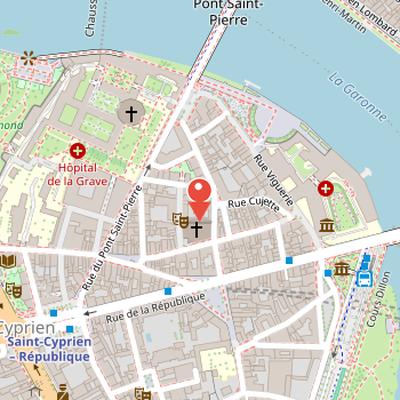
Saint Nicolas' Church is located on grande-rue Saint-Nicolas in the Saint-Cyprien district of Toulouse, on the left bank of the Garonne River. Classified as a historic monument, it is dedicated to the patron saint of those who travel by water and fear shipwreck, according to historian Guillaume Catel. Situated in a neighborhood affected by the annual floods of the Garonne, the church was reconstructed in 1300 in a typical southern Gothic style.
Its octagonal bell tower, in the Toulouse style, imitates the basilicas of Saint-Sernin and the church of the Jacobins. The tower has paired bays covered with mitre arches, and the portal opens at its base onto the great-rue Saint-Nicolas. Under the nave roof, mirandas indicate a covered wall-walk. The tympanum features a high-relief of the Adoration of the Magi, classified as a sculpted group under historic monuments and attributed to the workshop of Pierre Viguier. The nave, dating from the mid-14th century and divided into five bays, includes 19th-century paintings and six frescoes by Bernard Bénézet. The choir has rich 17th-century decoration, and the retable combines sculpture, painting, and reused earlier elements.
Nearby Objects
-
 Château d'eau 250 m away
 -
 Les Abattoirs 400 m away
 -
 Prairie des Filtres 450 m away
 -
 Quai de la Daurade 450 m away
 -
 Palace of the Visigoth Kings 500 m away
Location and Heritage Status
Saint Nicolas' Church is located on Grande-Rue Saint-Nicolas in the Saint-Cyprien district of Toulouse, on the left bank of the Garonne river. The church has been classified as a historic monument, underlining its recognized heritage value within the city.
Architecture and historic features
Saint Nicolas' Church is dedicated to the patron saint of all those who travel by water and fear shipwreck, according to historian Guillaume Catel. It stands in the Saint-Cyprien neighborhood, an area affected by the annual floods of the Garonne River. The church was reconstructed in 1300 in a typical southern Gothic style.
Its nave dates from the mid-14th century and is divided into five bays. The nave is in southern Gothic style and is attributed to Jean Constantin. It is decorated with paintings from the last third of the 19th century. The bell tower, built in Toulouse style, is octagonal and imitates the basilica Saint-Sernin and the church of the Jacobins. Its paired bays are covered with mitre arches, and mirandas visible under the nave roof indicate the presence of a covered wall-walk.
The portal opens onto the great-rue Saint-Nicolas at the base of the bell tower. Its tympanum features a high-relief of the Adoration of the Magi, classified as a sculpted group under historic monuments and attributed to the workshop of Pierre Viguier, active in the late 15th and early 16th centuries. The Virgin and Child on the tympanum has stylistic similarity to the statue known as Notre Dame de Grasse.
Interior Decoration and Furnishings
Saint Nicolas' Church in Toulouse contains a richly decorated choir from the 17th century and an interior marked by several notable works of art. The retable was created by sculptor Etienne Rossat and painter Jean-Baptiste Despax. It is made of red marble columns from Minervois and paintings by Despax, and its central panel is the painting Apotheose by Despax. The retable also reuses a bas-relief by Nicolas Bachelier, made in 1554 and gilded in the 17th century.
The church has six frescoes painted by Bernard Benezet between 1891 and 1894. These frescoes show scenes from the life of Saint Nicolas. The six chapels also preserve a variety of historic elements, including a Pieta sculpture by Jean-Louis Ajon, a Renaissance door from 1562, and fresco decorations from the 17th century in two of the chapels.
The Organ and Its Neo-Gothic Case
Saint Nicolas' Church in Toulouse contains an organ whose instrumental part was made between 1845 and 1847 by the workshop Daublaine and Callinet. It replaced an older organ that had been sold to Theodore Puget. That earlier organ was repaired and moved in 1867 to the church Saint-Blaise-et-Saint-Roch of Seysses. The organ's instrumental part is classified as a historical monument.
The console was made in 1848 by Andre Marie Daublaine and Louis Callinet, then modified in 1857 by Emile Poirier and Nicolas Lieberknecht, who were based in Toulouse after the bankruptcy of Daublaine and Callinet. It has three manual keyboards: a grand organ with 9 stops, a positive with 6 stops, and an expressive recit with 9 stops, as well as a straight German pedalboard with 5 stops.
The organ is housed in a neo-Gothic case with a large body and a dummy positive case with 2 turrets. This case is also classified as a historical monument.