Prairie des Filtres is a green area in the city of Toulouse, situated along the Garonne near Pont-Neuf and Cours Dillon. Its history reflects the transformation of a riverside area that was once urbanized and crossed by rue des Teuliers until the early 15th century. Major floods in 1430 and 1437 devastated the Saint-Cyprien district, and the left bank area, originally a marshy island, was gradually connected to the shore by sand deposits over time. In the 17th century, a retaining wall was built between Pont-Neuf and Porte de Muret using ancient marble blocks from the Garonne. The site takes its name from filtering galleries used to purify muddy water from the river, with the first established in 1821. Later, the prairie became a preferred place for popular events, charity festivals, military training, cattle races, and other gatherings. It was also used for football-rugby matches and large circuses.
Nearby Objects
-
 Château d'eau 300 m away
 -
 Saint Nicolas' Church 450 m away
 -
 Hôtel de Bagis 450 m away
 -
 Notre-Dame de la Dalbade 500 m away
 -
 Quai de la Daurade 600 m away
Location and Setting
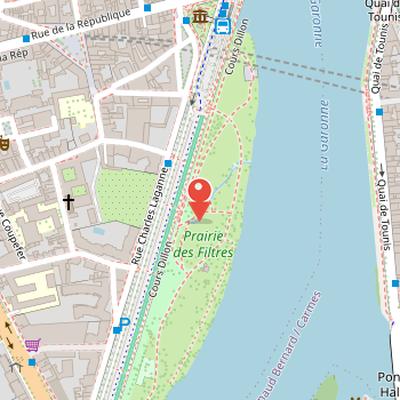
The Parc de la Prairie des Filtres is a green area in the city of Toulouse. It is located along the Garonne, near Pont-Neuf and Cours Dillon. Its position places it within a riverfront setting in the urban landscape of the city.
From Marshland to Water-Filtering Site
The Prairie des Filtres occupied a left-bank area that was originally a marshy island, later joined to the shore over time by sand deposits. In the early 15th century, the area was urbanized and crossed by rue des Teuliers, but flooding played a major role in its later history. A major flood in 1430 devastated the Saint Cyprien district and left only ruins, and another flood in 1437 discouraged inhabitants from resettling the area.
The site also reflects later riverbank works. In the 17th century, a retaining wall was built between Pont-Neuf and Porte de Muret using ancient marble blocks from the Garonne. The name Prairie des Filtres comes from filtering galleries used to purify muddy water from the Garonne. The first filtering gallery was installed in 1821, followed in 1827 by a second system made up of eleven interconnected wells. An additional gallery similar to the first was added in 1829.
By 1870, a flood had degraded water quality and reduced the quantity of water available. In 1872, new water sources such as the Portet filters were being considered. These facts place the prairie as both a flood-affected river landscape and an infrastructure site connected to the citys water supply history.
From Event Ground to Public Garden
Parc de la Prairie des Filtres has long served as a large open space for public life in Toulouse. Histoire identifies it as a preferred site for popular events, including the 14 July celebration initiated by municipal councillor Atoze Arzac. It also hosted charity festivals organized by mayor Amilhau in December 1871, as well as stands for Landes cattle races and agricultural fairs. The site was used for a wide range of gatherings, from the largest circuses to the landing of the first airplanes over Toulouse, and it remained a place for traditional fireworks. In 1889, the centenary of the Revolution was celebrated there with a simulacrum of the Battle of Valmy.
The prairie also supported more everyday and sporting uses. Histoire reports that various clubs were established there, including a swimming school for soldiers, and that it was the first football-rugby ground to host Stade toulousain matches. It also figures in accounts of rugby team achievements. The lush grass nourished a flock of sheep for a long time, and from 1914 to 1918 the area was converted into sheep grazing or workers gardens. At another stage, it was used as a military training ground, which led to complaints in 1873 that the prairie had been degraded. Residents of quai de Tounis also complained in summer 1873 about noise from the site.
Over time, the prairie was reduced by river development for flood control, but it continued to host public events. It is noted for having hosted the Rio Loco world music festival each summer since the mid-1990s. Since 1976, the Prairie des Filtres has been a public garden, described as one of the most pleasant gardens in Toulouse because of its proximity to the river and its views of the quays. In 2013, it also briefly became the site of a self-managed village opposed to law LOPPSI2, whose inhabitants were evicted by mayor Pierre Cohen about ten days after its establishment.
World Cup Fan Zone Use
According to the Histoire section, the Prairie des Filtres was temporarily reconfigured as a fan zone beginning with the quarterfinals of the 2018 FIFA World Cup. It broadcast all matches played by the French team until the end of the competition, covering three matches in total. The fan zone had a capacity of 7,000, which was doubled for the World Cup final.
Public Uses and Events
Parc de la Prairie des Filtres combines everyday leisure spaces with recurring public events. The site includes a parking area known as parking cours Dillon, a boulodrome, a large garden, and a playground intended for young children. It also serves as a meeting point for many student groups and as a family relaxation area. The boulodrome regularly attracts many residents from the Saint-Cyprien neighborhood, showing its role as a local gathering place.
The park is also a starting point for walks along the banks of the Garonne River. In its meadow area, rugby union matches are broadcast on a giant screen, including the 2007 Rugby World Cup matches. The site hosts the Rio Loco festival mainly in June on the prairie des filtres, followed a few days later by the Les siestes electroniques festival. A water skiing club is located on a concrete barge next to Pont Neuf, adding another distinct activity connected with the area.