Bobino is a performance hall at 20, rue de la Gaîté in the Montparnasse district of Paris. It takes its name from a famous clown and puppeteer. Established as a guinguette in 1873, it was transformed into a café-concert and became one of the most famous music halls in the capital after the First World War. The venue was destroyed in 1985 and subsequently replaced first by a discotheque and then by a cabaret-restaurant. From 2010, it resumed its original activity of combining shows and concerts under the direction of Jean-Marc Dumontet.
The name Bobino is also linked to an earlier theatre history. According to the provided history, the Théâtre du Luxembourg was created in 1816 to accommodate the traveling troupe of Bobino. Its performances included acrobatics, juggling, harlequinades, and pantomimes, and the venue became known as the Théâtre de Bobino, or familiarly Bobinche. After 1830, its repertory shifted toward vaudeville and melodrama.
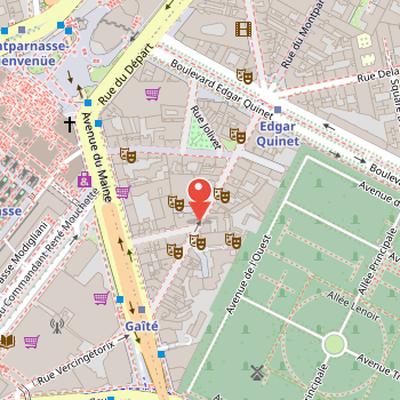
Nearby Objects
-
 Comédie-Italienne 60 m away
 -
 Théâtre Montparnasse 150 m away
 -
 The Kiss 250 m away
 -
 Montparnasse Tower 300 m away
 -
 Jardin Atlantique 350 m away
History of Bobino
Bobino is a performance hall at 20, rue de la Gaite in the Montparnasse district of Paris. It takes its name from a famous clown and puppeteer. The venue was established as a guinguette in 1873 and was later transformed into a cafe-concert. After the First World War, it became one of the most famous music halls in the capital. The original building was destroyed in 1985, after which the site was successively occupied by a discotheque and then a cabaret-restaurant. In 2010, Bobino resumed its original activity of combining shows and concerts under the direction of Jean-Marc Dumontet.
From Theatre du Luxembourg to Bobino
The Theatre du Luxembourg was created in 1816 at the corner of Madame and de Fleurus streets to accommodate the traveling troupe of the showman Bobino. Its performances mixed acrobatics, juggling, harlequinades, and pantomimes, which helped shape its popular identity. Parisians referred to it as the Theatre de Bobino, and more familiarly as Bobinche. After 1830, the theatre shifted its repertoire toward vaudeville and melodrama. It drew a popular audience, including many students from the Left Bank. In 1866, the building had become dilapidated, and Auguste Gaspari, the director of the Theatre du Luxembourg, moved the troupe to the Theatre des Menus-Plaisirs on boulevard de Strasbourg. The original building was demolished in early 1868 and replaced by a building at 61 rue Madame.
From Cafe-Concert to Song Theatre
In 1873, entrepreneur Fernand Strauss reused the Bobino name for a cafe-concert at 20 rue de la Gaite under the name Theatre des Folies-Bobino. The venue presented a mix of acts and short plays, including Bobino vit encore! in 1880, an adaptation of a success from the Theatre du Luxembourg. During the 1880s, however, the Folies-Bobino faced administrative obstacles and was not recognized as a real theater. In 1887, the police prefecture ordered the removal of the stage and allowed only a platform and fixed decoration.
A new phase began on January 1, 1897, when the venue became Bobino after acquisition by the Pathe cinema company. In 1912, impresario Montpreux took direction and shifted the programming toward chanson and music hall. Between 1909 and 1912, during exile in France, Lenin attended multiple concerts there and frequently met the French chansonnier Montehus at Bobino.
The venue expanded in 1918, and renovation works started in 1927 under director Paul Fournel. After this work, Bobino became an Italian-style theater with a capacity of one thousand people. Although this capacity was lower than that of Olympia, many artists considered Bobino a more intimate venue. In the 1930s, it became the main left-bank venue dedicated to song, hosting performers such as Damia, Lucienne Boyer, Felix Mayol, and Georgius. At the end of the decade, Edith Piaf also performed successfully there as a relatively new artist.
In 1958, Felix Vitry and Bruno Coquatrix purchased Bobino from the Castille family, who had owned it since the 1930s and wished to concentrate on the Europeen venue. The new directors programmed comedians Raymond Devos and Fernand Raynaud, along with non-star artists. Coquatrix withdrew in 1960 to manage only the Olympia venue, while Vitry renovated Bobino to make it more comfortable.
Notable Performers at Bobino
Bobino was strongly associated with major French chanson performers across several decades. Georges Brassens favored the venue and performed there about fifteen times between 1953 and 1976, including a five month residency in 1976. Léo Ferré appeared at Bobino from 1958 to 1971, while Barbara performed there from 1961 to 1975 and achieved a triumph on January 11, 1973, a success said to have inspired Ma plus belle histoire d amour. Dalida performed at Bobino in 1957, 1958, and 1965. Juliette Greco also appeared multiple times, with performances recorded in 1951, 1952, 1953, 1961, 1964, 1968, 1971, and 1972.
Joséphine Baker and Bobino
According to Histoire, Bobino was the venue for Joséphine Baker's last stage appearance, which was described as a successful show. Her final performance was funded with support from Monaco's princely couple. After her fourteenth performance, Baker suffered a cerebral attack at home, and she died on April 12, 1975. On April 15, 1975, her funeral procession passed in front of Bobino, which still displayed her name in large letters. Bobino then closed for eight days as a sign of mourning.
Closure, Reuse, and Revival
Bobino was closed in 1984 because of financial difficulties. In 1985, the building was bought and demolished by promoters, and from 1987 the site hosted a luxury hotel and a nightclub called Le Wiz. The nightclub also served as a filming location for Antenne 2's Wiz qui peut. The venue was not classified as cultural heritage in 1993, unlike Olympia.
Bobino reopened in 1991 under the name Studio Bobino, where it hosted shows and television recordings. It was owned and directed by Philippe Bouvard until 2006, with Patrick Garachon as artistic director from 1995 to 1998. During this period, it programmed a music-hall retrospective titled Il etait une fois Bobino and achieved success with comedians such as Yves Lecoq and Anne Roumanoff.
In 2006, producer Gerard Louvin renamed the venue Bobin'o and offered dinner shows, but the cabaret-restaurant closed because it did not succeed. The venue then closed again in summer 2010 for major renovations under director Jean-Marc Dumontet. After the work, the original name Bobino was restored. The venue now seats audiences in comfortable red velvet chairs and presents one-man shows, concerts, and musical performances.