Comédie-Italienne, also known as Théâtre-Italien, was a French name applied to Italian-language theatre and opera performed in France. Its earliest roots lie in visits by Italian commedia dell’arte companies employed by the French court, with support from Italian-born queens Catherine de' Medici and Marie de Medici. These troupes gave public performances in Paris at the theatre of the Hôtel de Bourgogne, probably the earliest public theatre built in France.
The name Comédie-Italienne was first officially used in 1680, when it was given to the commedia dell’arte troupe at the Hôtel de Bourgogne to distinguish it from the newly founded Comédie-Française. In the 17th century, the company was supported by the king, performed at the Hôtel de Bourgogne until 1645, then moved to the Petit Bourbon and later to the Palais-Royal, where it alternated with Molière’s troupe. After eviction from the Palais-Royal in 1673, both troupes moved to the Théâtre Guénégaud. Over time, French phrases, songs, scenes, and entire plays were incorporated into performances. The names Comédie-Italienne and Théâtre-Italien remained in use after the 1762 merger with Opéra-Comique, and were dropped in 1801 after a merger with Théâtre Feydeau.
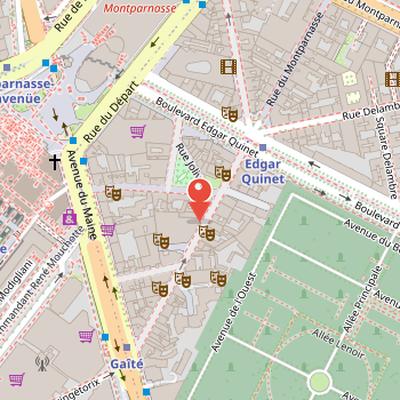
Nearby Objects
-
 Bobino 60 m away
 -
 Théâtre Montparnasse 90 m away
 -
 Montparnasse Tower 250 m away
 -
 The Kiss 250 m away
 -
 Jardin Atlantique 350 m away
Origins and Early Use of the Name
The names Comedie-Italienne and Theatre-Italien referred to Italian-language theatre and opera performed in France. Their early history is linked to commedia dell'arte companies employed by the French court, with Italian-born queens Catherine de' Medici and Marie de' Medici among their patrons. These troupes also gave public performances in Paris at the theatre of the Hotel de Bourgogne, which was probably the earliest public theatre built in France.
The first official use of the name Comedie-Italienne came in 1680, when it was given to the commedia dell'arte troupe at the Hotel de Bourgogne. The name distinguished the Italian troupe from the French troupe, Comedie-Francaise, which was founded in the same year. The term Theatre-Italien was also used for the Italian troupe, alongside Theatre-Francais for the French company.
Over time, performances under the Comedie-Italienne name increasingly included French phrases, songs, scenes, and entire plays. By 1762, the company had merged with Opera-Comique, although the names Comedie-Italienne and Theatre-Italien continued to be used after the merger, despite an almost exclusive French opera comique repertory. These names were finally dropped in 1801, when the company merged with Theatre Feydeau. From 1801 to 1878, Theatre-Italien referred to a succession of Parisian opera companies performing Italian opera in Italian. In 1980, the name La Comedie-Italienne was used again for a theatre in the Montparnasse district of Paris, where Italian commedia dell'arte plays are presented in French translation.
The Comedie-Italienne in the 17th Century
In the 17th century, the Comedie-Italienne was supported by the king and presented spectacles to a French-speaking public performed by professional Italian actors. Its early performances took place in the Hotel de Bourgogne until 1645, when the company moved to the Petit Bourbon. In 1660 it relocated again, this time to the Palais-Royal, where it performed in alternation with the troupe of Moliere.
The company was headed by Tiberio Fiorillo. Its repertory originally consisted of commedia dell'arte in Italian, an improvisational form of theatre with no scripts. Performances relied on multiple scenarios and specific stock characters. After the move back to the Hotel de Bourgogne in 1680, the company began presenting scripted plays by dramatists such as Regnard, Dufresny, and Palaprat. This shift came in a wider theatrical context in which Louis XIV gave the Comedie-Francaise a monopoly on spoken French drama around 1680.
In 1673, after eviction from the Palais-Royal by Lully's Academie royale de Musique, both troupes moved to the Theatre Guenegaud. The Comedie-Italienne continued to perform there in alternation until 1680, when it returned to the Hotel de Bourgogne. It remained there until the company was disbanded in 1697.
Relations with authority became increasingly strained. The company's cooperation with French playwrights was seen as a threat by royalty, which even considered refusing its annual pension. In 1697, after the company announced upcoming performances of La fausse prude, a play ridiculing Madame de Maintenon, the king ordered the actors sent away and the theatre shut down.
Revival in Early Eighteenth-Century Paris
After the death of Louis XIV in 1715, the Comedie-Italienne began to revive as part of Philippe d'Orleans's effort to restore pleasure and amusement to Paris. He and his friends recalled the Theatre-Italien from about twenty years earlier, at a time when the main theatrical options in the city were the Comedie-Francaise and the fair theatres. There was a clear need for comic theatre that could appeal to popular audiences while offering higher production values than the fair theatres.
In spring 1716, Philippe d'Orleans asked the Duke of Parma to send Italian actors to revive the Comedie-Italienne in Paris. The company had been disbanded nearly twenty years before that request. A troupe leader of good character and manners was required, and Luigi Riccoboni was chosen for the role. Riccoboni assembled a troupe of ten actors who were devout Christians.
The troupe began performing at the Palais-Royal on 18 May 1716 and later played at the renovated Hotel de Bourgogne. The first performance in the renovated theatre was La Folle supposee (La Finta Pazza), presented in Italian on 1 June 1716. After an initial period of success, audience numbers declined, and the troupe gradually began performing more plays in French. Between 1720 and 1740, the company had notable success with around 20 plays by Marivaux.
Italian Opera and the Comedie Italienne in Paris
Italian opera in Paris first appeared in the mid-17th century, with performances running from 1645 to 1662. Italian singers invited to France by the regent Anne d'Autriche and Cardinal Mazarin presented these works at several Paris venues. Early productions included a comedie italienne that may have been Marco Marazzoli's Il giudito della ragione tra la Belta e l'Affetto, shown at Cardinal Richelieu's theatre, the Salle du Palais-Royal, on 28 February 1645. Other early performances included Francesco Sacrati's La finta pazza at the Salle du Petit-Bourbon on 14 December 1645, Egisto, believed to be Egisto ovvero Chi soffre speri with music by Virgilio Mazzocchi and Marco Marazzoli, at the Palais-Royal on 13 February 1646, and Orfeo with music by Luigi Rossi at the Palais-Royal on 2 March 1647.
These productions were adapted to French taste, with ballets by French composers inserted between acts. They also relied on stage machinery designed by Giacomo Torelli for scenic effects and frequent set changes. Although many French spectators did not understand Italian, the performances were popular because of their visual spectacle. Italian opera was later abandoned in favor of French opera after Louis XIV assumed power, and the creation of the Academie d'Opera in 1669 marked a further shift.
Italian musical performers returned to Paris in the 18th century. The 1752 performances of the opera buffa La serva padrona led to the Querelle des Bouffons debate. After the success of one troupe, a resident theatrical company for opera buffa was conceived in 1787, and the Theatre de Monsieur was founded in January 1789 under the auspices of the Count of Provence, known as Monsieur. This company first performed at the Tuileries Palace theatre before moving to the Theatre Feydeau. The Italian troupe departed in 1792 because of the upheaval of the French Revolution, after which the theatre continued presenting French plays and opra-comique.
Theatre Venues and Repertoire
The Theatre-Italien was formed by Mademoiselle Montansier in 1801 to perform Italian opera in Italian. In that year it was officially known as the Opera Buffa and was familiarly known as the Bouffons. Its first performances took place at the Theatre Olympique on the rue de la Victoire in 1801, before the company moved to the Salle Favart on 17 January 1802. Mademoiselle Montansier retired from the Theatre-Italien on 21 March 1803.
The company then performed at the Theatre Louvois from 9 July 1804 and later at the Theatre de l'Odéon, called the Theatre de l'Imperatrice, from 16 June 1808. It remained there until 1815. During its early period, the repertoire included opera buffa by Domenico Cimarosa and Giovanni Paisiello, and later works by Ferdinando Paer and Simone Mayr were added. The Theatre-Italien also commissioned Valentino Fioravanti's I virtuosi ambulanti, first presented on 26 September 1807. It gave the first Paris performances in Italian of Mozart's Figaro on 23 December 1807, Cosi on 28 January 1809, and Don Giovanni on 2 September 1811.
Gaspare Spontini served as director from 1810 to 1812 and directed the company during the presentation of Don Giovanni. He also added opera seria by Niccolo Antonio Zingarelli and others to the repertoire.
Restoration and Early Nineteenth-Century Management
During the Bourbon Restoration, King Louis XVIII wanted to entrust the Theatre-Italien to soprano Angelica Catalani. This plan was interrupted by the return of Napoleon, and the Theatre-Italien actors remained longer at the Theatre de l'Imperatrice during the Hundred Days. After the restoration of Louis XVIII to power, Madame Catalani joined the troupe, but she later toured across Europe and left control of the theatre to Ferdinando Paer. Paer then presented the first Rossini opera in Paris, L'Italiana in Algeri, on 1 February 1817 in the first Salle Favart. His production at the Theatre-Italien was regarded as inferior and was accused of trying to sabotage Rossini's reception in Paris. In the 19th century, Madame Catalani's privilege was revoked and the theatre was shut down in 1818. Its administration was then handed over to the Academie Royale de Musique while it maintained autonomy. Paer served as director from 1819 to 1824 and again from 1826 to 1827.
Rossini Years and Later Paris Homes
In the 19th century, the Théâtre-Italien performed at several Paris venues while establishing itself as a major presenter of Italian opera. From 1819 to 1825, it was based at the Salle Louvois, which accommodated 1100 spectators. During this period it gave Paris premieres of several Rossini operas, including Il barbiere di Siviglia on 26 October 1819, Torvaldo e Dorliska on 21 November 1820, Otello on 5 June 1821, and Tancredi on 23 April 1822. It also presented some Rossini premieres at the Salle Le Peletier, including La gazza ladra on 18 September 1821, Elisabetta, regina d'Inghilterra on 10 March 1822, Mosè in Egitto on 20 October 1822, and La donna del lago on 7 September 1824, the last produced under Rossini's supervision.
Rossini arrived in Paris by 1 August 1824 and became director of the Théâtre-Italien on 1 December 1824. Under his direction, the troupe revived eight Rossini operas, including Il barbiere di Siviglia and Tancredi. The company also premiered Rossini's Il viaggio a Reims on 19 June 1825 and produced Giacomo Meyerbeer's Il crociato in Egitto on 25 September 1825. The troupe at this time included Giuditta Pasta, Laure Cinti-Damoreau, Ester Mombelli, Nicolas Levasseur, Carlo Zucchelli, Domenico Donzelli, Felice Pellegrini, and Vincenzo Graziani, and it also recruited singers such as Maria Malibran, Henriette Sontag, Benedetta Rosmunda Pisaroni, Filippo Galli, Luigi Lablache, Antonio Tamburini, Giovanni Battista Rubini, and Giulia Grisi.
The Théâtre-Italien moved from the Salle Louvois to the refurbished first Salle Favart on 12 November 1825. It later commissioned Bellini's I puritani on 25 January 1835 and Donizetti's Marino Faliero on 12 March 1835 at the first Salle Favart. In 1841 it settled permanently in the Salle Ventadour, where it premiered Rossini's Stabat Mater in 1842. The company continued to produce popular works by Gaetano Donizetti and Giuseppe Verdi before closing in 1878. Italian opera continued to be performed in Paris at the Theatre de la Gaite, the Theatre du Chatelet, and especially at the Opera.