Opéra de Nice is an opera house located in Vieux-Nice and inaugurated in 1885. It serves as a venue for choirs, the ballet Nice-Méditerranée, and the Nice Philharmonic Orchestra. The building is managed by the city of Nice under direct municipal administration and includes a production complex called the Diacosmie. It is classified as a historic monument by official decree.
The building has two main façades: one facing south on the quai des États-Unis and one facing north on rue Saint-François-de-Paule. The quai des États-Unis was formerly occupied by city walls and fishermen’s huts. The site has a long theatrical history. In the mid-18th century, the théâtre Maccarani stood near porte Saint-Éloi on the present site of the Opéra. It was bought by the société des Quarante in 1789, later enlarged and renovated, then transformed into the théâtre de la Montagne in 1792. After the city bought and demolished it in 1826, a new neo-classical Théâtre royal was built under the impulse of King Charles-Félix of Sardinia. The present theater was rebuilt and enlarged starting in 1882, with plans by François Aune validated by Charles Garnier.
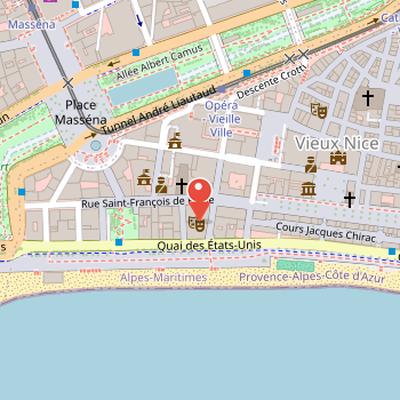
Nearby Objects
-
 Palais de la Préfecture 250 m away
 -
 Casino Municipal de Nice 250 m away
 -
 Place Masséna 300 m away
 -
 Église Sainte-Rita 300 m away
 -
 Nice Cathedral 350 m away
Architecture and Municipal Role
The Op ra de Nice is an opera house in Vieux Nice, inaugurated in 1885. It is managed by the city of Nice under direct municipal administration and serves as a venue for choirs, the ballet Nice Mediterran e, and the Nice Philharmonic Orchestra. The building has a seating capacity and includes a production complex known as the Diacosmie. Its two main fa ades face south onto the quai des Etats Unis and north onto rue Saint Francois de Paule. The quai des Etats Unis was formerly occupied by city walls and fishermen's huts. The opera house is classified as a historic monument by official decree.
From the Theatre Maccarani to the Municipal Opera
At the end of the 18th century, social life in Nice revolved around several theaters near place Saint-Dominique. One of them, the theatre Maccarani, stood near porte Saint-Eloi and on the present site of the Opera. Bought by the societe des Quarante in 1789, it was enlarged and renovated to meet an increasing winter audience. After French troops occupied Nice in 1792, the theater was transformed into a patriotic club and renamed theatre de la Montagne. The societe des Quarante continued to manage it until 1825, during the Sardinian Restoration.
In 1826, the city bought, demolished, and rebuilt the theater as the Theatre royal under the impulse of King Charles-Felix of Sardinia. The neo-classical building was designed by architect Benoit Brunati, who based it on Teatro San Carlo of Naples. Its interior included a spacious parterre without seats and several tiers of boxes. Jean-Baptiste Biscarra painted the large stage curtain, L'Apotheose de Catherine Segurane, showing the triumph of Catherine Segurane. The Theatre royal was inaugurated with a performance of Lucie de Lammermoor, but a disaster at the inauguration caused two hundred deaths, and a pyramid monument was later placed at the entrance to the chateau cemetery.
In 1882, the administration of Mayor Alfred Borriglione decided to rebuild and enlarge the theater on the ashes of the old one. The new plans by architect Francois Aune were validated by Charles Garnier. The new theater had an eclectic exterior and a horseshoe-shaped grand hall measuring nineteen by twenty-three meters. Emmanuel Costa painted the ceiling fresco in the grand foyer, with Phaeton driving the sun chariot, and four panels of Nine Muses. The new municipal theater was inaugurated with Aida by Giuseppe Verdi.
Historical Status and Administration
The municipal theater was renamed Opere de Nice in 1902. It is directly managed by the city of Nice and has an unspecified number of seats. Public entrance is located at 4-9 rue Saint-Francois-de-Paule. The opera was classified as a historic monument by official decree on an unspecified date.
Repertoire and Premieres
The Opra de Nice has been associated with a wide range of performances and creations through its choir, ballet, and the Nice Philharmonic Orchestra. Its repertoire includes several notable French presentations: La forza del destino in 1873, Lohengrin in 1881, Eugene Onegin in 1895, and L'Or du Rhin in 1902. The institution has also been a place of creation for new works, including La vida breve by Manuel de Falla, Elegie pour de jeunes amants by Hans Werner Henze, performed under Jean Perisson in 1960, and Elephant Man by Laurent Petitgirard. In addition, it has hosted two world premieres: La Prise de Troie by Hector Berlioz and Marie-Magdeleine by Jules Massenet.
Collaborations and Major Performances
The Opra de Nice has hosted a long series of representations and creations with major singers and composers, reflecting its role as a significant performance venue. Its history includes collaborations with Regine Crespin in La Walkyrie in 1953, Otello in 1954, Werther in 1975, La Grande-duchesse de Gerolstein in 1981, and Le Medium in 1984. It also worked with Montserrat Caballe in Il trovatore in 1971, Caterina Cornaro in 1974, Don Carlo and Un ballo in maschera in 1976, Adriana Lecouvreur in 1977 and 1978, Don Carlo in 1978 and 1979, and several productions in 1980 and 1981, including Luisa Miller, Maria Stuarda, La forza del destino, Andrea Chenier, and Manon Lescaut.
Other notable collaborations included Jose Carreras in Un ballo in maschera in 1976, Adriana Lecouvreur, Tosca, and Luisa Miller, as well as La Boheme with Luciano Pavarotti in 1976. In 1983, it staged Salome and Parsifal conducted by Jeffrey Tate with Gwyneth Jones and Leonie Rysanek, followed by Samson et Dalila in 1985 with Placido Domingo, Waltraud Meier, and Georges Pretre, and La clemenza di Tito in 1986 with Jennifer Larmore and Anne Sofie von Otter. In 1997, Don Carlos was directed by Luc Bondy with Karita Mattila and Jose van Dam.
The opera house continues to commission new work, including Hymne a l'ocean by Yann Robin in 2025, which was presented in Nice the same year as a preamble to the third UN Ocean Conference. It has also hosted artists such as Darius Milhaud, Andres Segovia, Waltraud Meier, Carlo Bergonzi, Franco Corelli, Teresa Berganza, June Anderson, Roberto Alagna, Ruggero Raimondi, Dmitri Khvorostovski, and Edita Gruberova, along with Juan Diego Florez in Falstaff and Le Barbier de Seville, Matti Salminen, Barbara Hendricks, and Rita Gorr in Eugene Onegin, Salvatore Licitra in Tosca, Jose Cura in Otello, Marcelo Alvarez in La traviata, and Rolando Villazon in Werther.
Ballet Nice-Mediterranee
Ballet Nice-Mediterranee was created in 1947 by Pierre Pasquini. Over time, it was successively led by Lycette Darsonval, Jean-Pierre Ruffier, Tony Pardina, Martine Parmain, Jean-Michel Bouvron, Marc Ribaud and Eleonora Gori. The company regularly invited choreographers and stars of the Paris Opera, including Claire Motte, Youly Algaroff, Liane Dayde and Josette Amiel. After 2009, it received its current name, when Eric Vu-An became artistic director. He held that position until 2024.
The company recruited eight solo dancers and began collaborations with the Conservatoire de Nice, the Pole national superieur de danse Rosella-Hightower, and the Monaco Dance Forum. Its recent history also included an investigation by the city inspection general services. A dismissal order was issued because there was a lack of serious or consistent evidence of harassment or discrimination, and this decision was definitively confirmed by the Aix-en-Provence chamber of instruction.
La Diacosmie and the Production Work of the Opéra de Nice
La Diacosmie is a complex at 8 rue Claude-Debussy in the Sainte-Marguerite district and serves as the production center of the Opéra de Nice. It was inaugurated to free the opera stage for performances by moving backstage and rehearsal functions to a separate site. The complex brings together workshops for decor, stage accessories, and costumes, as well as rehearsal studios for choirs, orchestra, and ballet. It serves both the Philharmonique de Nice and Ballet Nice-Mediterranee.
The workshop at La Diacosmie can also build decor for other institutions, including the Philharmonie de Paris. In 2019, France 3 Provence-Alpes-Cote d'Azur described the site, and in 2023 France Bleu Azur referred to it as a significant institution.
La Diacosmie also includes the Jedrinsky Hall, named after an individual and comparable in size to the Salle Apollon of the Acropolis. When not used for rehearsals, the hall becomes the Second Hall of the Opéra de Nice. It can host performances, with its capacity changing according to retractable seating and acoustic improvements.