Founded in 1836 on the initiative of art and history enthusiasts, the Musée des Beaux-Arts de Carcassonne is housed in the old city presidium. The building was expanded in 1876 under the direction of Charles Émile Saulnier, and the facade built around 1900 was completely restored in 2015. The museum was closed from 1942 to 1948. Since September 1, 2009, it has been managed by the Musée des Beaux-Arts of the Carcassonne School in the medieval city.
Its collections include 102 paintings from the Société des arts et sciences de Carcassonne in 1845, works from state ownership, and gifts from donors such as Casimir Courtejaire. The holdings also include works from the collection of Cardinal Joseph Fesch, paintings bought by Alphonse Coste-Reboulh in 1892, pieces from Chénier and Raynaud in 1893, and acquisitions by Delteil in 1984, Albert Pla in 1990, and Cahuzac in 1995. Additional works came from donations by l'Association des amis de la ville et de la cité and Amis du musée, as well as purchases through the Fonds régional d'acquisition des musées. The museum also holds an important archaeological collection, with some pieces preserved in the Lapidarium of the Count's Castle of Carcassonne. Its paintings are displayed in eleven rooms and mainly date from the 16th to the 20th century, including works by José de Ribera, Salvator Rosa, Mattia Preti, Jan Brueghel the Elder, Paulus Moreelse, Jan van Goyen, Cornelis Norbertus Gysbrechts, David Teniers the Younger, Pierre Mignard, Sébastien Bourdon, Pierre Subleyras, and Hyacinthe Rigaud.
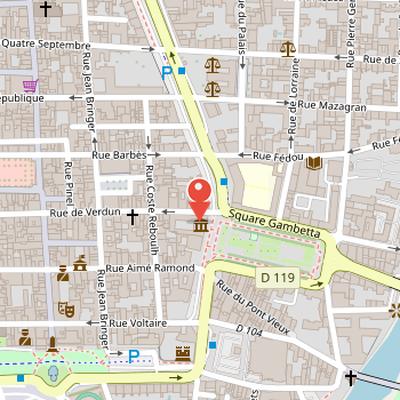
Nearby Objects
-
 Hôtel de Murat 120 m away
 -
 Carcassonne Cathedral 350 m away
 -
 Saint-Vincent Church 450 m away
 -
 Basilica of St. Nazaire and St. Celse 1000 m away
 -
 Théâtre Jean-Deschamps 1000 m away
History and Collection
Founded in 1836 through the initiative of art and history enthusiasts, the museum is located in the old city presidium. It was expanded in 1876 under the direction of Charles Emile Saulnier, and the facade built around 1900 was completely restored in 2015. The museum was closed from 1942 to 1948, and since September 1, 2009, it has been managed by the Musee des Beaux-Arts of the Carcassonne School in the medieval city.
Its collection was formed through a wide range of sources. It includes 102 paintings from the Societe des arts et sciences de Carcassonne in 1845, works from state ownership, and donations from generous benefactors such as Casimir Courtejaire. Parts of the collection also came from Cardinal Joseph Fesch's collection, as well as paintings bought by Alphonse Coste-Reboulh in 1892, pieces from Chénier and Raynaud in 1893, items acquired by Delteil in 1984, artworks purchased by Albert Pla in 1990, and items bought by Cahuzac in 1995. Additional works came from donations by the Association des amis de la ville et de la cite and Amis du musee, and through purchases made via the Fonds regional d'acquisition des musees.
The museum also holds an important archaeological collection, with some pieces preserved in the Lapidarium of the Count's Castle of Carcassonne. From 1951 to 1961, it housed part of the surrealist art collection of poet Joe Bousquet in a dedicated room.
The Painting Collection
The Gemaldesammlung is housed in eleven rooms and consists mainly of paintings from the 16th to the 20th century. Its holdings include works by José de Ribera, Salvator Rosa, and Mattia Preti, as well as by Jan Brueghel the Elder, Paulus Moreelse, and Jan van Goyen. The collection also features paintings by Cornelis Norbertus Gysbrechts, David Teniers the Younger, Pierre Mignard, Sebastien Bourdon, Pierre Subleyras, and Hyacinthe Rigaud. Later works are represented by Jean Simeon Chardin, Hubert Robert, Jean-Auguste-Dominique Ingres, Jean-Baptiste Camille Corot, Gustave Courbet, Leon Germain Pelouse, and Albert Marquet. A particular strength of the collection is its important group of works by Jacques Gamelin from Carcassonne.
Paintings in the Collection
The Gemaldesammlung at the Musee des Beaux-Arts de Carcassonne includes a varied group of paintings and portraits. Its holdings include Ambroise Fredeau's The Virgin and Child with Rosary, Pierre Mignard's Portrait of a Lady of the Court, and Joseph Parrocel's Combat of Christians and Turks. The collection also contains works by Francois Perrier, such as Acis and Galathea, and by Etienne Rendu, including Marsh in the Forest.
Several works are attributed to anonymous artists, among them Guillaume III Castanier and a portrait of Andre Chenier. The collection also preserves paintings by Henry d'Arles, including Interieur d'une grande cave from 1771 and Magasin de ble au bord du Tibre. Nicolas Bertin is represented by a group of mythological subjects: Acis et Galathee, Jupiter et Danae, Jupiter et Leda, Persee delivrant Andromede, and Psyche abandonnee par l'Amour.
The holdings further include portraits associated with the Chenier family, such as the portrait of Mme Louis Chenier, nee Elisabeth, the portrait of Madame Louis Chenier in Greek costume, La famille Chenier from around 1773, the portrait of Andre Marie Chenier from 1763, and the portrait of Louis Sauveur Chenier from 1773, all by Cazes fils. Other works listed in the collection are La table d'office ou Les apprts d'un dejeuner from 1756 by Jean-Simeon Chardin, Ruines de l'interieur de l'eglise des saints Innocents by Pierre-Antoine Demachy, Un jeune guerrier accompagne de son pere demande aux dieux le succes de ses armes by Jean-Germain Drouais, and Portrait d'homme from 1721 by Pierre Ernou.
Jacques Gamelin in the Paintings Collection
The paintings collection at the Musee des Beaux-Arts de Carcassonne includes a notable group of works by Jacques Gamelin. These holdings show a broad range of subject matter, including genre scenes, religious themes, historical and classical subjects, portraits, and battle scenes. Among the dated works are Die Versprochenen, Trinkgelage from 1778, and the portrait of Julie de Puymaurin Marcassus from 1775. The collection also includes several versions of Kavalerieschock, dated 1781, 1791, 1793, and 1799-1800, as well as Interieurszene from 1784. Other works attributed to Gamelin in the museum include Wachszene, Die Froemmigkeit von Kleobis und Biton, Heirat von Tobias und Sarah, Christus jagt die Haendler aus dem Tempel, Abraham wird von drei Engeln besucht, Die Vestalinnen, Das Wunder von Bolsena, Golgotha, Die Bestattung des Heiligen Laurentius, and Alexander und Diogenes. The collection also contains the portrait of the Familie Guillard, dated 1800. Taken together, these paintings indicate that the museum preserves an extensive representation of Gamelin's work across the late eighteenth century and around 1800.
Painting Collection at the Musee des Beaux-Arts de Carcassonne
The Gemalde sammlung at the Musee des Beaux-Arts de Carcassonne includes a range of paintings by several named artists. Among the works held there are Portrait de femme by Adelaide Labille-Guiard, Regulus retournant a Carthage 1779 by Nicolas-Bernard Lepicie, and L'enfant malade by Tadeusz Kuntze. The collection also includes Etude de tete d'homme 1804 by Paulin Guerin and Samson et Dalila by Antoine Pesne.
Several portrait paintings are represented in the holdings, including Portrait de Mme Nicolas de Poulhariez by Jean Raoux, Guillaume IV Castanier and Francois Ie Castanier by Hyacinthe Rigaud, Portrait de Pierre II de Poulhariez by Antoine Rivalz, Portrait de Madame Poulhariez et de sa fille Anne by Pierre Hubert Subleyras, and Portrait de Philippe Francois Nazaire Fabre d'Eglantine 1793 by Pierre Augustin Thomire. Other works in the collection include Paysage aux grands rochers by Hubert Robert, La Peche au flambeau 1776 by Jean-Baptiste Tierce, Bouquet de fleurs dans un verre d'eau by Anne Vallayer-Coster, and Paysage a la cascade by Claude Joseph Vernet. Together, these works indicate a collection with portraits, landscape scenes, and still-life painting among its recorded holdings.
Paintings in the Museum Collection
The Gemaldeammlung at the Musee des Beaux-Arts de Carcassonne includes a wide range of paintings and related works by many artists. Among the listed pieces are Heiliger Julianus Hospitator by Edmond Aman-Jean from 1882, Die junge Hirtin by Hippolyte Berteaux, and Ansicht der Steinbruche von Cervara by Edouard Bertin. The collection also contains historical and literary subjects such as Leonidas benugt sich damit, Kleombrotos zu verbannen by Pierre Bouillon, Boule de suif by Paul-Emile Boutigny from 1884, and Die unschuldige Hochzeit by Jean-Eugene Buland from 1884.
Several works reflect religious, mythological, or dramatic themes, including Sappho spielt die Lyra by Leopold Burthe from 1849, Christlicher Martyrer steigt aus einer Barke by Alexandre Cabanel from 1855, and Die Tochter von Jiftach by Edouard Debat-Ponsan from 1876. Other paintings focus on landscape and everyday life, such as Landschaft by Camille Corot, Die Felsen von Ornans by Gustave Courbet from 1869, Die Waschfrauen by Armand Guillaumin, In der Prarie by Julien Dupre, and Rand einer Oase by Victor Huguet from 1866.
The collection also includes portraits and self-portraits, such as Portrat von Madame Cormon by Fernand Cormon from 1870, Portrat der Grossmutter by Henry d'Estienne from 1899, and several works by Jean Jalabert, including a miniature self-portrait, a portrait of Alphonse Coste-Reboulh en Sorezien, a portrait of Madame Coste, nee Reboulh, and her son Alphonse, and a self-portrait with his family from 1858. Together, these works show that the museum holds paintings from different periods, subjects, and artistic approaches.
Paintings in the collection
The Gemalde collection includes a range of paintings by 19th and early 20th century artists. Among the landscape works is Paysage by Louis-Auguste Lapito, dated 1855, as well as Maisons et rochers a Larroque, circa 1906, by Henri Marre. Several works by Achille Lauge are also represented, including a portrait of Madame Astre from 1892, L'allee de saules from 1896, Le relais from 1909, Fleurs et poires from 1909, La route de Cailhau from 1910, Fleurs et fruits from 1910, and a portrait of Albert Sarraut. Other holdings include Les premiers pas, exhibited in the Salon of 1883 by Georges Laugée; La Delivrance des emmures de Carcassonne, exhibited in the Salon of 1879 by Jean-Paul Laurens; Le pecheur et la nymphe, exhibited in the Salon of 1837 by Henri Lehmann; and La Moisson, exhibited in the Salon of 1874 by Leon Augustin Lhermitte. The collection also contains Combat de Romains et de Gaulois and Le dernier des Merovingiens by Evariste-Vital Luminais. Together, these works indicate a collection with portraits, landscapes, still lifes, and historical subjects.
Selected Works in the Painting Collection
The Gemaldeammlung at the Musee des Beaux-Arts de Carcassonne includes a varied group of paintings by French artists, with subjects ranging from portraits and landscapes to historical and literary scenes. Among the works by Henri Martin are Selbstportrat als Johannes der Taufer (1883), Der Schmerz, Landschaft in Lauragais (1891), and Portrat von Albert Sarraut (1897-1898). Other portrait works in the collection include Emilie Roumens' Portrat einer Frau and Narcisse Salieres' Portrat von Charles Portal de Moux, created before 1870. The collection also contains scenes such as Charles-Louis Muller's Aufruf der letzten Opfer des Terreur im Gefangnis Saint-Lazare am 7 Thermidor Jahr II, Eugene Medard's Die Aufklarer, and Edouard Rosset-Granger's Orpheus (1884).
Landscape and place-based subjects are also represented. Leon Germain Pelouse is present with Ein Bauernhof im Wald and Grandcamp bei Niedrigwasser (1884), while Raphael Ponson is represented by Kuste in Bandol. The museum also holds Henri Rachou's Das Augustinerkloster (1899), Emile Roumens' Die Festung von Carcassonne, Achille Zo's Das Tor von Toledo (1869), and Leonard Saurfelt's Der Markt (1877). Additional works include Marie Petiet's Eingeschlafene Lesende (1882), Jules Salles' Il Fratellino, Jean-Baptiste Jules Trayer's Die Arbeit, and Paul Vayson's Der Fruhling. Together, these works show a collection with strong attention to portraiture, historical subjects, and scenes of everyday life and landscape.
Painting Collection
The painting collection of the Musee des Beaux-Arts de Carcassonne includes works by several different artists and subject types. Among the listed works are Albert Marquet's Quai von Conti im Herbst and Roger Grillon's Lagrasse, Strasse von Ribaute, both of which suggest landscape or urban views. The collection also contains Baeuerin mit Kind by Otto Brandt and Selbstportrat by Christian Seybold, as well as religious scenes such as Rast der Heiligen Familie wahrend der Flucht nach Agypten by Marco Benefial, Die Trennung des Heiligen Petrus und des Heiligen Paulus by Giovanni Lanfranco, Heiliger Antonius der Grosse by Giovanni Richa, and David im Gebet David by Giuseppe Sacchi. Other works in the collection include Die Kaskade von Terni by Carlo Labruzzi, Landschaft and Reisende uberfallen von Raubern am Waldrand by Andrea Locatelli, Stillleben mit Teppich by Francesco Noletti, Interieur eines Schafstalls by Giuseppe Palizzi, and Die Maultiertreiber by Pietro della Vecchia together with Die Frau des Maultiertreibers by Pietro della Vecchia. Together, these holdings indicate a collection spanning landscape, religious, portrait, still life, and genre subjects.
Selected Works in the Gemalde Collection
The Gemalde collection of the Musee des Beaux-Arts de Carcassonne includes a range of Dutch and related paintings with subjects spanning landscapes, portraits, interiors, seascapes, still lifes, and mythological or religious scenes. Among the landscape and coastal works are Anthonie Jansz. van der Croos's Ansicht von Leyde, Henry Ferguson's Landschaft mit Hirtin und Herde vor antiken Ruinen, Joris van der Haagen's Umgebung von Arnhem, Jan Lagoor's Bewaldete Landschaft, and Jan van Goyen's Bauernhof an der Kuste from 1631. The collection also includes Aernout van der Neer's Hollandes Dorf am Rand des Kanals, Martinus Schouman's Seestuck, and Willem van de Velde der Jungere's Seestuck from 1672.
Other holdings reflect domestic, social, and courtly themes, such as Barend Graat's Portrat einer Familie in einer Landschaft, Dirck Hals's Galante Szene, Nicolaas Verkolje's Amor schlaft bei Venus, and Paulus Moreelse's Madame Van Schurman. The collection also contains genre and interior scenes including David Teniers der Altere's Hollandes Interieur and David Teniers der Jungere's Die Holzfaller, as well as Nicolas Maes's Kind und Triton and Domenicus van Wijnen's Die Verjungung der Ammen von Bacchus.
Still life painting is represented by Jan van Huijsum's Blumen und Fruchte and Cornelis van Spaendonck's Vase mit Blumen und Nest. Animal and hunting subjects appear in Abraham Hondius's Barenjagd, while Jacob de Wet's Die Geburt Christi provides a religious subject. Taken together, these works show the breadth of the Gemalde collection through its concentration on Dutch painting and its varied subject matter.
Paintings, Sculpture, and Decorative Arts
The Gemaldeesammlung at the Beaux-Arts de Carcassonne includes a wide range of paintings, sculpture, and decorative arts. Its paintings collection features works by Nicasius Bernaerts, including Jagdstillleben and Kampf von Hunden und Katzen, as well as Jan Brueghel der Aeltere's Landschaft mit Personen, Frans Francken II's Die 7 Werke der Barmherzigkeit, Cornelis Norbertus Gysbrechts' Stillleben, trompe-l'oeil, and Jacob Jordaens' Die Versuchung der Heiligen Magdalena. Other paintings in the collection include Philipp Ferdinand de Hamilton's Jagdattribute, Jan Baptist Lambrechts' Szene in einem Nachtlokal, Alexander Keirincx's Die Rast der Nymphen, Michiel Jansz. van Mierevelt's portraits of a man and a woman, Juan de Arellano's Blumenkorb, Jose de Ribera's Die Tranen des Heiligen Petrus, and Jose Maria Sert's Tobias und der Engel. The collection also holds sculptural works such as Hubert Lavigne's Kleiner Faun, together with busts by Alexandre Falguiere, Ayram, Denys Puech, Henry Maurette, and Antoine Bourdelle.
Beyond fine art, the museum displays a collection of clock pendulums and faiences from Moustiers, Marseille, and Delft. Two showcases present 18th-century goldsmith works, mainly from Toulouse, Limoux, and Carcassonne, including pieces by Louis Ier Samson, Jean-Louis Duran, Etienne Siffren-Marrel, Philippe Aribaud, Francois Raffin, Jean-Pierre Aribaud I, and Jean-Pierre Aribaud II. The collection also includes works inherited from the family of Baron Guillaume Peyrusse and his brother Andre. Among its more notable historical objects are the telescope used by Napoleon I on the brig l'Inconstant during his return from Elba, discovered in storage in 2011, and the dagger of Souleyman el-Halaby, used to assassinate General Kleber in Egypt in 1800.