Église Saint-Vincent de Carcassonne is a church building in the new borough created on the left bank of the river after Saint Louis ordered its construction. The two parish churches of the borough, Saint Michel in the south and Saint Vincent in the north, were laid out following the old topography. The new church of Saint Vincent soon proved too small, and King Philippe IV authorized the purchase of four domunculas in 1308 for its expansion or reconstruction. Work began in the 1320s with the western part, including the porch and nave, while the choir was completed at the end of the century. The tower later served as a watchtower. The church was damaged by cannon fire during the wars of religion and restored afterward. In 1794, the Revolution transformed it into a foundry for artillery carriages, before it was returned to worship at the population’s request. Restoration began again in 1871, and a major campaign started in 2008 with funding from the City, State, Region, and Department.
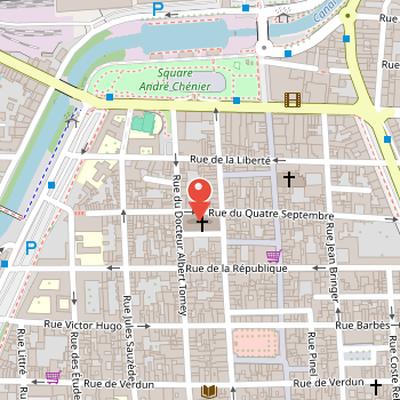
Nearby Objects
-
 Carcassonne Cathedral 450 m away
 -
 Musée des Beaux-Arts de Carcassonne 450 m away
 -
 Hôtel de Murat 500 m away
 -
 Basilica of St. Nazaire and St. Celse 1400 m away
 -
 Théâtre Jean-Deschamps 1400 m away
Formation and Early Development
According to Histoire, Carcassonne consisted of the Cite and two surrounding boroughs until 1247. The first church dedicated to Saint Vincent stood north of the Cite, while a church dedicated to Saint Michel was located to the south. Both churches were demolished in 1240 during Raimond II Trencavel's failed attempt to retake the Cite. Saint Louis then ordered the creation of a new borough on the left bank of the river, where two parishes were established: Saint Michel in the south and Saint Vincent in the north. The two churches were built following the old topography in this new borough.
The new church of Saint Vincent soon became too small and was probably constructed with precarious materials. In 1308, King Philippe IV authorized the purchase of four domunculas for its expansion or reconstruction. Construction began in the 1320s with the western part of the building, including the porch and nave. The choir was completed at the end of the century. Histoire also notes that the tower of Saint Vincent served as a watchtower during an unspecified century.
Restoration, Reuse, and Parish Resistance
The history of the church includes repeated episodes of damage, reuse, and restoration. It was restored after being damaged by cannon fire during the wars of religion. During the Revolution, the building was transformed in 1794 into a foundry for the manufacture of artillery carriages, with seven large double forges installed in the chapels and two simple forges in the apse. It was later returned to worship at the request of the population. Restoration work began again in 1871.
The church also became the focus of a conflict over the 1905 law separating Churches and the State, when an inventory of church property was mandated. Parishioners and the priest, Abbe Peyre, opposed the inventory. Officials forced entry by breaking the door with an axe, while parishioners silently protested inside overnight. The inventory was then suspended. Parishioners collected pieces of the broken door and made a commemorative panel.
A major restoration campaign of the monument began in 2008, funded by the City, State, Region, and Department.
Architecture and Construction of Saint Vincent Church
Eglise Saint-Vincent de Carcassonne is a Gothic church of Languedocien type. Its plan is organized around a single nave, with six chapels on the north side and seven on the south. The chevet is made up of a nine-sided apse flanked by two seven-sided absidioles, and the chevet and sacristies follow the original 14th-century plan. The main apse has five windows with flamboyant tracery.
Construction of the nave extended over 60 years. The first four bays were built in the first half of the 14th century, while the last two bays date from the second half of the same century. The lateral chapels and choir were vaulted from the beginning, but the nave was originally covered by an exposed framework resting on diaphragm arches. After the tribune was built in 1737, vaulting work began on the tribune and nave, and these works required the church to close for one year in 1753.
The western facade and bell tower were built in the 1320s. The monumental portal on the western facade is topped by a radiating decoration that has been recently restored. The portal was once adorned with four standing statues under canopies, representing Saint Vincent, two apostles, and Saint Louis; these statues were moved to the church narthex in 1956.
The Bell Tower
The bell tower of the monument is 54 meters high and has an octagonal shape with a square base. It was built in two phases. The first two floors, which have a square plan, were built in the second quarter of the 14th century, while the upper floors, with an octagonal plan, date from the first half of the 14th century. An encorbelled tower at the northeast angle also dates from the first half of the 14th century. The tower is reached by a staircase of 232 steps.
Beyond its architectural form, the bell tower had several practical roles. It served as a watchtower during wars. It was also used by Cassini and his sons in the creation of their famous map of France. In 1798, it served as a geodesic point for Pierre Mechain and Jean-Baptiste Joseph Delambre.
The Gothic Nave
The church's single nave has a remarkable span of 18 meters. It was regarded as the widest Gothic nave in the world for one century after the 14th century, and it remained the widest Gothic nave in France for five and a half centuries. These measurements make the nave the most distinctive architectural feature of the monument and a key element of its historical significance.
The Organ of Saint Vincent
The organ of Saint Vincent was acquired by the marguilliers of Saint Vincent in 1737, and its construction was entrusted to the Toulouse builder Christophe Moucherel. Its case is topped with five turrets, each featuring statues of two large angel musicians and Saint Vincent. Near the keyboard, the organ also has bas-relief sculptures showing musical instrument trophies, including a flute, lute, and tambourine. The instrument was classified as a historical monument in 1984 and was recently restored with the support of the City of Carcassonne. Henri Ormières is its titular organist and also presides over the association Orgues en Bastide Saint-Louis et Barbacane, which has organized the festival Les Vents d Anges since 1999.
The Carillon Bells
The church's carillon is located inside the tower and is nationally classified. It currently has 54 bells. Its history shows several changes over time: in 1710, the carillon had 7 bells, and in 1773 these bells were melted to create a new carillon with 17 bells. Among the bells is one named l'Andrene, sponsored by Andre Beraud. This bell honors Andre Chenier, who lived for seven years in Carcassonne.