The Basilica of St. Nazaire and St. Celse is a Catholic church located in the cité de Carcassonne, France. It was formerly a cathedral and has been a minor basilica since 1898. Its history is linked to the earliest cathedral tradition in Carcassonne, with a foundation attributed to the 6th century. The first cathedral dedicated to Saints Nazaire and Celse is associated with the period of Theodoric the Great, and a church in Carcassonne is probably documented from the late 6th century.
The present building is of Romanesque origin and is made of sandstone. Its oldest parts date to the 11th century. Construction of a new larger Romanesque cathedral was initiated by the Trencavel family, and building stones blessed by Pope Urban II in 1096 correspond to the first campaign of work on the apse and choir. Only the first two eastern pillars of the nave and a crypt discovered in 1857 remain from the Romanesque cathedral construction. The current nave, with three vessels and six vaulted bays, was built in the middle of the 12th century and reflects a plan organized with alternating cylindrical columns and square pillars with engaged columns.
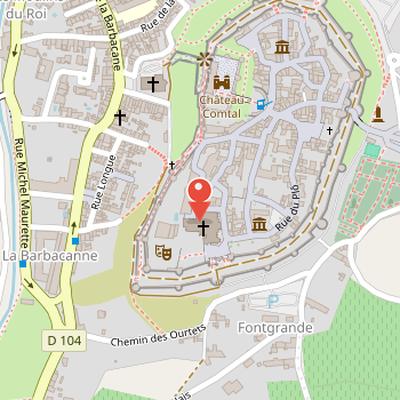
Nearby Objects
-
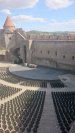 Théâtre Jean-Deschamps 70 m away
 -
 Hôtel de Murat 950 m away
 -
 Musée des Beaux-Arts de Carcassonne 1000 m away
 -
 Carcassonne Cathedral 1100 m away
 -
 Saint-Vincent Church 1400 m away
Status and Location
The Basilica of St. Nazaire and St. Celse is a Catholic church located in the cite de Carcassonne, France. It has held the status of a minor basilica since 1898. Before becoming a basilica, it was formerly a cathedral, reflecting its earlier role in the religious history of the site.
Origins and Romanesque Development
The history of the Basilica of Saint-Nazaire and Saint-Celse begins with the first cathedral of Carcassonne, which Historique dates to the 6th century under Theodoric the Great. Theodoric was king of the Ostrogoths and regent for Amalaric after intervening against Clovis in 508. By 589, King Reccared I had abandoned Arianism for Catholicism at the Council of Toledo, and the first historically known bishop of Carcassonne, Sergius, was present at that council. Historique suggests that a church in Carcassonne was probably built in the late 6th century, although the exact site of the first cathedral remains debated between Saint-Nazaire and Notre-Dame. What happened to the cathedral during the Muslim occupation of Septimania and Carcassonne in 725 is unknown. After Pepin the Short captured Carcassonne in 759, tradition holds that Charlemagne restored the church of Saint-Nazaire, and the first authentic text mentioning the cathedral under Saint Nazaire's invocation dates to 925 under bishop Gimer.
The present basilica is of Romanesque origin and built in sandstone, with its oldest parts dating to the 11th century. The Trencavel family initiated construction of a new, larger Romanesque cathedral on the site of the Carolingian cathedral at Carcassonne. Historique states that no traces of the Carolingian cathedral remain. Building stones blessed by Pope Urban II on April 5, 1096, correspond to the first construction campaign for the apse and choir. Only the first two eastern pillars of the nave and a crypt discovered in 1857 remain from the Romanesque cathedral construction. The condition of the crypt suggests that it had been an earlier structure. The Romanesque cathedral plan also follows the former apse layout.
Romanesque Nave Design
The current nave was constructed in the middle of the 12th century as a three-aisled structure with six vaulted bays. The central vessel was built with broken barrel vaults on doubleaux, while the collateral vessels used full barrel vaults on doubleaux. Its design was modeled after the first state of the abbey church of Alet. The construction features an alternation of cylindrical columns and square pillars with engaged columns. Although the collateral vessels were planned to be lower than the central vessel, the vaults of the three vessels were made at approximately the same level. The form of the capitals on the two piers from the first construction phase was also preserved.
Medieval Damage and Repair
The buildings associated with the site suffered damage during the siege of Carcassonne in 1209. In response, stones taken from the demolition of the refectory, the cellar, and the chapter's stables were used to repair and reinforce the ramparts. Bishop Guy des Vaux-de-Cernay later repaired the damages by abandoning one third of the episcopal tithes from churches beginning in 1215. Further repairs included the reconstruction of the refectory and cellar of the chapter, confirmed in 1228 and 1232. In 1259, Bishop Guillaume Radulphe enlarged the chapter enclosure to the public road leading to the Razes gate, and in the expanded enclosure he built an infirmary with a chapel, where he was also buried. During the Gothic period expansions of the cathedral, the nave was preserved intact.
Political Background to the Crusader Period
The historical context associated with the Basilica of St. Nazaire and St. Celse was shaped by a series of political and religious actions in the early 13th century. In 1224, Amaury de Montfort ceded to King Louis VIII all lands conquered by Simon de Monfort, while the Church granted lands to Amaury de Montfort on the condition that Pope Honorius III accepted the king's terms. Between July 21 and August 19, 1225, the Council of Bourges condemned Raymond VII of Toulouse and deprived him of his possessions. On February 20, 1226, King Louis VIII convened the Parliament of Paris, which agreed to support him in the Albigensian Crusade. Cardinal Saint-Ange, the papal legate, excommunicated Count Raymond VII, and Louis VIII took the cross against the Albigensians on March 23, 1226. Louis VIII also acquired the lands of Raimond II Trencavel, Viscount of Carcassonne, by the Treaty of Paris.
Expansion of the Choir and Transept
In 1267, Bishop Bernard de Capendu and the cathedral chapter requested royal permission to enlarge the choir and transept of Saint-Nazaire Cathedral in Carcassonne. On April 24, 1268, King Louis IX authorized the seneschal of Carcassonne to take two cannes from the street for the enlargement, on the condition that the bishop and chapter provide equivalent land to widen the street opposite the work. The construction of the choir and transept required substantial funds, and several measures were taken to support the project. Bernard de Capendu increased temporal rights on churches and chapels in order to collect tithes and manage revenues more strictly. A synodal constitution of 1270 required all testators to contribute to the cathedral works according to their means. Later, Bishop Pierre de La Chapelle-Taillefert assigned one third of the confiscated revenues from non-resident priests to the cathedral works. A confraternity was also established to support the construction. In 1291, Pope Nicholas IV granted an indulgence to those visiting the cathedral on the feast and octave days of Saints Nazaire and Celse, further linking the building campaign to devotional practice.
Expansion, Restorations, and Changing Status
Between 1269 and 1330, the cathedral was expanded in the Rayonnant Gothic style. This work included a transept, a very slender choir, sculpture decorations, and stained glass windows. The building also contains interior elements that combine Gothic and Roman styles in stained glass, sculptures, and decorations, while its facades feature numerous stained glass windows depicting scenes from the life of Christ and the apostles. A Roman portal was entirely rebuilt in the 19th century during the restorations carried out by Eugene Viollet-le-Duc, who also undertook extensive exterior renovations and whose work revealed painted apse and choir remains later published by him.
The expansion was financed in part by prelate Pierre de Rochefort, who paid for many decorations and vault completions. His presence is still marked in the building by the coat of arms displayed in the choir, apse, and south transept arm, as well as by a commemorative monument in the north collateral chapel. The coat of arms of bishop Pierre Rodier is also displayed in the south collateral chapel.
Historically, the cathedral remained the main religious center of Carcassonne until the 18th century. Its cathedral chapter maintained a small music corps with an organist, a music master, and at least five choir boys. The chapter was suppressed in 1790, the cathedral lost its status in 1801 in favor of Saint-Michel church in the bastide, and the title was transferred as the Cite's population moved to the lower town. The building remained a cathedral until 1803, was classified as a historical monument in 1840, and was granted the title of basilica in 1898 by Pope Leo XIII.
The cathedral was once surrounded by the canons' buildings, including a chapter house, dormitory, refectory, kitchens, caves, and stables. These buildings were demolished in 1792. The cloister, located south of the building, has been occupied by an open-air theater since 1908, renamed Theatre Jean Deschamps in 2016. More recently, the electrical installations were brought up to standard in 2018, and exterior restoration work on the choir and transept roofs began in 2019.
Stained Glass in the Sanctuary and Transept
The sanctuary and transept are decorated with stained glass that forms one of the basilica's most notable visual features. At the center is a stained glass window dedicated to the Childhood and Passion of Christ, dating from about 1280. This central work is surrounded by Renaissance stained glass windows. On the left side are windows dedicated to the lives of Saint Peter and Saint Paul, dating from 1300 to 1310, while on the right side are windows showing the lives of the patrons Saint Nazaire and Saint Celse from the same period.
In the first two chapels of each transept arm, the stained glass develops around the theme of the tree. The left side features the Tree of Jesse surrounded by prophets and dating from the 13th century. The right side shows the Tree of Life with branches to prophets and inscriptions, dating from about 1310 to 1320. These Tree of Life windows were incorrectly replaced by the Tree of the Temptation of Adam and Eve during a restoration in 1860 by Alfred Gerente. Large radiant rose windows also pierce the facades of the transept arms.
The Organ of the Basilica
The basilica's organ has a long documented history of construction, repair, and restoration. A new organ was offered to the cathedral by Vitalis de Lestang in 1637 and made by Crespin Verniole, while the buffet was made by Jean Rigail and Jean Melair. A later organ was commissioned in 1679 from the organ maker Jean de Joyeuse and constructed between 1680 and 1688. The instrument was repaired and enlarged by Jean-Pierre Cavaille between 1772 and 1775, and its instrumental part was restored by Michel Roger from 1900 to 1904. Classified as a historical monument as an object in 1970, it was restored again by Bartolomeo Formentelli from 1982 to 1985 because of its poor condition, and was then inaugurated by Michel Chapuis. The organ has a French-style pedalboard and mechanical transmissions.