Carcassonne Cathedral is the mother church of the diocese of Carcassonne and Narbonne in the department of Aude and the Occitanie region. It is located in the former suburb of Carcassonne, the bastide Saint-Louis, and is a building in the Southern Gothic style. The cathedral replaced Saint-Nazaire-et-Saint-Celse in the center of Carcassonne as the episcopal seat in 1803.
Its history begins in 1247, when construction was ordered by King Saint Louis to replace an ancient sanctuary destroyed during the siege of the city by Raymond II Trencavel in 1240. Initially smaller than it is today, the building had to be enlarged by 1283. After the fire of 1355, caused during the Anglo-French conflict by the troops of the Prince Noir, the church survived but was severely damaged and later incorporated into new fortifications. Traces of these changes remain near the apse, including a cylindrical military tower. The cathedral underwent major renovations after 1803, with work disrupted by a fire in 1809 and later overseen by Léon Ohnet and Eugène Viollet-le-Duc.
The building has a single nave with eight bays, side chapels, a seven-sided apse, and a façade with a large rose window and a bell tower. It has been classified as a historic monument since 1840.
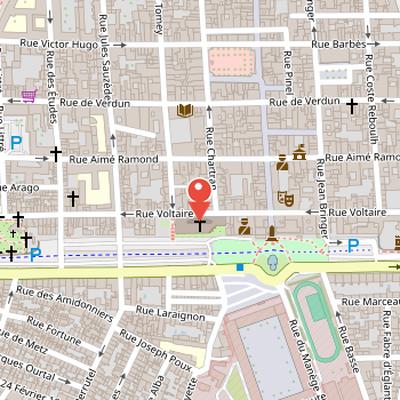
Nearby Objects
-
 Hôtel de Murat 300 m away
 -
 Musée des Beaux-Arts de Carcassonne 350 m away
 -
 Saint-Vincent Church 450 m away
 -
 Théâtre Jean-Deschamps 1100 m away
 -
 Basilica of St. Nazaire and St. Celse 1100 m away
Cathedral in the Bastide Saint-Louis
Carcassonne Cathedral is the mother church of the diocese of Carcassonne and Narbonne in the department of Aude and the Occitanie region. It is located in the former suburb of the city of Carcassonne, the bastide Saint-Louis. The building is in the southern Gothic style. In 1803, it replaced the cathedral Saint-Nazaire-et-Saint-Celse in the center of Carcassonne as the episcopal seat.
Construction and Transformation
Construction began in 1247 by order of King Saint Louis to replace an ancient sanctuary destroyed during the siege of the city by Raymond II Trencavel in 1240. The building was originally smaller, but by 1283 it had become too limited in size and required expansion. During the Anglo-French conflict, the church survived the fire of 1355 caused by the troops of the Prince Noir, although it suffered severe damage. In the reconstruction that followed, it was incorporated into new fortifications, and traces of this military adaptation remain near the apse, including a cylindrical tower.
Before the 19th century, the site was also surrounded by ditches up to 20 meters wide, later filled in and replaced by a wide public promenade. The building became a cathedral in 1803, when the episcopal seat moved from Saint-Nazaire Cathedral to Saint-Michel Church. Significant renovation work began after this change of function, but it was interrupted by a fire on the night of October 4 to 5, 1809. From 1850, the works were overseen by Leon Ohnet, and in 1857 management was entrusted to architect Eugene Viollet-le-Duc, marking his first major project in Carcassonne.
Architectural Layout and Key Features
Carcassonne Cathedral has a plan made up of a single nave with eight bays and multiple side chapels. The side chapels are topped by rose windows added by Viollet-le-Duc. The sanctuary choir consists of a seven-sided apse with two apsidioles attached. In the choir, several large ogival-style windows contain stained glass restored by Alfred Gerente after the 1849 fire. The nave is covered by ogival vaults built from 1657 to 1752, replacing a visible framework, while the choir vaults date from the 15th century. On the facade, a large rose window with a diameter of 9 meters is a prominent feature. The facade is also flanked by a massive bell tower with a rectangular base of three floors and an octagonal top. The bell tower contains eight swinging bells.
Historic Protection and the Organ
Carcassonne Cathedral, also known as Saint-Michel Cathedral, has been classified as a historic monument since April 6, 1840. The surrounding lands were classified as historic on June 16, 1946, and numerous objects from the cathedral are referenced in the Palissy database. The cathedral organ is one of its most notable furnishings. It was built by Aristide Cavaille-Coll in 1860, replacing an organ installed in 1687 by Jean de Joyeuse, and it was inaugurated by Louis James Alfred Lefebure-Wely. The original organ case was rebuilt for the collegiate church of Saint-Hippolyte of Poligny, Jura, while the oak case now at Carcassonne was designed by Eugene Viollet-le-Duc in neo-Gothic style without real turrets. It is topped by thirteen life-size statues depicting Saint-Michel and musician angels. The organ has 44 stops on three manuals and pedalboard with mechanical action. It underwent restorations in 1929, 1937, and 1963, and received a complete restoration in 1998 by Manufacture languedocienne de grandes orgues of Lodeve. The organ itself was classified as a historic monument in 1993.