Sainte-Blandine de Lyon is a Catholic church in Lyon, constructed under the supervision of Clair Tisseur at the end of the 19th century in neo-Gothic style. It serves the population of the south of Presqu’île beyond the Perrache railway tracks. The building’s history reflects the progressive densification of the Perrache district, which made the Ainay church too small for local needs. After earlier plans and a first project that remained limited to foundations, construction began in 1864 and was completed in 1869, with inauguration on 29 June 1869. The church was originally conceived without a spire, which was later added in 1890 thanks to a donation by Father Vindry. The building is described as having an octagonal spire on a square tower. Its interior includes a pulpit sculpted by Comparat under the direction of Joseph-Étienne Malaval, as well as stained glass windows probably dating from 1869. The church later experienced renewal linked to the La Confluence urban development project and the liturgical and spiritual program Lyon centre.
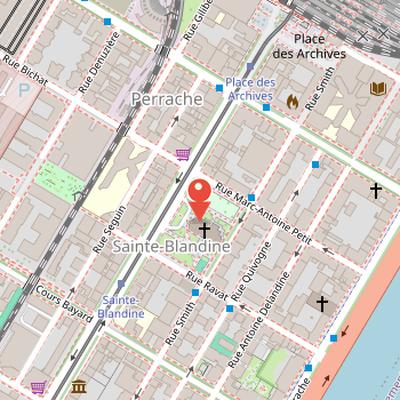
Nearby Objects
-
 Prison Saint-Paul 300 m away
 -
 Perrache 400 m away
 -
 Gare de Lyon-Perrache 400 m away
 -
 Patinoire Charlemagne 450 m away
 -
 Hôtel Terminus 500 m away
Architecture and Urban Renewal
Sainte-Blandine de Lyon is a Catholic church located in Lyon. It was constructed under the supervision of Clair Tisseur at the end of the 19th century in the neo-Gothic style. The church serves the population of the south of Presqu'ile beyond the Perrache railway tracks. In later years, it experienced a renewal linked to the La Confluence urban development project in Lyon, as well as a liturgical and spiritual renewal through the Lyon centre program.
Construction and Architectural Development
The construction history of Sainte-Blandine de Lyon is closely linked to the growing population of the Perrache district, which made the nearby Ainay church too small for local needs. The municipal council reserved land for a new parish church, and a provisional chapel authorized in 1838 was never realized. In 1841, Louis-Jacques-Maurice de Bonald asked abbey Dartigues to found a new parish dedicated to Sainte Blandine.
An early project was launched in 1845 by architect Rene Dardel and entrepreneur Simeon Ennemond Francois Hotelard, but only the foundations were built. After the death of abbey Dartigues in 1861, father Merley resumed the project and defined the site limits by M.A.-Petit, Ravat, and des Echevins streets, over an area of 1.7 hectares. The neo-Gothic style was chosen, with Clair Tisseur as architect and M. Roucheton as mason contractor. Tisseur insisted on using Tayget stone as the main masonry material.
The building was planned as an octagonal spire on a square tower. The departmental council of Civil Buildings gave a favorable opinion on October 2, 1863, while expressing reservations about the bell towers and the strength of the pillars. Construction began in 1864 and was completed in 1869. The church was inaugurated on June 29, 1869, at a final cost of 311,000 francs.
The originally planned spire was not built because of a lack of funds. It was later constructed thanks to a donation by father Vindry, parish priest in 1890. Joseph Etienne Malaval was responsible for the spire construction and also designed much of the church furniture. A mezzanine was inaugurated in May 1903 to increase capacity for the growing attendance.
Furniture and Stained Glass
The churchs furnishings and works of art include a pulpit sculpted by Comparat under the direction of Joseph-Etienne Malaval. It is supported by four columns, with capitals decorated with the symbols of the four evangelists. The pulpit is further adorned with five high-reliefs, including three symbols of the Trinity and the coats of arms of Pope Leo XIII and Foulon.
The stained glass windows are attributed to the Pagnon-Deschelettes workshop. Some of the main windows are probably dated to 1869, based on the medallion in bay 4 showing the church without its spire. The aisle windows are dated 1888 and 1889. Their subjects include the lives of Jesus Christ and the Virgin Mary, and one medallion shows the church of Sainte-Blandine in an unfinished state. Half of the churches stained glass windows were damaged by a hailstorm, and they had not been restored as of 1941.
Parish Reorganization and Growth
The parish of Sainte-Blandine was detached from Saint-Martin d'Ainay, which had previously served the southern part of the Presqu'ile alone. This separation reflected a broader contrast between the area of Ainay, described as bourgeois or aristocratic, and the south side of the railway tracks, presented as a much poorer and more popular district.
A new parish dynamic emerged in 2011, when the parish was entrusted to Father David Grea. He brought the Christian pop group Glorious to Sainte-Blandine, after the group had settled in the Sainte-Croix church in 2008 and had organized weekly events combining prayer and concerts. Under Grea, the parish was structured around new evangelization, with strong communication and personalized welcome, in a formula inspired by practices in American megachurches. Attendance rose from two hundred in 2011 to one thousand in 2015.
The dynamic led by Glorious also gave rise to other groups, including Hopen. After Father Grea left the parish and the priesthood to marry, the Lyon centre program continued.
Familya Center Opposite the Church
Vie paroissiale et spirituelle locates the Familya center, formerly called Maison des Familles, opposite the church. The source identifies Pierre-Edouard Sterin as a supporter of the center and describes it as anti-abortion. It also reports that the Lyon metropolis stopped funding the Familya center from 2025.