The International City of Gastronomy and Wine is located in Dijon, on the site of the former general hospital of Dijon. It is part of a wider project designed to promote the French gastronomic meal and the Burgundy vineyard climats, both inscribed on the UNESCO World Heritage list. The project places Dijon within a network of cities of gastronomy, alongside Lyon, Rungis, and Tours.
In 2012, an appeal for projects dedicated to a city of gastronomy was launched by the Mission française du patrimoine et des cultures alimentaires, a state organization that obtained the label for the French gastronomic meal. Dijon was selected as the driving center for the promotion and valuation of vine and wine culture. The city works with the Institut de la vigne et du vin Jules Guyot and the UNESCO Chair Vin et culture at the University of Burgundy.
A strategic orientation council was created to support the operational phase of the project and define directions for cultural spaces, including permanent and temporary exhibitions. The broader development also includes cultural and tourist facilities, as well as housing on the former hospital grounds.
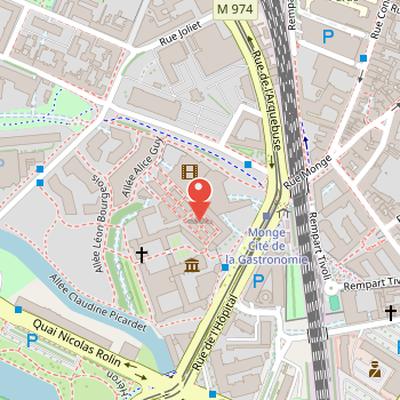
Nearby Objects
-
 Saint-Philibert Church 550 m away
 -
 Dijon Cathedral 550 m away
 -
 Église Saint-Jean de Dijon 550 m away
 -
 Théâtre Dijon-Bourgogne 550 m away
 -
 Musée archéologique de Dijon 600 m away
Intro at the CIGV de Dijon
Intro is located in the CIGV de Dijon, on the site of the former general hospital of Dijon. Its mission is to promote the French gastronomic meal and the Burgundy vineyard climats. These two elements are both inscribed on the UNESCO World Heritage list, giving Intro a role in presenting and highlighting recognized aspects of French culinary and wine heritage.
Project Development and Site
In 2012, Mission francaise du patrimoine et des cultures alimentaires launched an appeal for projects dedicated to a city of gastronomy. Several cities, including Dijon, applied, and Dijon was selected as part of a network of cities of gastronomy alongside Lyon, Rungis, and Tours. Within this network, each city developed a specific theme, and Dijon was designated as the driving center for the promotion and valuation of vine and wine culture. Its role is supported by collaboration with the Institut de la vigne et du vin Jules Guyot and the UNESCO Chair Vin et culture at the University of Burgundy. The UNESCO World Heritage listing of the Burgundy vineyard climats further reinforces Dijon's link to vine and wine culture.
A strategic orientation council was created to accompany the operational phase of the project. It brings together 27 members from fields including economy, the viticulture industry, and journalism. The council is presided over by Jocelyne Perard, head of the UNESCO Chair culture and wine traditions, and by Eric Pras, starred chef and culinary director of CIGV. It defines orientations for the cultural spaces, including themes for permanent and temporary exhibitions.
The city of gastronomy is intended to host various facilities in order to ensure year-round attendance. Dijon city hall selected Eiffage as master builder for the project. The site is located on the grounds of the old general hospital of Dijon, after the last hospital services left and the lands were acquired by the city. The project includes cultural and tourist facilities as well as a housing complex on these grounds. The housing combines rehabilitated seventeenth-century buildings by Groupe Francois 1er with new buildings. The project was delayed by several legal appeals, notably from the municipal opposition, and the last appeal was rejected by the Court of Appeal of the Administrative Tribunal of Lyon. Dijon city hall also replaced 13 million euros in funding previously provided by the Cote-d'Or department.
Opening and Visitor Attendance
The opening of the city of gastronomy was initially planned for 2019, but legal appeals and the 2020-2021 health crisis postponed it. François Rebsamen announced the opening on September 25, 2021, and the inauguration weekend included François Hollande. In its first four months in summer, the complex recorded 100,000 visitors, although there were fewer local tourists than expected. The city of gastronomy welcomed its millionth visitor in April 2022. By 2025, its third anniversary showed attendance of just over 830,000 visitors per year, below the expected one million.
Dining and Wine Spaces
The International City of Gastronomy and Wine includes a commercial space with boutiques devoted to gastronomy, wine, and tableware, as well as a gastronomic bookstore, a bar-brasserie, and the Experiential Kitchen. Its oenotheque, La Cave de la Cite, offers about references of Burgundian, French, and international wines, with 250 available by the glass using distributors at La Cave de la Cite. Two restaurants are also part of the site under the culinary direction of Eric Pras: La Table des Climats, a gastronomic restaurant, and Le Comptoir de la Cite, which serves cuisine d'encas in a more accessible format.
Cultural and educational facilities
The International city of gastronomy and wine brings together several cultural, educational, and business functions. Its cultural pole includes three main venues: the 1204 Center for architecture and heritage interpretation, the Chapel of the Climats, and the Sainte-Croix de Jerusalem chapel. The 1204 Center is dedicated to the urban history of Dijon through a permanent exhibition and temporary displays. The Chapel of the Climats is located in the former main chapel of the general hospital, facing Cour Grangier, and contains a permanent exhibition on local wine and vineyards. The Sainte-Croix de Jerusalem chapel dates from the Middle Ages and is decorated with works from that period.
An additional space presents both a permanent and a temporary exhibition on gastronomy and wine. The site also includes a Pathé cinema with nine screening rooms. A four-screen arthouse cinema called Supernova had been planned, but the project was canceled months before the opening of the Description site.
The complex also provides conference center facilities, training rooms, exhibition spaces, and a business incubator bringing together about fifteen entities, including the competitiveness cluster Vitagora. In the educational field, the Wine School of the Burgundy Interprofessional Wine Bureau offers wine tasting initiation workshops. Ferrandi School established its fifth campus in Dijon, its third in the region after Bordeaux and Rennes, and hosts about 100 international students for intensive English-language training lasting from two weeks to more than six months.
A related hospitality project, the Sainte-Anne Hotel Dijon of the Hilton group, had its first stone laid in 2021. Planned as a five-star establishment with 125 rooms, a spa, a restaurant, and a business center from 2023, it required an investment of 38 million euros, but the project was suspended and placed in judicial liquidation without opening.