Place du Carrousel is a public square in District I of Paris, situated at the open end of the courtyard of the Louvre Palace. It lies directly between the Louvre Museum and the Tuileries Garden, and marks the eastern end of the garden. The square takes its name from the carrousel, a type of military equestrian parade, after a parade held there by Louis XIV in 1662.
The area has a long urban history. Before the square was created, it was occupied by an empty field between the Tuileries Palace and the wall of Charles V. A garden called Mademoiselle was established there in 1600 and destroyed in 1655. The square itself was created in 1662 for the carrousel celebration and was then smaller than it is today, enclosed by a fence. During the Revolution, it was renamed Place de la Fraternité. Its present proportions were reached after the completion of the Louvre Palace in the 1850s, and the disappearance of the Tuileries Palace in 1883 opened it westward toward the historical axis.
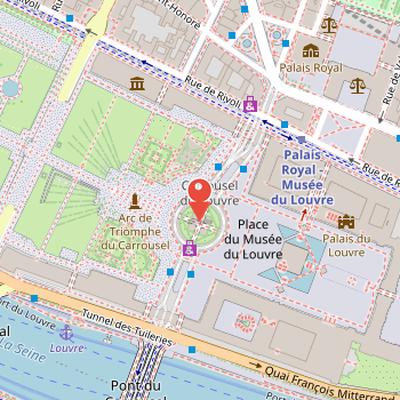
Nearby Objects
-
 Carrousel du Louvre 90 m away
 -
 Hôtel de Rambouillet 100 m away
 -
 Louvre Palace 140 m away
 -
 Marly Horses 140 m away
 -
 Musée des Arts Décoratifs 200 m away
Place du Carrousel
Place du Carrousel is a public square in District I of Paris. It is situated at the open end of the courtyard of the Louvre Palace, in the space that occupied the Tuileries Palace until 1883. The square lies directly between the museum and the Tuileries Garden, and it marks the eastern end of the garden. The name Carrousel refers to a type of military equestrian parade. The square received this name in 1662, when Louis XIV used the site for such a parade.
The Formation of Place du Carrousel
Before the square existed, the area was an empty field between the Tuileries Palace and the wall of Charles V. Historia notes that this wall became unnecessary after the construction of the Louis XIII wall further west. A garden called Mademoiselle was established there in 1600 and destroyed in 1655. In 1662, the Carrusel square was created for a celebration of the carousel event, and it was then smaller than it is today, lying between the Hotel de Longueville and the courtyard of the Tuileries Palace. The square was enclosed by a fence. During the Revolution, it was renamed Place de la Fraternite. Its present proportions were reached after the completion of the Louvre Palace in the 1850s, and the disappearance of the Tuileries Palace in 1883 opened the square westward toward the historical axis. Between the Arc de Triomphe du Carrousel and the entrance to the Louvre Museum stand two statues by Antoine-Francois Gerard, identified as La Historia and Francia Victoriosa.
The Royal Family at the Tuileries
On October 5, 1789, a crowd forced the royal family to leave Versailles for Paris under National Guard supervision. Historia lists Louis XVI, Marie Antoinette, their children, and the Count of Provence with his family among those relocated. The king and queen settled in the Tuileries Palace after moving to Paris, making the area associated with the royal household at the center of revolutionary unrest.
During this period, many plots were designed to help the royal family escape France. Historia notes that the queen refused several plans because she did not want to leave without the king, while other opportunities were lost because of the king's indecisiveness. A failed escape attempt on June 21, 1791 ended with the entire royal family being captured 24 hours later in Varennes and returned to Paris in less than one week.
The tensions around the Tuileries became increasingly violent. On June 20, 1792, a terrifying crowd stormed the palace and made the king wear the bonnet rouge. The royal family’s vulnerability was exposed again on August 10, 1792, when an armed crowd forced them to seek refuge in the Legislative Assembly. One and a half hours later, the palace was invaded by the crowd. About seven hundred Swiss Guards were massacred in front of the palace, and their bodies decorated the courtyard, palace gardens, and banks of the Seine. On August 13, 1792, the royal family was locked in the Temple Tower in the Le Marais district, where they were held in harsher conditions than at the Tuileries.
Revolutionary Uses of the Place du Carrousel
According to Historia, the guillotine was erected in the Place du Carrousel on August 21, 1792, and remained there until May 11, 1793, except for two short interruptions. During this period, thirty-five people were guillotined at the site. On August 2, 1793, a wooden pyramid was built at the former guillotine location as a tribute to Jean-Paul Marat. It carried an inscription honoring him dated July 13, Year I. The pyramid site then displayed Marat's famous bath and writing desk until July 28, 1794.
Destruction of the Tuileries and Reuse of the Square
During the 1848 revolution, the Tuileries Palace was looted and badly damaged by revolutionaries. On May 23, 1871, twelve men under the communard Dardelle set fire to the palace at 7 p.m. The fire lasted 48 hours and completely destroyed the building. Its ruins remained in place for eleven years after the 1871 fire. In 1882, the French National Assembly voted to demolish the ruins, and despite popular opposition, the demolition was carried out in 1883. Salvaged parts of the Tuileries building were sold to a private businessman. After the palace was cleared, the Place du Carrousel was reused as a public square.
The Arc as the Focus of Place du Carrousel
The Arc de Triomphe du Carrousel was commissioned in 1806 to commemorate Napoleon's military victories from the previous year. It was constructed between 1806 and 1808 and served as the honor entrance to the Tuileries. After the disappearance of the palace, the arch became the dominant element of the Place du Carrousel, giving the square its principal visual focus and historical identity.
Location and Historical Significance
Place du Carrousel is a plaza in the 1st arrondissement of Paris. It is associated with 17th-century French architecture and with architecture dated to 1662. The site is also designated as an individual site within UNESCO World Heritage areas in France. In addition to its architectural and heritage significance, Place du Carrousel was a venue for the Paris 1900 Olympic Games.