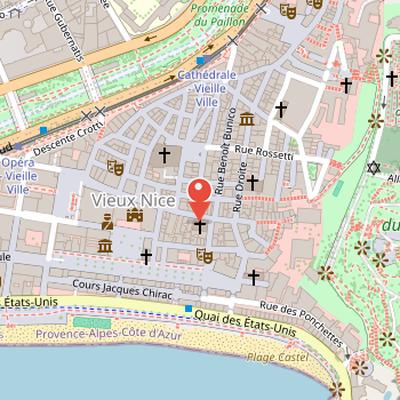
Église Sainte-Rita de Nice is a baroque church located in Vieux-Nice at 1 rue de la Poissonnerie. It is commonly called Église Sainte-Rita, or glèia Santa-Rita, and is also known as chapelle Saint-Jaume, chapelle Saint-Giaume, chapelle Saint-Jacques-le-Majeur, and chapelle Sainte-Rita. The building is classified as a historic monument by arrêté.
Its history is associated with L’église de l’Annonciation, described as one of the oldest churches in Nice. The historical record states that the church’s erection dates to around the year 900 and that it was dedicated to apostle Jacques le Majeur for 935 years. It also served as a parish for 893 years and was the second most important of the four parishes in Nice. Later records mention the exchange of Saint-Jacques church in 1531, the arrival of the Carmes after the destruction of their convent in 1543, the completion of the new construction around 1685, the addition of a bell tower in 1740–1741, and its closure and conversion to a salt depot in 1793.
Nearby Objects
-
 Church of Gesù 100 m away
 -
 Palais de la Préfecture 110 m away
 -
 Nice Cathedral 120 m away
 -
 Palais Lascaris 200 m away
 -
 Chapelle de la Visitation Sainte-Claire 300 m away
Names and Heritage Status
The church is a Baroque building located in Vieux-Nice at 1 rue de la Poissonnerie. It is commonly called eglise Sainte-Rita, and it is also known as chapelle Saint-Jaume, chapelle Saint-Giaume, chapelle Saint-Jacques-le-Majeur, and chapelle Sainte-Rita. The building is classified as a historic monument by arrete, reflecting its protected heritage status.
History of the Church
The history associated with the church connects it to L'eglise de l'Annonciation, one of the oldest churches in Nice. Historic records place its erection around the year 900 and state that it was dedicated to apostle Jacques le Majeur for 935 years. It also served as a parish for 893 years and was the second most important of the four parishes in Nice. In 1531, monks from the abbaye Saint-Pons exchanged prieuré Sainte-Reparate for Saint-Jacques church with the cathedral chapter; the church is also known in Niçois as Saint-Giaume. The agreements related to this exchange were finalized on an unspecified date.
After the destruction of the Carmes convent during the siege of 1543, the Carmes sought a new location and chose Saint-Jacques church. An agreement between the Carmes and the abbaye Saint-Pons was approved by Pope Paul V on an unspecified date. By 1604, after a period of Benedictine administration, Carmes priests were serving the church, and they established the confraternity Notre-Dame-du-Mont-Carmel there. The first stone of a new construction was laid on an unspecified date, and the building was completed around 1685, with finishing works continuing for five more years. A bell tower was added in 1740-1741.
The church was closed in 1793 and converted into a salt depot by decree of the government of the Terror. A serious fire later destroyed the large painting of the Transfiguration of Jesus-Christ above the apse; the painting was by Domenichino. Facade renovations in 1983 revealed an inscription on the lintel, and major renovations were carried out in 1984-1985 by the Oblate Fathers with help from the faithful. During restorations, two altars were changed: Sainte-Croix was replaced by Sainte-Rita in 1934, and the altar of Saint-Joseph was restored to Saint-Erasme.
Interior Chapels and Decorative Program
The church presents an unfinished facade whose original structures were gradually lost through successive renovations. Its porch concentrates the main ornamental emphasis, setting white marble against the high plastered wall of the building. The walnut door leaves, stamped with the monogram of the Oblates of the Virgin Mary, were sculpted around 1845 by Oblate brother Julien Barberis. Above the lintel, an inscription recalls the former presence of the Carmelites on the site: "O quae carmeli Gaudes quos purgant ignes / Habitare recessus hos tua vota iuvent". The nave stands beside the former municipal loggia and the old Carmelite convent.
Inside the church, the choir enclosure pillars carry two chalices with engraved hosts, one showing the Crucifixion and the other the Resurrection. A fresco above the main altar depicts The Adoration of the Blessed Sacrament by angels. The left side of the nave contains several chapels with layered devotional histories. The first chapel on the left was formerly dedicated to the Holy Cross, then to Our Lady of Seven Sorrows, and was dedicated to Saint Rita in 1934. It preserves two successive decorative layers representing Our Lady of Seven Sorrows and Saint Rita. The memory of the Mother of Jesus is also evoked by the instruments of the Passion painted on the vault and by an 1840 painting by Charles Garacci, The Deposition of Christ, on the right wall. On the left wall is a painting of Saint Elizabeth of Hungary, an almost exact copy of a work from the choir of the Church of the Gesu, showing the saint giving alms beside two sisters of the female confraternity of the Grey Penitents of Nice in grey robes. The presence of this painting is described as inexplicable, since the confraternity chapel was never installed in the Church of the Annunciation. This chapel also contains a naive statue of Sainte Rita from the beginning of the 20th century.
The church also contains the corporate fishermen's chapel, identified as the second chapel on the left and also called the chapel of the fishermen's brotherhood of Nice. Fishermen departed in procession with Saint Pierre's statue to bless the waters on Saint Pierre's day. The chapel retains its original decoration themed on the life of Saint Pierre, with an anonymous central painting of The Vocation of Pierre dated 1699, statues of Saint Paul and Saint Andre on either side, and symbols of Saint Pierre, especially keys. The side walls include paintings dated 1699 by Louis-Abraham van Loo depicting La delivrance de Pierre and Saint Jean l'Evangéliste. The vault features artworks of La Vocation de Pierre, L'ascension, and Jesus giving Pierre the power to bind and loose, with four stucco dolphins around the central medallion.
Further along, the marble chapel Notre-Dame-du-Mont-Carmel occupies the last bay on the left before the choir. It has rococo architecture and decoration, and the Carmelite order established the cult of Notre-Dame du Mont-Carmel and decorated the chapel from 1760. Its ensemble includes a white marble statue of the Virgin and Child holding the scapular, created by the Genoese J.B. Ansaldi around 1760-1771, framed by two polychrome twisted marble columns. Another chapel on the left preserves two testimonies of the Nice tradition, including access to the Balduini family tomb, counts of Clans, in the floor, a display case on the left wall with a representation of the Virgin as a child wrapped in precious fabrics, and scenes related to the life of the Virgin by N. Masset from 1854. These include Saint Anne, Saint Joachim, and the child Mary on the left and a Death of Saint Joseph scene on the right. A chapel isolated from the nave by a very rich marble balustrade with yellow and black marble carvings by Cordelano and a corporate chapel for coopers occupy the right side near the choir.
Saints, Guilds, and Chapel Iconography
The chapel contains a dense program of religious imagery linked to local devotion, guild life, and confraternity use. Its Caracteristiques present Saint Julien of Auvergne or Brioude as a Roman soldier who secretly converted to Christianity and was martyred near Brioude. An altar painting shows Saint Julien surrounded by Saint John the Baptist on the left and an angel on the right, while other elements suggest a possible confusion between Saint Julien of Brioude and the legend of Saint Julien the Hospitaller, including an angel disguised as a leper and the episode of the Young Man and the Angel, shown with a child holding a fish on a string. In the County of Nice, Saint Julien was reputed to cure children's diseases and was also the patron saint of coopers, which helps explain his presence near Rue Barillerie; in 1754, the coopers joined the carpenters' guild.
The vault and side walls continue this focus on martyrdom, with scenes describing the phases of the deaths of Saint Julien of Brioude and Saint Ferreol. On the left wall is a Decapitation of Saint Ferreol dated 1651 or 1681, and on the right wall a Miracle of Saint Ferreol shows figures dipping a cloth in the martyr's blood. Above the retable, stuccoes depict a Father Eternal and cherubs, as found in churches in Nice.
A second chapel on the right was dedicated to a religious confraternity for converting fishermen and was united with the Archconfraternity of Notre-Dame-des-Victoires of Paris. Its altar, painted by Cottolengo in 1854, represents the Virgin of the Immaculate Heart, partly as the Woman of the Apocalypse with a crown of twelve stars and a moon crescent. The heart pierced by a dagger refers to the Seven Sorrows, while Saint Michael the Archangel kills the Dragon to the right, Saint Gabriel appears on the left, Saint Teresa of Avila is shown below with a heart pierced by the arrow of ecstasy, and Saint Alphonsus Liguori stands beneath Saint Gabriel. At the bottom, ships full of fishermen converge toward the Virgin. Above the retable is a carved wooden heart pierced by a dagger, which opens to reveal a list of confraternity members. A left wall painting of Saint Anthony the Hermit, by an anonymous author, completes the interior program.
Corporation Patron Saints and Chapel Context
The recorded features place the paintings within the corporate religious life of Nice. Saint Anthony was the patron of the carriers' corporation, which had a chapel on the right bank of the Paillon near the old bridge. A pig appears to the right of the Saint Anthony painting, matching the note that the carriers' corporation owned a pig allowed to roam the streets under the owner's responsibility for any damages.
On the right wall, Saint Homobon is identified as a cloth merchant from Cremona canonized in 1199. His figure is accompanied by tools contemporary to the painting, including scissors, a wooden measuring tool, and possibly an iron. The corporation of tailors and apprentices was created in 1783 and seated at Saint-Martin-Saint-Augustin church, where it was under the patronage of Saint Homobon. The painting of the corporation was still located in Saint-Martin-Saint-Augustin church in 1948.
The Sailors' Chapel and Its Painted Decoration
The first bay on the right upon entering contains a corporate sailors' chapel whose decoration is organized around the sailors' corporation. Saint Erasmus, identified in Nice as the protector of sailors, is indicated by a cartouche above the central painting. The chapel also includes navigation instruments, such as an anchor, rudder, compass, and oar, shown in the altar's lower cartouche and in the upper left of the vault. At the center of the vault appears the motto 'Iras maris frangit.'
The central painting shows Saint Erasmus extending his right hand toward a ship in distress. The ship appears newer than the probable date of the painting, and it bears the civil flag of Sardinia adopted in 1814, with a blue background and a red upper left corner with white crosses. This has been interpreted as an addition to the original canvas, possibly offered as a votive gesture by a grateful sailor. Cherubs at Saint Erasmus's feet also hold navigation instruments.
On the left side wall, a painting of Saint Rosalie interceding to end the plague recalls the plague events of 1630 to 1631.