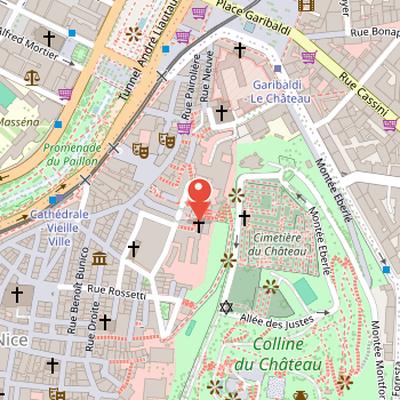
The Chapelle de la Visitation Sainte-Claire is a church building in Vieux-Nice, on rue Sainte-Claire, within a complex that also includes the former couvent de la Visitation, a washhouse, and a garden. The site extends west to rue des Serruriers and east to the slopes of the château de Nice hill. The adjoining convent is currently disused.
According to the historical record provided, Poor Clare sisters built the chapel at the beginning of the seventeenth century and constructed the adjoining convent in the second half of that century. The convent was decommissioned during the French Revolution, then assigned to Visitandine sisters during the Restoration by King Victor-Emmanuel of Sardinia. They renamed the site chapelle de la Visitation-Sainte-Claire and couvent de la Visitation. In 1828, fresco painter Giuseppe Toselli was commissioned to decorate the chapel interior. Restoration began in 1985 on the façade and Saint-Joseph chapel, with work by Patrice Giuge and Marc Lavalle. The façade uses Terre de Sienne tones, fluted pilasters, a trompe-l'œil pediment, and portraits of Saint Claire and Saint Joseph.
Nearby Objects
-
 Cimetière du Château 110 m away
 -
 Palais Lascaris 160 m away
 -
 Église Saint-Martin-Saint-Augustin 150 m away
 -
 Church of Gesù 200 m away
 -
 Chapelle du Saint-Sépulcre 250 m away
The Chapelle and Its Former Convent
The Chapelle de la Visitation Sainte-Claire is located in Vieux-Nice and is associated with the Visitation Sainte-Claire convent beside it. The convent is currently disused, and there is a project to transform it into a five-star hotel. Together, the chapel and the adjacent convent form part of the site linked to this proposed new use.
Location and Setting
The Chapelle de la Visitation Sainte-Claire is located in Vieux-Nice on rue Sainte-Claire. It is part of a broader complex that includes the couvent de la Visitation, a washhouse, and a garden. The site extends west to rue des Serruriers and east to the slopes of the chateau de Nice hill, placing the chapel within a larger urban and historic setting.
History and Restoration of the Chapelle de la Visitation-Sainte-Claire
The Sainte-Claire chapel was built by Poor Clare sisters at the beginning of the seventeenth century, and an adjoining convent was constructed in the second half of the same century at the corner of Sainte-Claire and Serruriers streets. During the French Revolution, the convent was decommissioned. In the Restoration period, King Victor-Emmanuel of Sardinia assigned the buildings to Visitandine sisters, who renamed the site chapelle de la Visitation-Sainte-Claire and couvent de la Visitation. The proximity and similarity of the chapelle de la Visitation-Sainte-Claire and the chapelle de la Visitation led to possible confusion between the two places.
In 1828, the Visitandine sisters commissioned fresco painter Giuseppe Toselli to decorate the chapel interior. Restoration work began in 1985 on the Sainte-Claire chapel facade and the Saint-Joseph chapel. Fresco painters Patrice Giuge and Marc Lavalle of Nice were entrusted with the restoration. Since no documents existed about the old facade, three composition proposals were developed, each drawing on Toselli's ornamental vocabulary and classical style. The final facade design uses natural Terre de Sienne dominant colors, with embedded fluted pilasters and a trompe-l'oeil pediment. Its molding includes oves and pearls, and portraits of Saint Claire and Saint Joseph flank the entrance. The cross on the facade was designed by Patrice Giuge. The Sainte-Claire chapel is considered one of the most beautiful churches in Vieux Nice for its stylistic and technical realization.
From Convent to Priory and Hotel
Aujourd'hui reports that the municipality of Nice granted the buildings to Marcel Lefebvre's traditionalist movement Saint-Pie-X. These buildings formed the Saint-Joseph priory. The publication also states that Paul Touvier was hidden at the Saint-Joseph priory by order of the Knights of Notre-Dame, and that he was later arrested there on an unspecified date. Touvier was convicted in 1994 for complicity in crimes against humanity.
Aujourd'hui further notes that the mayor of Nice said the convent had been unused for a long time in an unspecified month. The mayor then announced that the convent would be converted into a five-star hotel by the Perseus company. A 90-year construction lease was signed between Perseus and the city of Nice, and the hotel later opened in an unspecified year.