Palais Lascaris is a former aristocratic residence located in the heart of the old town of Nice, dating from the first half of the 17th century. Built in the Genoese Baroque style, it is embedded in an ancient urban layout and its architects are unknown because documentary sources are lacking. The palace was property of the Ventimiglia-Lascaris family until 1802. After a period of decline, it was bought by the city of Nice in 1942. Rehabilitation work began in 1963, ended in 1970, and the building opened to the public that same year. In 2001, the city’s collections of instruments were moved here from Musée Masséna, and the palace became a museum of ancient musical instruments. It now houses about 500 instruments, which the Nice city council describes as the second most important collection in France. The building itself includes an opulent main facade, an imposing entrance hall, a monumental staircase, and ceremonial apartments on the noble floor.
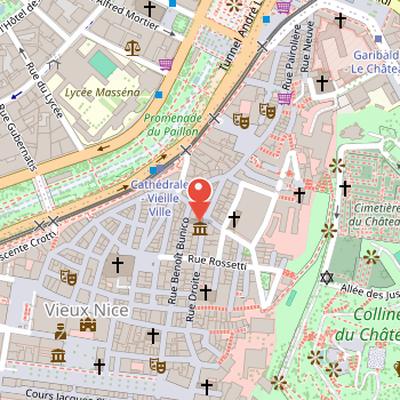
Nearby Objects
-
 Church of Gesù 100 m away
 -
 Nice Cathedral 130 m away
 -
 Chapelle de la Visitation Sainte-Claire 160 m away
 -
 Église Sainte-Rita 200 m away
 -
 Palais de la Préfecture 250 m away
Palais Lascaris: History and Architecture
Palais Lascaris is a former aristocratic residence in Nice, located in the heart of the old town and dating from the first half of the 17th century. Its architects are unknown because documentary sources are lacking, but the building is identified with the so-called Genoese Baroque style. Today, it functions as a museum of ancient musical instruments. The museum houses a collection of about 500 instruments, which the Nice city council describes as the second most important collection in France. This combination of historic residence and specialized museum gives the building a notable place in the cultural heritage of the city.
From Private Palace to Public Museum
Palais Lascaris remained property of the Ventimiglia-Lascaris family until 1802. By the beginning of the 20th century, the palace was in poor condition. It was bought by the city of Nice in 1942, and the city decided to create a museum of regional arts and popular traditions there. Rehabilitation work began in 1963 and ended in 1970, the same year the palace opened to the public. In 2001, the collections of instruments belonging to the city of Nice were moved from Musee Massena to Palais Lascaris, and a museum of musical instruments was created in the palace.
Architecture and Collections of Palais Lascaris
Palais Lascaris is a Baroque style palace set within an ancient urban layout. Its main facade is notably opulent, with windows and balconies fitted with white marble balusters. The interior begins with an imposing entrance hall covered by a ribbed vault decorated with motifs in vivid tones, and a monumental staircase surrounded by arcades and decorated with statues leads to the rooms on the first floor.
The first-floor rooms are used for temporary exhibitions, while the second floor, known as the noble floor, contains ceremonial apartments. The palace preserves ceiling decorations painted in fresco in the mid-18th century, and its salons were enriched in the 19th century with statues and rocaille decoration. Museum rooms are furnished with 18th and 19th-century furniture, and the walls are adorned with Flemish and Aubusson tapestries.
The collection also includes numerous religious-themed paintings showing the influence of the Order of Saint John of Jerusalem, as well as devotional objects such as reliquaries from the heritage of the Lascaris-Vintimille family. The exhibition space is dedicated to a permanent collection of ancient musical instruments, formed from the legacy of Antoine Gautier (1825-1904).
Antoine Gautier's Musical Legacy
The instrumental collection now associated with the site mainly originates from the legacy of Antoine Gautier, which was activated in 1904 after the city council accepted it on September 19 of that year. Gautier, born in Niza in 1825, was the son of Joseph Octave Gautier, a wealthy timber merchant, and Felicite Rossetti, daughter of prefect Rossetti and granddaughter of senator Rossetti. After classical studies at the Jesuit college, now Lycee Massena, he became a lawyer.
Gautier had installed his music room and large collection of musical instruments in his house on Papacino street. His salon attracted numerous artists, including Jacques Thibaud and Eugene Ysaye, and in January 1902 Gabriel Faure performed several piano compositions there. Through his will dated May 26, 1901, and a codicil dated June 8, 1901, Gautier bequeathed to Niza 60,000 francs and his collections of musical instruments, accessories, musical works, and music books. He also stipulated an annual sum of 600 francs for a luthier to conserve the instruments, with Francois Bovis named as the appropriate specialist.
The Instrument Collection at Palais Lascaris
The collection at Palais Lascaris is notable for the variety and rarity of its musical instruments. It includes violas d'amore by Joannes Florenus Guidanti of Bologna, dated 1717, by Gagliano of Naples from 1697, by Johann Schorn of Salzburg from 1699, and by Johann Ott of Fussen from 1727. The collection also contains a violin bass by Paolo Antonio Testore of Milan from 1696.
Among its plucked instruments are several rare baroque guitars, including one by Giovanni Tesler of Ancona from 1618, a baroque guitar by Rene Voboam of Paris circa 1650, and one by Jean Christophle of Avignon from 1645. The collection further includes an anonymous 18th-century harpsichord that was formerly a claviorganum.
Many of the instruments are southern-made, and the collection also extends beyond Europe. It contains about fifty non-European instruments from the 19th-century Gautier collection, as well as a group of jazz instruments, including a Grafton saxophone from the 1950s.
Collections Deposited at Palais Lascaris
In 2009, the AXA Group deposited the Gaveau-Errard-Pleyel Fund at Palais Lascaris. This collection was later shown in the exhibition Erard, l'invention de la harpe moderne, 1811-2011 in 2011 and in Le Clavier vivant in 2012. On January 31, 2013, the Institut de France deposited the Tissier-Grandpierre collection at the same site. This collection includes 66 instruments, among them 18 antique harps. The instrumental collection at Palais Lascaris is also part of the MIMO project, and its records are available on the Europeana website.