Champmol, or the Chartreuse de Champmol, was a Carthusian monastery founded in 1383 on the outskirts of Dijon, now in France. At the time, Dijon was the capital of the Duchy of Burgundy. The monastery was established by Duke Philip the Bold and intended as a dynastic burial place for the Valois Dukes of Burgundy. It was conceived to rival burial places such as Cîteaux and Saint-Denis. Construction began after land had been purchased and materials quarried from 1377, with work carried out under the architect Druet de Dammartin of Paris. Councillors from Dijon supervised the project on the duke’s behalf, while monks, servants, novices, and other workers were present at the site. Champmol was described as the grandest project in a reign noted for extravagance, and it was lavishly enriched with works of art. The monastery remained in use until its dissolution in 1791 during the French Revolution, and its dispersed remnants remain important for understanding the art of the period.
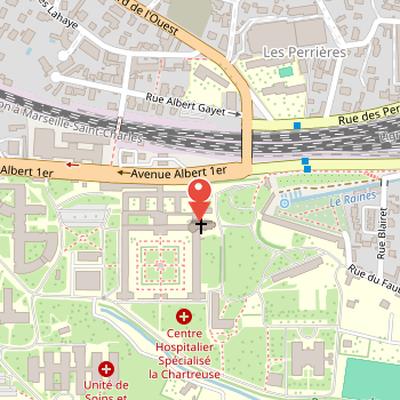
Nearby Objects
-
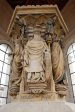 Well of Moses 80 m away
 -
 Grenadier 900 m away
 -
 International City of Gastronomy and Wine 1100 m away
 -
 Place Darcy 1300 m away
 -
 Dijon Cathedral 1300 m away
Chartreuse de Champmol
The Chartreuse de Champmol was a Carthusian monastery on the outskirts of Dijon. The city is now in France, but in the 15th century it was the capital of the Duchy of Burgundy. The monastery was founded in 1383 by Duke Philip the Bold and served as a dynastic burial place for the Valois Dukes of Burgundy. It remained in use until it was dissolved in 1791 during the French Revolution.
The monastery was described as the grandest project in a reign known for extravagance. It was lavishly enriched with works of art, and the dispersed remnants of its collection remain important for understanding the art of the period.
Founding and Early Development
Champmol was founded after land was purchased and quarrying began in 1377. Construction started in 1383 under the Paris architect Druet de Dammartin, who had previously designed the Duke's chateau at Sluis and had also worked as an assistant on the Louvre. The work was overseen for the Duke by councillors from Dijon, who lived in small houses near the chapel while the site was being built. Alongside them were non-ordained monks, servants, novices, and other workers.
At the time of its foundation, Champmol stood about two arrow shots outside the city gates of Dijon, though it now lies within the modern city boundaries. Dijon was then a city of about 10,000 inhabitants and the largest in Burgundy proper, even if towns in the Netherlands recently inherited by the Duke were larger. Burgundy itself was the more securely held part of the duchy and represented the senior title of the dynasty associated with Champmol.
The site was intended to rival major burial places such as Citeaux and Saint-Denis. More than sixty members of the Capetian House of Burgundy were buried at Citeaux Abbey near Dijon, and the Valois, who succeeded that house in 1361, established Champmol in this context. Although it was a Carthusian foundation, visitors and pilgrims were encouraged to come, and the dukes paid expenses linked to hospitality. In 1418, papal indulgences were granted to those visiting the Well of Moses. The ducal family had a private oratory overlooking the church, now destroyed, while ducal visits themselves were rare.
Ducal accounts record major commissions for paintings and other works until about 1415, after which additional work was added more slowly by the dukes and other donors. Because the accounts survive in detail, they later helped Martin Warnke formulate a view of the status of court artists and identify an autonomous consciousness of art and artists in the record of Champmol.
The Tombs of the Dukes
The Tombs of the Dukes were created for the Valois dynasty of Burgundy, which lasted less than a century. They consisted of only two monuments, both designed with painted alabaster effigies, lions at their feet, and angels at their heads. Beneath the effigy slabs, the tombs included small unpainted pleurants, or mourners, arranged among Gothic tracery.
Philip the Bold died in 1404 and Margaret III, Countess of Flanders, died in 1405. Margaret III chose to have her remains rest with those of her parents in Lille. Philip the Bold had planned a single monument from 1381 and commissioned Jean de Marville. Construction of his tomb began in 1384, and Claus Sluter was placed in charge in 1389. When Philip died, only two mourners and the framework of the tomb had been completed. John the Fearless gave Sluter four years to finish the work, but Sluter died after two years. Claus de Werve then took over and completed the sculptures in 1410. The effigies were painted by Malouel.
John the Fearless later wanted a double tomb with Margaret of Bavaria, modeled on his father's tomb. Nothing was done on this project until 1435, and Claus de Werve died in 1439 without finding suitable alabaster. Jean de La Huerta was contracted in 1443 and sent drawings for the effigies, completing most of the tomb except the effigies before leaving Dijon in 1456. Another master finished the monument, which was installed in 1470.
Philip the Good died before John the Fearless's tomb was installed. He was first buried in Bruges, and Charles the Bold later moved his remains from Bruges to Champmol after some years. No monument had been planned for Philip the Good.
Later Tombs and Revolutionary Damage
The second tomb repeated the design of the first tomb, although it shows stylistic differences resulting from a century-long period of execution. Some of its pleurants copied those of the first tomb very closely. Philip the Good also had a portrait of himself placed in the choir alongside portraits of two earlier dukes. None of the original dukes' portraits are thought to survive, and the surviving portraits may be copies of the originals. After the Revolution, the tombs were moved to Dijon Cathedral in 1792. The following year, Dijon Cathedral was converted into a Temple of Reason, and the tomb effigies were vandalised. The present tomb effigies are reconstructions. Ten pleurants and many other elements were removed by looters after the Revolution.
Surviving Works from Champmol
The works of art from Champmol represent much of the finest monumental French and Burgundian art of the period. They include contributions by Claus Sluter, Jacques de Baerze, Melchior Broederlam, Henri Bellechose, Jean Malouel, and Jean de Beaumetz. Among the best known are sculptures by Claus Sluter and his workshop for the church portal, the kneeling figures of Philip and his Duchess, and the lower parts of the Well of Moses with six life-size Old Testament prophets. Other surviving elements include the head and torso of the crucified Christ from the Well of Moses, the funerary crown of Philip the Bold made of brass and glass, and one of the crucifixions from the hermitages added in 1433.
Champmol also preserves important painted and carved devotional works. Jacques de Baerze produced two painted and gilded carved wood retables, which are the only complete Netherlandish carved altarpieces before the late 15th century. Their outer panels formed part of a larger retable containing the only surviving paintings by Melchior Broederlam. The site also includes the Retable of Saint George, an early 15th-century painted altarpiece probably donated by a monk whose donor portrait appears on it, and two bone and ivory relief triptychs by the Embriachi workshop donated by Duke Philip in 1393.
Several funerary monuments from Champmol are also represented. These include the tombs of Philip the Bold and John the Fearless with Margaret of Bavaria. The effigies on the tombs are 19th-century reconstructions based on old drawings and prints, and about ten pleurant figures are copies of originals. A large Madonna and Child attributed to Jean Malouel was rediscovered in 1960 and is believed to be one wing of a diptych opposite a portrait of John the Fearless.
Most items from Champmol are now in the Musee des Beaux-Arts in the former palace of the Dukes, while fragments from the Well of Moses and similar pieces are in the Archaeological Museum. The works survived the Revolution, but they suffered damage mainly from weathering. Other pieces include the only surviving one of 24 paintings by Jean de Beaumetz and four pleurant figures from Philip's tomb, now in the Cleveland Museum of Art, and two altarpieces by Charles-Andre van Loo that replaced older works in 1741.
Later History of Champmol
After the death of Charles the Bold in 1477, Burgundy proper was recovered by force by France. Even so, kings descended from the dukes through the Habsburgs and other lines continued to support the monastery and occasionally visit it. The site suffered slight damage during the siege of Dijon in 1513 and again in the French Wars of Religion, but it remained largely in its 15th-century state until plans were made to update it in the 1770s.
Changes began earlier in the century when the altarpieces of Saints Denis and George were replaced in 1741 by paintings by Charles-Andr van Loo. Both paintings are now in the Dijon museum. The remodeling of the 1770s led to the destruction of some medieval parts of the monastery, and even greater destruction followed the French Revolution. The monastery was suppressed in 1791, and on May 4, five days after the monks left, Emmanuel Cretet bought the buildings and land. Cretet, later Minister of the Interior under Napoleon and known as Comte de Champmol, destroyed large parts of the buildings and the church.
In 1833 the estate was bought by the local departement as a mental asylum. Many new buildings were erected afterward, and the site now houses a psychiatric hospital. The phrase aller a la chartreuse became a local expression for developing a mental disorder. Some of the historical artworks and remains survived: visitors can see the Sluter sculptures, many contents are in the Dijon museum, and the tombs and carved retables are housed in the former Palace of the Dukes.
References and Scholarship
The available references for Champmol include a dossier from the Dijon Museum in French. Additional scholarly sources cited are Laura D. Gelfand's 2005 contribution to Y Me Tarde in Art and architecture of late medieval pilgrimage in Northern Europe and the British Isles, edited by Sarah Blick and Rita Tekippe, and her 1994 work Fifteenth-century Netherlandish devotional diptychs; Origins and function from Case Western Reserve University. Other references include James Snyder's 1985 book Northern Renaissance Art, published by Harry N. Abrams, and John White's Art and Architecture in Italy, 1250 to 1400, published by Penguin Books in 1966 with a second edition in 1987.
Further Reading
Further reading on Champmol includes the bibliography from the Cleveland exhibition. One listed source is Stephen N. Fliegel and others' Art from the Court of Burgundy: Patronage of Philip the Bold and John the Fearless, 1364-1419, an exhibition catalogue published by the Cleveland Museum of Art in Cleveland in 2004. Another is Cyprien Monget's La chartreuse de Dijon, a three-volume work published in Montreuil-sur-Mer and Tournai between 1898 and 1905.