The Well of Moses is the vestige of a calvary that stood in the middle of a well at the centre of the grand cloister of the charterhouse of Champmol. Commissioned by Philippe II de Bourgogne, it was sculpted and painted between 1396 and 1405 by Claus Sluter and his nephew Claus de Werve, with polychromy by Jean Malouel. The work is now located in the park of the specialized hospital center of Dijon in Bourgogne-Franche-Comté.
Only the lower part survives. It consists of a hexagonal pillar surmounted by six statues of Old Testament prophets, while only a few fragments of the figures around the cross are preserved at the archaeological museum of Dijon. The sculpture illustrates the typological link between the Old and New Testaments and includes many Carthusian symbols. It also served as a work of propaganda in favour of the Duke of Bourgogne. Noted for its realism and elaborate decoration, it is considered a masterpiece of International Gothic sculpture and a precursor of Renaissance art. It has also been the subject of several replicas and has inspired many artists, both ancient and contemporary.
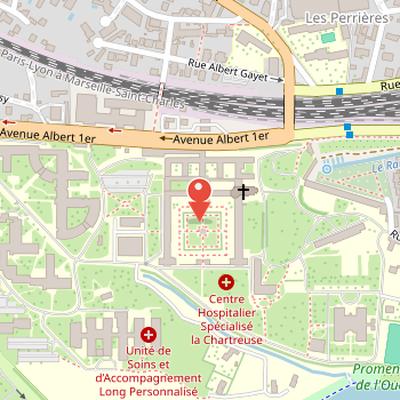
Nearby Objects
-
 Champmol 80 m away
 -
 Grenadier 850 m away
 -
 International City of Gastronomy and Wine 1100 m away
 -
 Place Darcy 1300 m away
 -
 Dijon Cathedral 1300 m away
History and Artistic Significance
The Well of Moses is the surviving vestige of a calvary that stood in the middle of a well at the center of the grand cloister of the charterhouse of Champmol. It was commissioned by Philippe II de Bourgogne and created by the Dutch sculptor Claus Sluter and his nephew Claus de Werve, with polychromy supplied by Jean Malouel. According to the accounts of the dukes of Bourgogne, it was sculpted and painted between 1396 and 1405.
The work is now located in the park of the specialized hospital center of Dijon in Bourgogne-Franche-Comte. Its upper part was destroyed during the 19th century, and only the lower part remains. This surviving section consists of a hexagonal pillar surmounted by six statues of Old Testament prophets. A few fragments of the statues around the cross are preserved at the archaeological museum of Dijon.
The Well of Moses demonstrates the typological link between the Old and New Testaments and contains many Carthusian symbols. It also served as a work of propaganda in favor of the Duke of Bourgogne. The monument is noted for its realism and magnificent decorations, and it is considered a masterpiece of International Gothic sculpture and a precursor of Renaissance art. It has also been the subject of several replicas and has inspired many artists, both ancient and contemporary.
The Well and Calvary at Champmol
The Well of Moses was part of the Carthusian monastery founded by Philippe le Hardi at Champmol near Dijon after he acquired the domain in 1378. The duke financed the construction and decoration of the monastery and asked in his 1386 will to be buried there. The monastery included a small cloister for common living spaces and a large cloister surrounded by monks' cells. In this large cloister, a well and a calvary or large cross formed a traditional feature, and Philippe le Hardi commissioned sculptural works for both elements.
Claus Sluter led the sculpture workshop at Champmol from 1389 until his death in 1406, after which Claus de Werve succeeded him. Sluter sculpted the statues on the chapel portal before the well between 1389 and 1393, and he also sculpted the duke's tomb between 1381 and 1410. Jean Malouel, the official painter of the duke in Dijon and successor to Jean de Beaumetz, handled the polychromy of the well. The monastery accounts preserve detailed history of the calvary, whose fabrication began in 1396 and whose upper part was completed in 1399.
Construction and Completion
The construction of the Well of Moses unfolded over several years through successive deliveries, carving campaigns, and installations. According to the historical accounts, the first eight stone blocks from the Asnieres quarry were delivered in October 1396. In November 1396, Sluter ordered a metal bar to reinforce the cross arms, and three stonemasons were paid from late 1396 to 1398 to assist with carving the cross. A sculptor named Hennequin or Jean Prindale collaborated on the statues of Christ and Mary Magdalene. Masons carved and installed the pedestal during 1398, while new stones from Asnieres arrived in early 1398 and again in 1399 for the base of the cross. All blocks were installed and sealed in the summer of 1399, and the statue of Christ was installed in July 1399.
Work on the prophets and related decoration continued after this phase. The sculpture of the prophets and their support began between 1396 and 1402, and Claus de Werve, Sluter's nephew, was employed to carve the angels of the Moses well during this period. The angels were sealed on site in 1402. Six blocks of Asnieres stone were delivered to Sluter's house in Dijon on March 5, 1401, and sculpture of three prophets and other decorations of the current well began after that date. Rogier de Westerhen assisted Sluter from 1401. Moses, David, and Jeremiah were completed by 1402 and installed on the calvary before July. In 1402, Jean Malouel began painting the calvary, colors and gold leaf were supplied, and a wooden structure was built around the sculpture to protect it from the weather. That same year, goldsmith Hennequin de Hacht supplied a copper halo for Mary Magdalene's statue and spectacles for Jeremiah's statue. Further work continued in 1404, when three blocks of stone were delivered to Sluter's workshop for the prophets Zechariah, Isaiah, and Daniel. These statues were completed and sealed on site in early 1405. Sluter's inventory shows that the statues were completed before his death in 1406.
History and Restoration of the Well of Moses
The site was formerly known as the croix or grand calvaire. It was protected permanently in 1407 by a wooden structure and oilcloth, and in 1411 by a wooden construction supported by columns. Its current edicule is dated to the 17th century by a sundial from 1638 and a drawing from 1686. After 1736 and before 1789, the edicule collapsed, causing the cross and statues to disappear. The site was then sold as national property during the Revolution. After the upper part disappeared, it was called the puits des Prophetes, and the name puits de Moise appeared in notes by Louis-Benigne Baudot. Emmanuel Cretet bought the property and turned it into his residence, destroying the chapel while the well remained in his gardens.
The site was abandoned and bought by the department of Cote-d'Or in 1833. Between 1839 and 1844, asylum buildings were constructed around the well. The well and chapel portal were classified as historical monuments in 1840. In 1842, sculptor Francois Jouffroy restored the well, and in 1852 architect Pierre-Paul Petit rebuilt the edicule with the same dimensions. A complete condition assessment in 1990 found the structure generally in good state, though cleaning was recommended because of yellowing and pollution deposits. A test cleaning was carried out in 1999, followed by a complete cleaning between 2001 and 2003. This restoration showed that no paint had been added beyond Malouel's original application and revealed a rich and diverse color scheme that had previously been lost, increasing interest among art historians. The site was closed in 1995 because of vandalism, reopened for visits in 2004 during the exhibition at the Museum of Fine Arts of Dijon, and has been open year-round on a regular schedule since 2010.
Pedestal and Form of the Well of Moses
The puits de Moise forms the pedestal of the now disappeared calvaire. It is set on a hexagonal pile that raises the monument to an approximate height, and the pile stands in a water basin of certain depth that is directly fed by the groundwater table. The upper part of the pedestal rests at a specified distance from the ground and supports the prophets. It is separated from the pile by a dripstone and finished with a cornice covered by rockwork representing Golgotha.
Each face of the pile formerly bore the arms of the sponsor Philippe II de Bourgogne, painted at the center of a radiant sun. Traces of these paintings remain visible on the faces showing Jeremie and Zacharie. The surviving descriptions also note the statues of Moise at the center and David on the right, as well as a detail of the tablets of the law carried by Moise.
David and Jeremiah in the Well of Moses
The surviving descriptions emphasize the expressive and symbolic treatment of the figures on the Well of Moses. One image shows David with his face visible, flanked by two angels, while another presents him crowned with a fleur-de-lis crown, holding a harp in his right hand and a scroll in his left hand. The harp is mostly covered by his cloak, and the scroll carries the text of Psalm 22, 17. His cloak is described as golden cloth lined with ermine, worn over a blue tunic cut with long stripes. The blue of the cloak is patterned with radiant suns, a device said to symbolize both King Charles VI and Philippe le Hardi, and to underline the relationship between the duke and the kings of France as son, brother, uncle, and regent.
Jeremiah is also described in detail. He is shown opening his arms and holding a feather in one hand and an inkwell and phylactery in the other. He wears a cap descending to the eyes, a red tunic, and an azure cloak embroidered with large gold foliage. Another description says he holds a book from which a scroll falls carrying text from Lamentations, I, 12. He is presented as a clean-shaven prophet, unlike typical medieval depictions of Old Testament prophets, and he originally wore glasses similar to those worn by Duke Philippe II. The figure has been linked to Jeremiah, considered the most important prophet for the Carthusians. According to the English art historian Susie Nash, it could also represent Duke Philippe II of Burgundy. This reading is supported by resemblances to the statue of Duke Philippe II in the portal of the Charterhouse chapel by Claus Sluter and to other known portraits of Philippe II, Duke of Burgundy. The figure is also described as representing what Philippe le Hardi could not achieve in life: retiring as a Carthusian in his founded convent.
Fragments and Reconstruction of the Well of Moses Calvary
The calvary connected to the Well of Moses was probably destroyed at the end of the 16th century. Its surviving fragments were found in 1842 during drainage work at the well. Among them were Christ's legs, sawn at the knees, and the crossed arms of Mary Magdalene or the Virgin. A bust of Christ cut above the waist had also been kept in a niche above a door at 40 rue Condorcet in Dijon, and Paul Guignard donated it to the Archaeological Museum of Cote-d'Or, identifying it as a relic of the calvary. The fragments associated with the monument are now preserved in the Archaeological Museum of Dijon.
The Christ representation is marked by closed eyes, an open mouth, hollow cheeks, and an appearance close to a death mask. Blood flows from the wound on Christ's right side, and paint traces indicate that his legs were covered in blood. The bust is carved in Tonnerre stone, unlike the feet, which are in Asnieres stone. It also lacks the same traces of polychromy as the other statues, and has been considered too complete to have fallen from the top of the cross. Its attribution to Sluter and to the Moise well has been challenged by Susie Nash.
The overall shape of the calvary remains controversial. One hypothesis proposed three statues at the foot of the cross: the Virgin, Saint John, and Mary Magdalene. Susie Nash instead argues for a single statue, Mary Magdalene kneeling and facing Christ, with the crossed arms preserved as vestiges. She also notes that the terrace of the well does not bear enough traces for several statues, and that a single figure at the foot of the cross matches common calvaries of the period. Ancient texts about the calvary never mention other statues, and a similar crucifixion scene appears on the Polyptych Orsini panel by Simone Martini, conserved at Champmol charterhouse at the end of the 15th century. This single-statue hypothesis remains disputed by art historians such as Sherry Lindquist.
The orientation of Christ in the monument has also been reconsidered. A previous hypothesis placed him facing the external entrance of the cloister, as if addressing visitors like Moses or David. Nash argues instead that Christ should be placed on the axis of the angle between David and Jeremiah, facing the cloister internal entrance reserved for Carthusians. The cross may have reached about 4 meters in height, and the monument as a whole may have approached 7 meters.
Materials, Polychromy, and Collaboration
The calvary associated with the Well of Moses combined sculpture and painting in a closely integrated design, with painting described as nearly as important as the sculpture itself. Its upper parts were made from stones from the Tonnerre quarries, while the lower parts used stones from the quarries at Asnieres-les-Dijon. The current Moses well and the Magdalene statue are made almost entirely of stone blocks from the Asnieres quarry known as Bois des grottes, and the legs of Christ are made from stone from the Tonnerre quarry called Angy. Although the two stones were of equivalent quality, the Asnieres stone was more diaclasee and less suitable for large sculptures than the Tonnerre stone. The upper pedestal rested on a table made of Is-sur-Tille stone, chosen because it was more waterproof.
The work was carried out in collaboration with Jean Malouel, a native of the Northern Netherlands who lived near the artist in Dijon. In 1398, the two worked simultaneously on the calvary, including at night with torchbearers. Ducal accounts record pigments such as lead white, minium, vermilion, massicot, verdigris, and sinople. In 1402, pigments and gold and tin leaves were ordered for Malouel, while blue pigments such as azurite or ultramarine from lapis-lazuli were used but not recorded in that order. The colors of the prophet clothing varied according to the richness of the drapery sculpture, with richer drapery paired with simpler colors and simpler drapery with richer polychromy. The calvary was noted for its beauty, rich polychromy, and gilding.
Typology and Carthusian Meaning
The Well of Moses reflects a recurrent theme in medieval Christian art: the linking of the Old and New Testaments through biblical typology. This approach, first developed by the Church Fathers, aimed to show that ancient texts already contained events later revealed in the Gospels. In art, typology brought together New Testament scenes and one or more Old Testament scenes, and it became especially popular through works such as the Bible des Pauvres by Nicolas de Hanapes and the Speculum humanae salvationis by Ludolphe le Chartreux. The Well of Moses follows this visual logic by placing biblical figures in a structured relationship that connects prophecy, law, and devotion.
The calvary was enclosed in a space reserved for Carthusian monks and was essentially intended for them. Its iconography was therefore closely tied to Carthusian spirituality. The presence of Mary Magdalene at the foot of the cross evokes a model of contemplative life and devotion to the cross. Between the prophets stand four angels wearing liturgical clothing and making gestures that recall worship and Carthusian liturgy. One angel between Moses and David holds his hands open and raised to shoulder height, recalling a prayer position and the priest's gesture during the mass canon. Another, between David and Jeremiah, crosses his arms on his shoulders, symbolizing the Carthusian monk's gesture during mass to identify with Christ crucified. The angels between Daniel and Isaiah and between Zachariah and Daniel are shown in meditation, with joined hands or with one hand to the chest and the other covering the face. The last two angels are not dressed in liturgical clothing and mourn Christ's passion.
The prophets themselves also carry meanings connected to the Carthusian order. According to Nash, Jeremiah is the most important prophet for the Chartreux; he is shown reading in silence as a model of meditation, solitude, and the quest for God. The monks read the book of Jeremiah during Holy Week until Friday. Zachariah holds a pen and inkwell, representing the copying of texts. Daniel appears to speak to Isaiah while Isaiah listens in silence, representing sermons. Moses holds the tables of the law and embodies the Carthusian rule, while his upright posture and eyes turned toward the sky symbolize the efficacy of prayer. David represents the author of the psalms recited by the Chartreux throughout the day.
Design, Meaning, and Pilgrimage Use
Although the well was located in the Chartreux space, it was not reserved for the Carthusians. The monument was conceived as the center of a ducal mausoleum intended to function as a pilgrimage site. Its imagery links it closely to Duke Philippe le Hardi, the commissioner of the work: Jeremiah may have traits of the duke, the fleur-de-lis on David's crown near Jeremiah recall the duke's proximity to the French king, and the duke's coat of arms appears on the sides of the pile above water. The extremities of the ancient cross also bore the coats of arms of Philippe and Marguerite III de Flandre, while a frame at the foot of the cross showed radiant suns and the initials PMP of the ducal couple. The monument was meant to remind the Carthusians to pray for their protector's soul.
From 1418, the site also fulfilled another role. An indulgence granted by Cardinal Giordano Orsini allowed people who prayed at the foot of a cross on certain days of the year to receive spiritual benefit, and Jean sans Peur, son of Philippe le Hardi, was present when the first indulgence was granted on site. The indulgence was renewed in 1432 by Cardinal Niccolo Albergati for those who prayed at the site, and again in 1445 by papal legate Pietro del Monte, who specified that the cross was involved. Pilgrims were invited to take a souvenir from the site, and they could buy a pilgrimage ampoule to collect water from the well and bring it home. The well of Moses served as a fountain of life, and numerous ampoules bearing the arms of the Dukes of Burgundy were found in archaeological excavations in France and the former Burgundian Netherlands.
Posterity and Artistic Influence
The later influence of the Well of Moses can be seen in sculpture and in manuscript illumination in Bourgogne and nearby regions. The work inspired many statues, including several saint figures that were modeled on the prophets. Among the examples cited are a bust of Saint Antoine in the Archaeological Museum of Dijon, attributed to Claus Sluter's workshop, and statues in the Collegiate Church of Saint-Hippolyte in Poligny in Jura, made with Asnieres stone. These later works include Saint Thibault, whose clothing resembles Isaie and whose face resembles David, as well as Saint Andre, whose face resembles Moise. A statue of Saint Paul in the former Abbey Saint-Pierre of Baume-les-Messieurs was also sculpted in Asnieres stone.
The work also left a strong mark on manuscript painting. Jean Malouel is cited as the author of the calvary polychromy, and the Limbourg brothers incorporated a similar hexagonal monument with statues in La Rencontre des mages in Les Tres Riches Heures du duc de Berry. Other illuminations in Les Tres Riches Heures and Les Belles Heures likewise show related motifs, including a Gothic polygonal monument covering a fountain of life, a kneeling Mary Magdalene facing the cross, and a calvary similar to the upper part of the Well of Moses. Susie Nash notes that this calvary influence in painting is more subtle.
The Well of Moses also appears to have served as a direct reference for later artists. It is found in two panels of the Triptyque de l'Annonciation d'Aix attributed to Barthelemy d'Eyck, and it may have been encountered by a painter serving Rene d'Anjou in Dijon around 1435. It inspired a prophet reading a book on a polygonal pedestal, and Mary Magdalene was portrayed kneeling with crossed arms in the posture of the Sluter calvary statue. Its reputation was strong enough to lead to a smaller copy made in 1508 for the cemetery of the Dijon hospital near the original location, while another ancient copy was made for the cloister of Saint-Vincent cathedral in Chalon-sur-Saone before being destroyed in 1562. A copy was also planned for the charterhouse cloister in Evora, but it was never realized.
Posthumous Reception and Influence
The posthumous reception of the work was shaped by a mold made by Jules Fontaine in 1840. A mold without polychromy has been kept in the French monuments museum in Paris since 1880. Other molds are held at the Carnegie Museum of Art in Pittsburgh since 1906, in the Tsvetaev cast collection of the Pushkin Museum in Moscow, in Statens Museum for Kunst in Copenhagen, and in the Museum of Fine Arts in Budapest since 1908. The mold was also displayed in the Rijksmuseum hall in Amsterdam in 1924. Casts of six prophets and six angels are conserved at the Museum of Fine Arts in Dijon, where they have been exhibited in the museum galleries since 2013. The work has been studied by historians and art historians and has also inspired contemporary artists. It appears in several drawings of the sculpture signed by Adrien Dauzats or Gustave Moreau. The work is mentioned in Aloysius Bertrand's prose poem Gaspard de la Nuit, analyzed in Joris-Karl Huysmans' L'Oblat in 1903, and described by Johan Huizinga in Automne du Moyen Age. William Martin Conway described Sluter as a master, and Erwin Panofsky judged the sculpture notable.